
US introduces new 10 and 12.5 per cent tariffs, replacing temporary 10 per cent levy

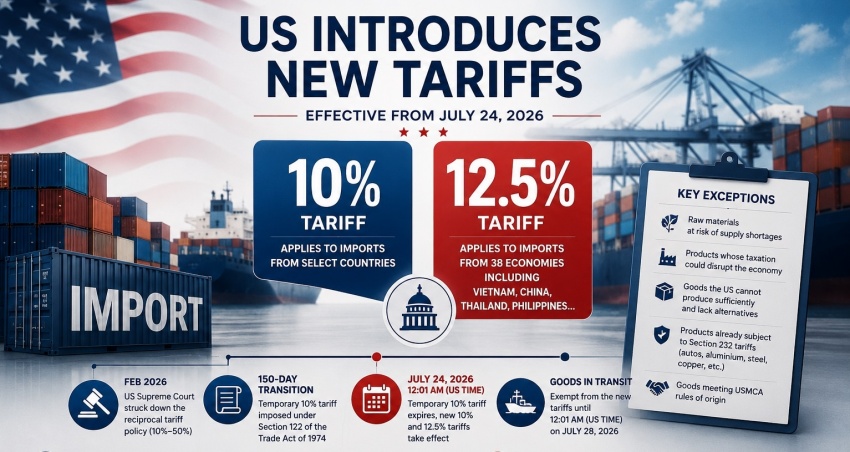 |
According to a notice issued by the Office of the US Trade Representative (USTR), the additional duties apply to goods entered for consumption, or withdrawn from bonded warehouses for consumption, from 12:01 a.m (US time) on July 24, 2026. The new tariff rates of 10 and 12.5 per cent officially took effect at midnight on July 24, replacing the temporary 10 per cent tariff that expired simultaneously.
According to a USTR document released on July 23, the new tariffs will cover 99.4 per cent of US trade. CNBC reported that the agency said it is not yet able to estimate the amount of revenue the new duties will generate.
The tariffs will apply to all goods imported from economies subject to the investigation, with several exceptions. These include raw materials facing potential supply shortages, products whose taxation could disrupt the broader economy, and goods that cannot be produced in sufficient quantities in the US and for which there are no viable alternative sources.
Products already subject to tariffs under Section 232 national security measures introduced last year, including automobiles, aluminium, steel, and copper, will also be exempt from the new duties. In addition, certain products that meet the rules of origin under the US-Mexico-Canada Agreement will not be subject to the new tariffs, reflecting the high degree of integration within North American supply chains and the significant US value content of these goods.
USTR Jamieson Greer also pledged that, for countries that have concluded trade agreements with the US, the new tariffs will not cause total tariff levels to exceed the ceilings agreed between the two sides.
According to the USTR announcement, the 10 per cent tariff will apply to imports from countries including Cambodia, Indonesia, Argentina, Bangladesh, Malaysia, the United Kingdom, Canada, Ecuador, El Salvador, Guatemala, Honduras, India, Jordan, and Mexico.
Meanwhile, for the European Union, Taiwan, Japan, South Korea, and Switzerland, the new tariff, when combined with the existing most-favoured-nation duty, will result in a total tariff rate of either 10 or 12.5 per cent, depending on the economy.
A total of 38 economies will face the 12.5 per cent tariff, including Vietnam, China, Thailand, and the Philippines.
The new tariffs are widely viewed as the latest step in the US efforts to restore the near-universal tariff policy championed by President Donald Trump during his election campaign.
In February 2026, the US Supreme Court struck down the reciprocal tariff policy of 10 to 50 per cent that President Trump had introduced last year under national emergency legislation to reduce the country's trade deficit.
Following the ruling, President Trump invoked Section 122 of the Trade Act of 1974 to impose a temporary 10 per cent tariff for 150 days. That measure officially expired at 12:01 a.m (US time) on July 24, with the new tariff rates taking effect immediately afterwards. Goods already in transit will remain exempt until 12:01 a.m on July 28 (US time).
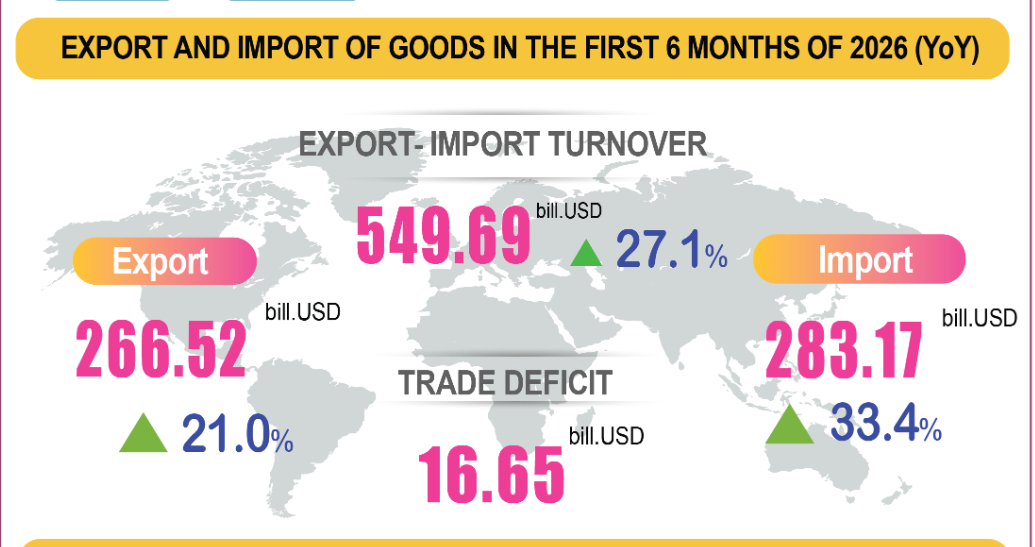
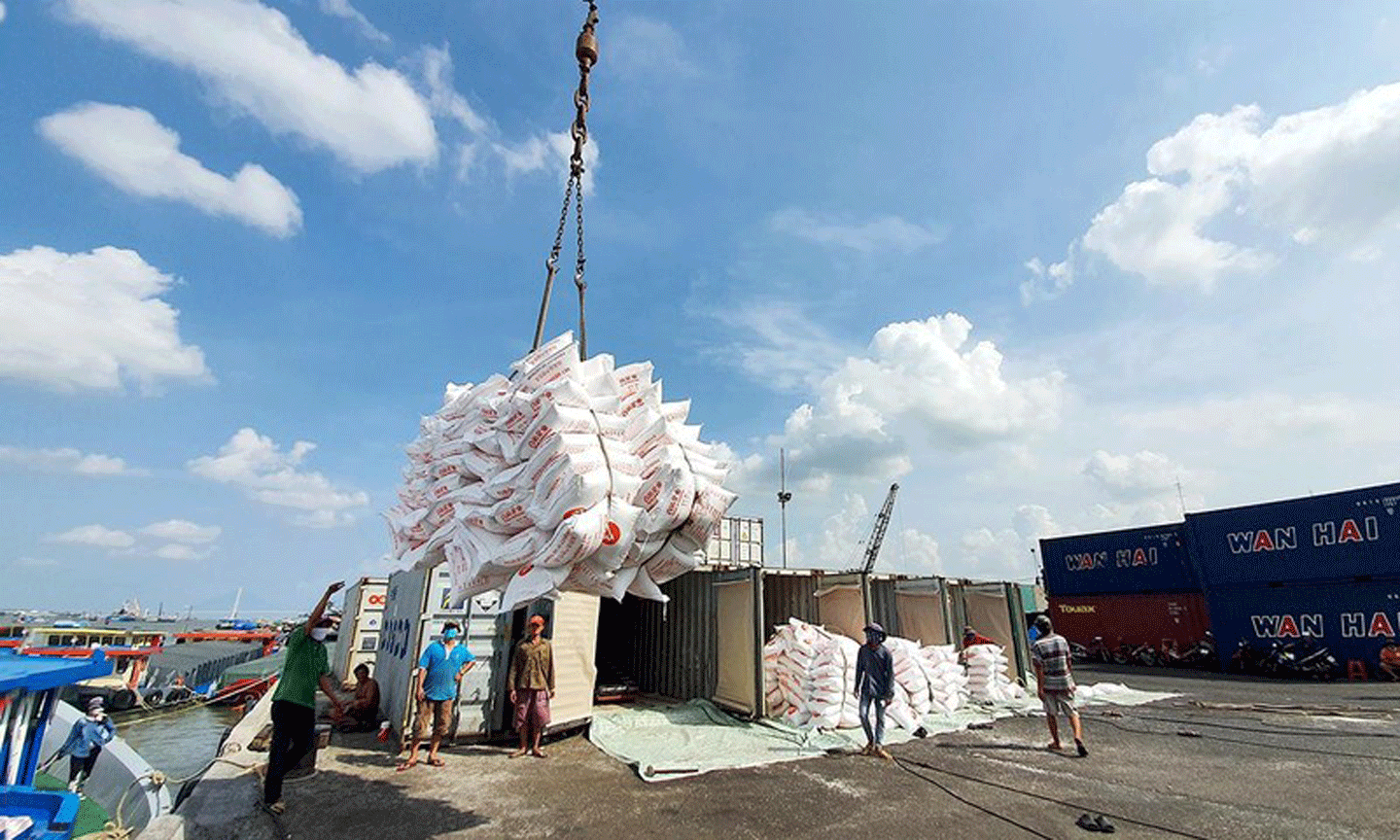

What the stars mean:
★ Poor ★ ★ Promising ★★★ Good ★★★★ Very good ★★★★★ Exceptional
 Tag:
Tag:
Related Contents








Latest News




More News
- Raising construction materials supply chain standards amid green transition (October 08, 2026 | 14:00)
- Samsung Vietnam to deepen cooperation with local manufacturers (October 08, 2026 | 12:00)
- Sojitz in Vietnam: 40 years from individual projects to a business cluster 'KATAMARI' (October 08, 2026 | 09:00)
- Coteccons targets 'Quality Growth' with 25 per cent dividend plan (October 07, 2026 | 13:00)
- Vietnam Education Forum opens UK Education Mission's Hanoi visit (October 07, 2026 | 12:27)
- Tax authorities deactivate TINs of nearly 180,000 businesses (October 07, 2026 | 12:08)
- World Bank raises Vietnam's 2026 GDP growth forecast to 7.4 per cent (October 07, 2026 | 11:41)
- Vietstock 2026 to spotlight livestock innovation and green transition (October 07, 2026 | 09:00)
- Vietnam’s GDP grows over 9 per cent in first nine months (October 05, 2026 | 18:45)
- Vietnam earns $56.3 billion from agro-forestry-fishery exports (October 05, 2026 | 18:32)










 Mobile Version