
Vietnam posts trade deficit as imports outpace exports in first half

 |
| Source: National Statistics Office |
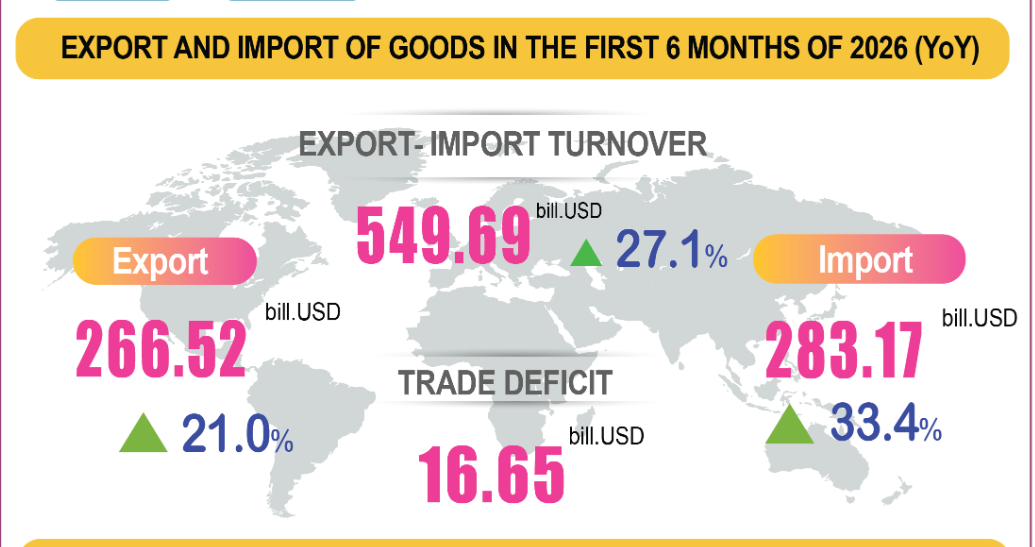
Data released by the National Statistics Office (NSO) under the Ministry of Finance on July 3 showed that Vietnam's merchandise trade balance swung to a deficit of $16.65 billion in the first six months of 2026, compared to a surplus of $7.95 billion in the same period last year.
The agency stressed that the widening deficit should not be viewed as a warning sign, as the surge in imports was driven mainly by raw materials, machinery, and intermediate goods serving the manufacturing and processing industries.
Total import-export turnover reached $549.7 billion in the first half of the year, up 27.1 per cent on-year. Exports rose 21 per cent to $266.52 billion, while imports climbed 33.4 per cent to almost $283.2 billion.
In June alone, total trade turnover surpassed $104.2 billion, increasing 5.2 per cent from the previous month and 36.3 per cent on-year. Exports amounted to $50.8 billion, up 8.2 per cent on-month, while imports reached $53.43 billion, up 2.5 per cent, resulting in a monthly trade deficit of $2.64 billion.
Second-quarter exports were estimated at $143.6 billion, up 22.7 per cent on-year and 16.8 per cent compared to the first quarter. Imports were estimated at $156.6 billion, rising over 39 per cent on-year and 23.7 per cent on-quarter.
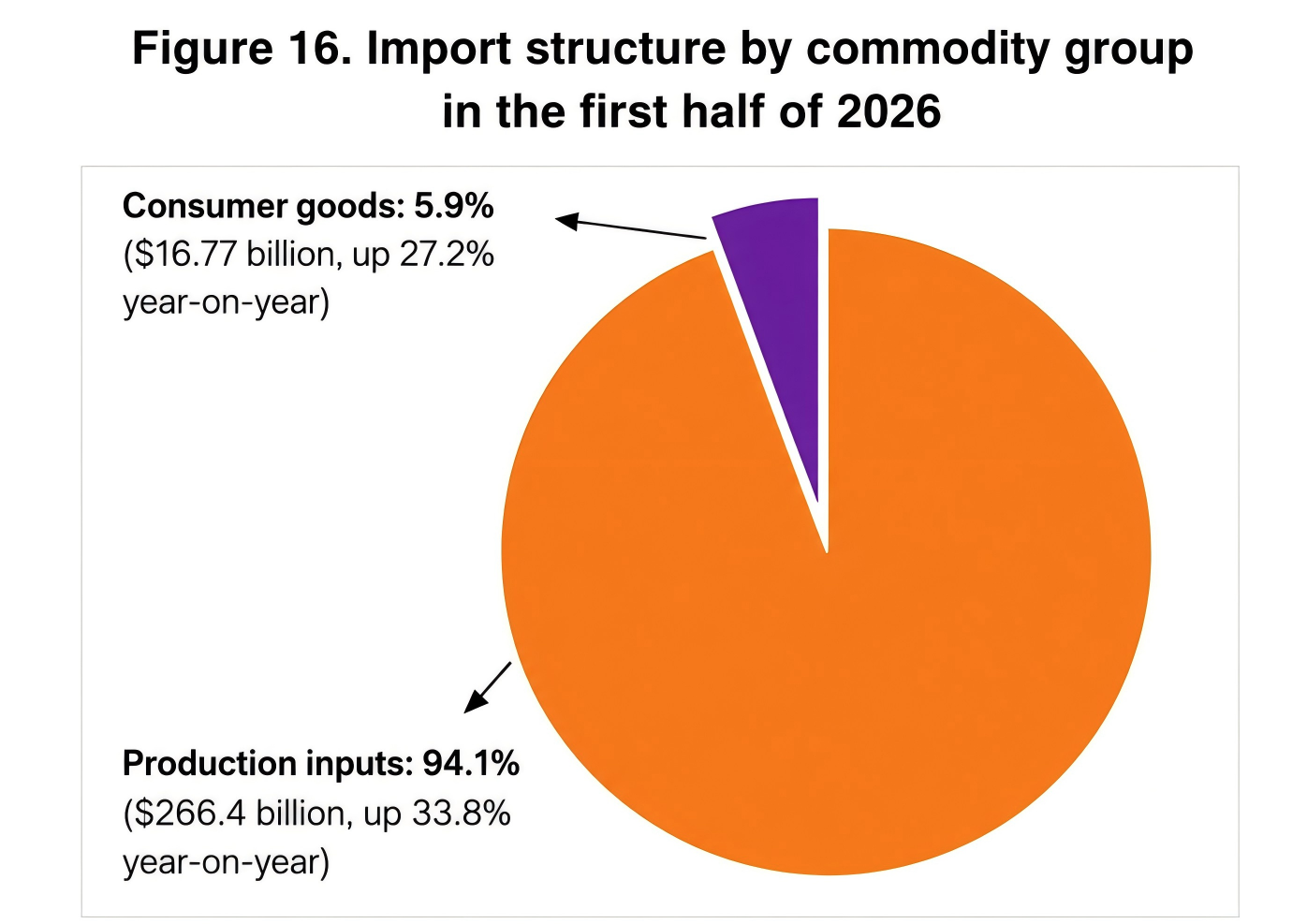 |
According to the NSO, import growth outpacing exports reflects expanding demand for production inputs and the strong recovery of manufacturing activities, particularly in the foreign-invested sector.
Nguyen Thu Oanh, director of the Service and Price Statistics Department under the NSO, said the trade deficit should be assessed based on the composition of imports rather than the headline figure alone.
"The current import growth demonstrates the adaptability of Vietnamese enterprises despite an increasingly uncertain global environment," Oanh said.
"The key point is that imports are concentrated in production materials, raw materials, and manufacturing inputs rather than finished consumer goods. This indicates that businesses are proactively securing machinery, materials, and production inputs to expand output and meet future market demand."
According to Oanh, the import structure also reflects growing business confidence in production and export prospects for the remainder of the year.
She noted that the current trade deficit remains manageable, with the more important issue being the long-term sustainability of Vietnam's external trade through greater market diversification and reduced dependence on a limited number of trading partners.
Export performance remained resilient during the first half of the year, with 29 export items generating more than $1 billion each, accounting for 92.1 per cent of total export turnover. Five product groups exceeded $10 billion, representing 62.6 per cent of total exports.
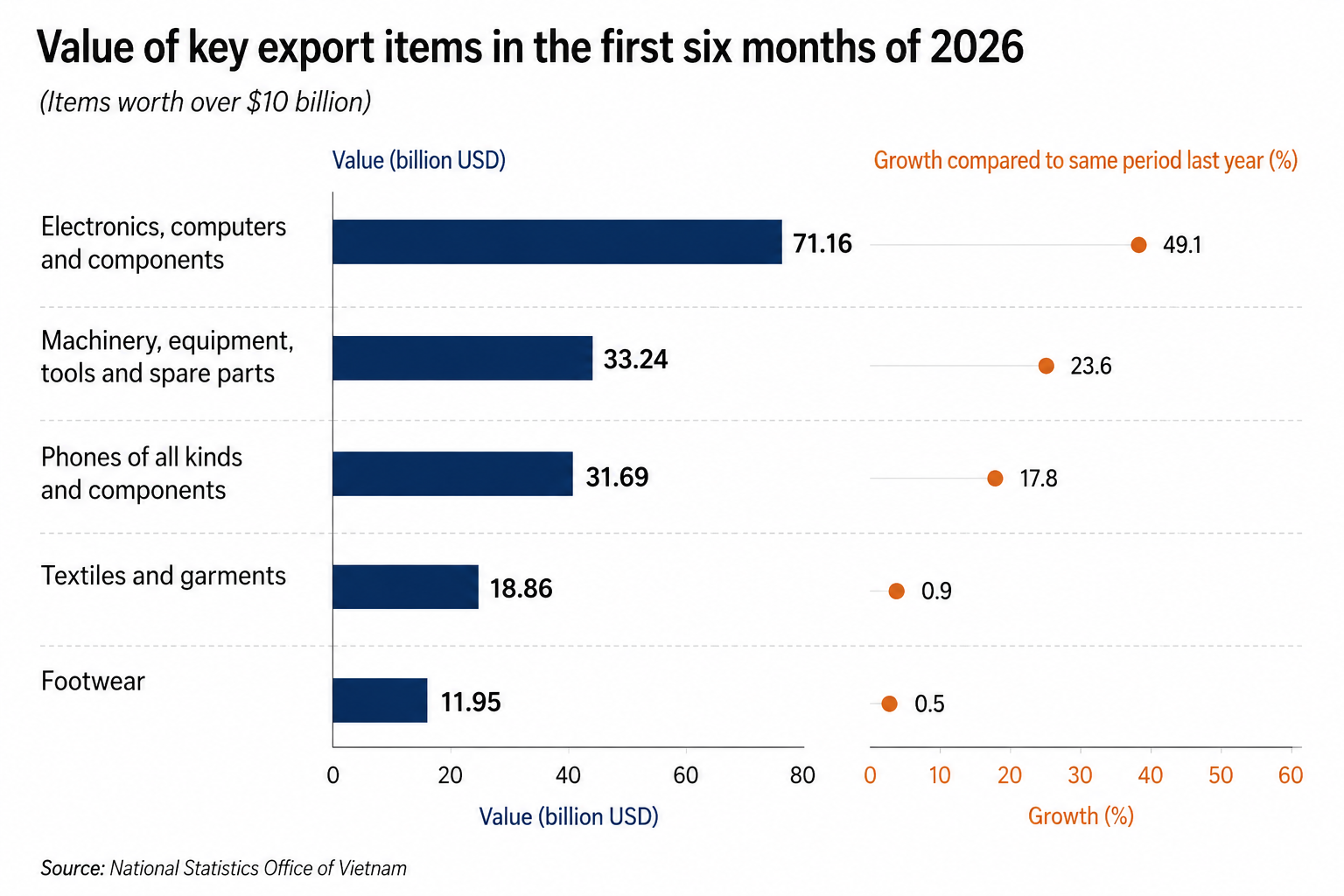 |
Electronics, computers, and components remained Vietnam's largest export category at $71.16 billion, soaring 49.1 per cent on-year. Machinery, equipment, tools, and spare parts ranked second with $33.24 billion, up 23.6 per cent, followed by phones and components at $31.69 billion, up 17.8 per cent.
Garment exports reached $18.86 billion, edging up 0.9 per cent, while footwear exports totalled $11.95 billion, up 0.5 per cent.
Manufactured goods continued to dominate Vietnam's export basket, generating $239.8 billion and accounting for 90 per cent of total exports. Agricultural and forestry products contributed $19.23 billion, equivalent to 7.2 per cent, followed by seafood at $5.76 billion, or 2.2 per cent. Fuel and mineral exports stood at $1.73 billion, representing 0.6 per cent.
The United States remained Vietnam's largest export market, with exports reaching $86.5 billion during the first half of the year. China continued to be Vietnam's largest import source, with imports valued at $115.2 billion.
Vietnam recorded a trade surplus of $75.3 billion with the United States, up 21.3 per cent on-year, while its surplus with the EU increased 15.2 per cent to $21.9 billion. The surplus with Japan edged down 5 per cent to $1.2 billion.
Meanwhile, Vietnam's trade deficit with China widened to $77.3 billion, up 39 per cent from a year earlier. The deficit with South Korea surged 81 per cent to $26.4 billion, while the deficit with ASEAN expanded 36.1 per cent to $10.1 billion.
The NSO concluded that stronger import growth should be interpreted in the context of expanding production capacity and manufacturers' preparation for export orders in the coming quarters, rather than as a sign of weakening trade fundamentals.
What the stars mean:
★ Poor ★ ★ Promising ★★★ Good ★★★★ Very good ★★★★★ Exceptional
 Tag:
Tag:Related Contents





Latest News






More News
- Sojitz in Vietnam: 40 years from individual projects to a business cluster 'KATAMARI' (October 08, 2026 | 09:00)
- Coteccons targets 'Quality Growth' with 25 per cent dividend plan (October 07, 2026 | 13:00)
- Vietnam Education Forum opens UK Education Mission's Hanoi visit (October 07, 2026 | 12:27)
- Tax authorities deactivate TINs of nearly 180,000 businesses (October 07, 2026 | 12:08)
- World Bank raises Vietnam's 2026 GDP growth forecast to 7.4 per cent (October 07, 2026 | 11:41)
- Vietstock 2026 to spotlight livestock innovation and green transition (October 07, 2026 | 09:00)
- Vietnam’s GDP grows over 9 per cent in first nine months (October 05, 2026 | 18:45)
- Vietnam earns $56.3 billion from agro-forestry-fishery exports (October 05, 2026 | 18:32)
- DSV balances resilience and decarbonisation in supply chains (October 05, 2026 | 18:20)
- Electronics exports reach $175.4 billion in the first nine months (October 05, 2026 | 18:12)



Latest News





 Mobile Version