
Unlocking growth drivers for the southern economic region

Participants at the 2026 Vietnam Economic Forum in Ho Chi Minh City, organised by Nguoi Lao Dong on June 9, noted that the Southeast region continues to play its role as the country's key economic engine. The forum focused on the southern economic region as a driver of double-digit growth.
 |
| Experts at the Vietnam Economic Forum in Ho Chi Minh City on June 9 |
According to Dr. Tran Du Lich, for Vietnam to achieve its goal of becoming a developed nation by 2045, the southern region must take the lead in transforming its growth model from one reliant on capital and low-cost labour to one driven by science, technology, innovation, and labour productivity.
"The importance of adopting a 'regional mindset' in investment attraction rather than having localities pursue investment independently," Lich said.
He added that under the new regional structure, Ho Chi Minh City will continue to serve as the core hub and a destination for multinational corporations, but should also aspire to become a launchpad for entrepreneurs across Southeast Asia.
According to Lich, the resolutions, special policy mechanisms, and strategic infrastructure projects being implemented by the central government, ministries, and local authorities are expected to unlock new development opportunities for the entire region.
"Regional coordination must be more substantive, linked to specific projects and clear objectives. Investment in expressways, ring roads, logistics, seaports, airports, and economic corridors must be synchronised to create an integrated development space connecting Ho Chi Minh City, Dong Nai, Tay Ninh, and neighbouring localities," he added.
Pham Van Xo, chairman of the Ho Chi Minh City Import-Export Business Association, stressed the need to harmonise institutional frameworks and reduce logistics costs for businesses.
"What is most important at this stage is to maximise the unique strengths of each locality within a unified development space," Xo said. "Every province and city has its own competitive advantages, ranging from industrial production and logistics to seaports and cross-border trade. When effectively integrated, these strengths can form a complete regional value chain."
According to World Bank statistics, Vietnam's logistics costs remain relatively high, accounting for approximately 16–20 per cent of GDP, significantly higher than many countries in the region. Transportation, warehousing, transshipment, and waiting-time costs continue to undermine business competitiveness.
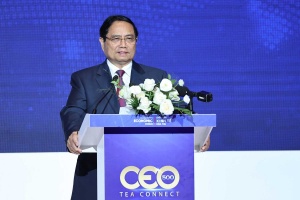 | PM urges Ho Chi Minh City to innovate and remain Vietnam’s economic locomotive Concluding his remarks at the “CEO 500 - Tea Connect” forum on the afternoon of November 25, Prime Minister Pham Minh Chinh praised the insightful opinions shared at the event, noting that they provided momentum and inspiration for Vietnam to continue pursuing its two centennial development goals. |
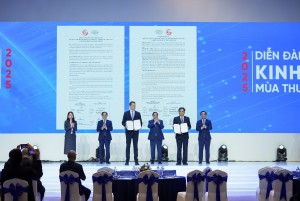 | Vietnam affirms regional leadership at Autumn Economic Forum 2025 Vietnam affirmed its leading regional role at the Autumn Economic Forum 2025, driving global investment into green and digital transformation pillars. |
What the stars mean:
★ Poor ★ ★ Promising ★★★ Good ★★★★ Very good ★★★★★ Exceptional
 Tag:
Tag:Related Contents


Latest News



More News
- Expanding education partnerships to drive mutual growth (October 06, 2026 | 16:04)
- VTG 2026 to showcase textile and footwear innovation in Ho Chi Minh City (October 06, 2026 | 16:00)
- Infineon boosts Vietnam footprint with Ho Chi Minh City office (October 06, 2026 | 10:02)
- Vietnam Customs expands priority enterprise scheme to 74 firms (October 03, 2026 | 08:00)
- ASL Law opens Danang office (October 02, 2026 | 22:12)
- Project ACTIVE 2.0 launches in Vietnam to boost cervical cancer care (October 02, 2026 | 22:02)
- Vietnam launches first embodied AI conference to advance robotics ecosystem (October 02, 2026 | 17:00)
- DKSH Performance Materials – A trusted partner in Vietnam’s evolving personal care landscape (October 02, 2026 | 14:28)
- Ghanaian delegation reviews PSL Machinery’s cashew factory-management and implementation roadmap (October 02, 2026 | 10:18)
- People living with chronic kidney disease and diabetes should be aware of infectious disease risks (September 30, 2026 | 18:00)


Latest News



 Mobile Version