
Science and technology continues to drive digital economic growth

In July, the total revenue of the entire science and technology industry reached nearly VND499 trillion ($19.96 billion), an increase of 22.6 per cent over the same period last year, contributing more than VND107 trillion ($4.28. billion) to the national GDP.
During the period, the ICT industry's revenue reached VND478.54 trillion ($19.14 billion), up 9.4 per cent. Postal output reached 330 million parcels, up 18.7 per cent.
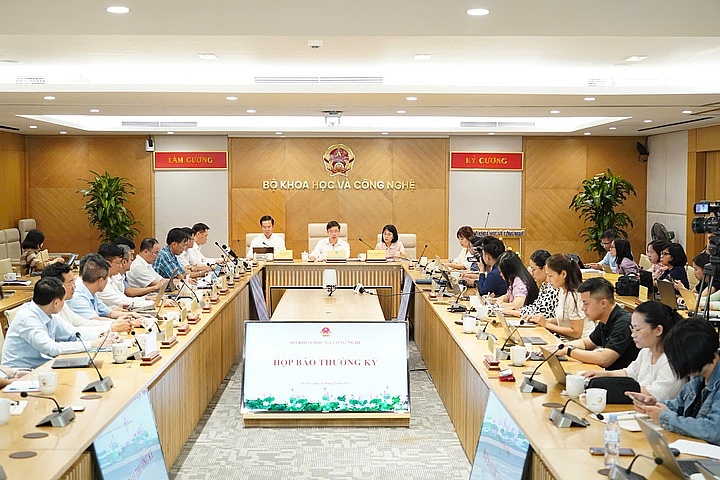 |
| The press meeting on August 5. Photo: MST |
Vietnam's mobile network speed ranked 19th globally (148.64 Mbps), up 29 places. Total transactions on the national data integration and sharing platform (NDXP) reached 3.3 billion.
The VQII infrastructure quality index in June increased by 2.054 per cent, contributing an estimated $0.87 billion to GDP. Mobile game downloads in Vietnam in the first six months of the year reached 5.2 billion, and are expected to exceed 10.3 billion by the end of the year.
Revenue from major e-commerce platforms reached VND387.5 trillion ($15.5 billion), up 21.5 per cent. Vietnam's AI economic scale is expected to reach $120-130 billion by 2040.
In July, the ministry consulted the government and the prime minister to issue one decree and three important decisions. Decree No.194/2025/ND-CP lays the legal foundation to promote connection and data sharing among state agencies, aiming to build a transparent and effective digital government.
Decisions No.1562/QD-TTg and No.1565/QD-TTg establish technical infrastructure and policies to ensure comprehensive digital transformation, and the personalisation of public services with individuals and businesses at the centre.
The ministry also coordinated with ministries and agencies to develop and submit to the government new decrees on supporting specialised officials in digital transformation and the public-private partnership mechanism in science and technology.
In addition, three new circulars were issued to specify regulations on information systems, and data and telecommunications management, enhancing the effectiveness of state management.
In August, the ministry will focus on developing and submitting to the government four draft laws: the amended Law on High Technology; the amended Law on Technology Transfer; amendments to the Law on Intellectual Property; and the Law on Digital Transformation for approval at the 10th session of the 15th National Assembly.It will also develop, complete, and submit to the government 16 draft decrees guiding the implementation of four laws which were passed by the National Assembly at the 9th session of the 15th National Assembly.
The ministry will also develop a project to form large-scale strategic domestic technology enterprises to develop digital infrastructure, digital human resources, digital data, strategic digital technologies, and network security, and support and develop digital technology enterprises to reach out globally.
 | New decree positions sci-tech as key driver of regional development The Vietnamese government issued a decree on June 12 to decentralise state management of science and technology to local people's committees. |
 | Vietnam launches science and technology exchange Vietnam’s Ministry of Science and Technology (MoST) launched a science and technology exchange on June 30, aiming to boost technology transactions, and improve productivity and efficiency. |
 | PPPs in science and technology pave way for private investment New mechanisms are opening up the door for the private sector in science and technology and digital transformation in the form of public-private partnerships (PPPs). |
 | Customs reform to prioritise high-tech and innovative businesses Au Anh Tuan, deputy director general of the Department of Vietnam Customs, outlines key changes to the Customs Law aimed at simplifying procedures and offering more incentives for high-tech, innovative, and semiconductor businesses, and helping to support supply chains and boost the startup ecosystem. |
 | PPP rules to power Vietnam’s innovation Unprecedented regulations on public-private partnerships in the science and technology sector are expected to accelerate innovation and digital transformation across Vietnam’s business community. |
What the stars mean:
★ Poor ★ ★ Promising ★★★ Good ★★★★ Very good ★★★★★ Exceptional
 Tag:
Tag:
Themes: Digital Transformation
- Vietnam-Australia forum boosts AI and digital technology cooperation
- Digital transformation shifts focus to added value
- Amazon Kuiper licensed for private satellite telecommunications network in Vietnam
- AWS ramps up security tools amid growing AI risks
- Machine vision and 3D: How logistics and warehousing are catching up with manufacturing
Related Contents








Latest News





More News
- French experts share AI and digital governance insights in Hanoi (October 11, 2026 | 08:00)
- Digital government push focuses on data connectivity and AI (October 10, 2026 | 08:00)
- Ho Chi Minh City holds dialogue with businesses to address operational hurdles (October 09, 2026 | 17:27)
- AI beginning to reshape recruitment criteria (October 09, 2026 | 16:49)
- Electronics firms boost raw material reserves sevenfold amid supply concerns (October 09, 2026 | 08:00)
- NSRP navigates global energy supply volatility (October 08, 2026 | 16:59)
- Minitab launches campaign to combat illegal software use in Vietnam (October 08, 2026 | 15:54)
- Raising construction materials supply chain standards amid green transition (October 08, 2026 | 14:00)
- Samsung Vietnam to deepen cooperation with local manufacturers (October 08, 2026 | 12:00)
- Sojitz in Vietnam: 40 years from individual projects to a business cluster 'KATAMARI' (October 08, 2026 | 09:00)








 Mobile Version