

Vietnam's next cycle: capital shifts from low-cost manufacturing to higher-value investment and M&A

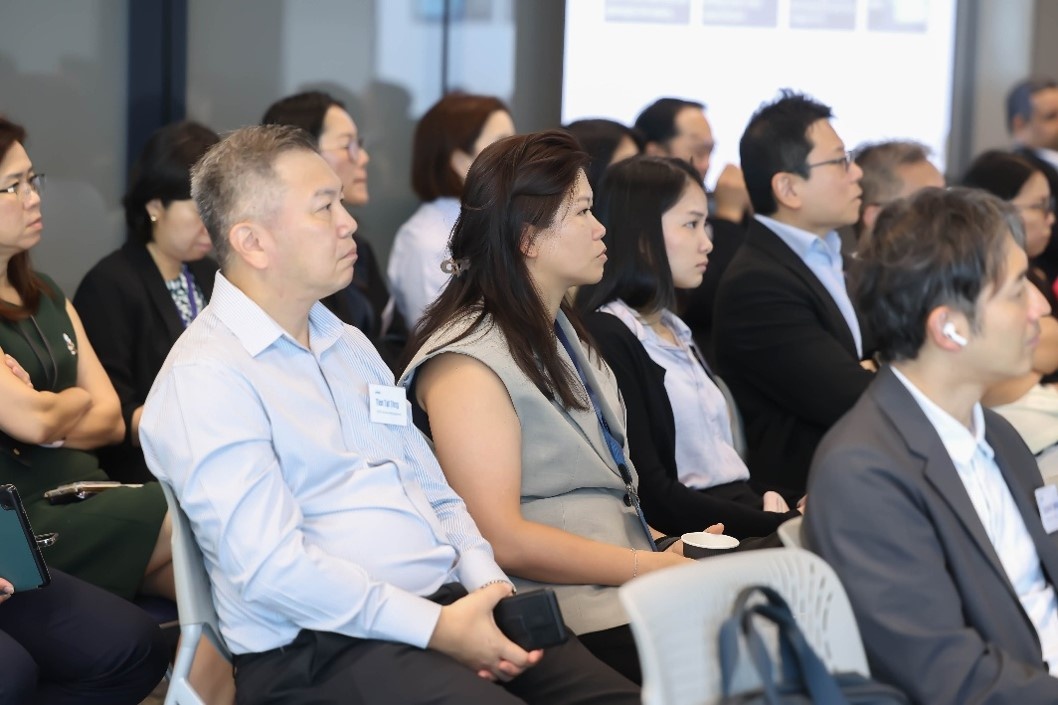 |
| Business leaders, investors and senior advisers gathered in Singapore for KPMG's Vietnam's Next Cycle briefing. Photo courtesy of KPMG |
For two decades, international investors asked one question about Vietnam: where to put the factory. At the Singapore edition of Vietnam's Next Cycle, KPMG's regional briefing series, the question had visibly changed – to where to place technology, R&D, regional functions and capital. That shift, more than any single headline number, defines Vietnam's next investment cycle.
The briefing brought together investors, business leaders and senior advisers from across Southeast Asia. Singapore was chosen as the first stop for a simple reason: it is already one of Vietnam's largest investment partners. It is also a key regional centre for capital, business headquarters and cross-border deal activity.
Singapore is Vietnam's second-largest foreign investor, with cumulative registered investment capital of nearly $97 billion across more than 4,500 projects. In the first seven months of 2026, it was the largest source of newly registered FDI, committing approximately $7.5 billion, representing 35.6 per cent of total newly registered capital in Vietnam during the period.
The relationship is also deepening structurally. In March 2025 the two countries elevated ties to a Comprehensive Strategic Partnership – Singapore's first with an ASEAN member state – building on the Strategic Partnership of 2013 and the Green-Digital Economic Partnership of 2023. The partnership broadens cooperation into areas such as energy connectivity, the digital economy, innovation and capital markets, including initiatives to enhance stock market connectivity and depository receipt arrangements.
Vietnam's economy reached approximately $514 billion in 2025 on GDP growth of 8.02 per cent – its second-strongest year since 2011 and among the strongest performances in Asia. Momentum has carried into 2026: registered FDI reached $34.65 billion in the first half, up 61 per cent on-year, while disbursed FDI rose 11.2 per cent to $13.03 billion, the highest first-half implementation in five years.
KPMG noted that the gap between commitment and delivery is narrowing, a signal that matters more to investment committees than headline pledges.
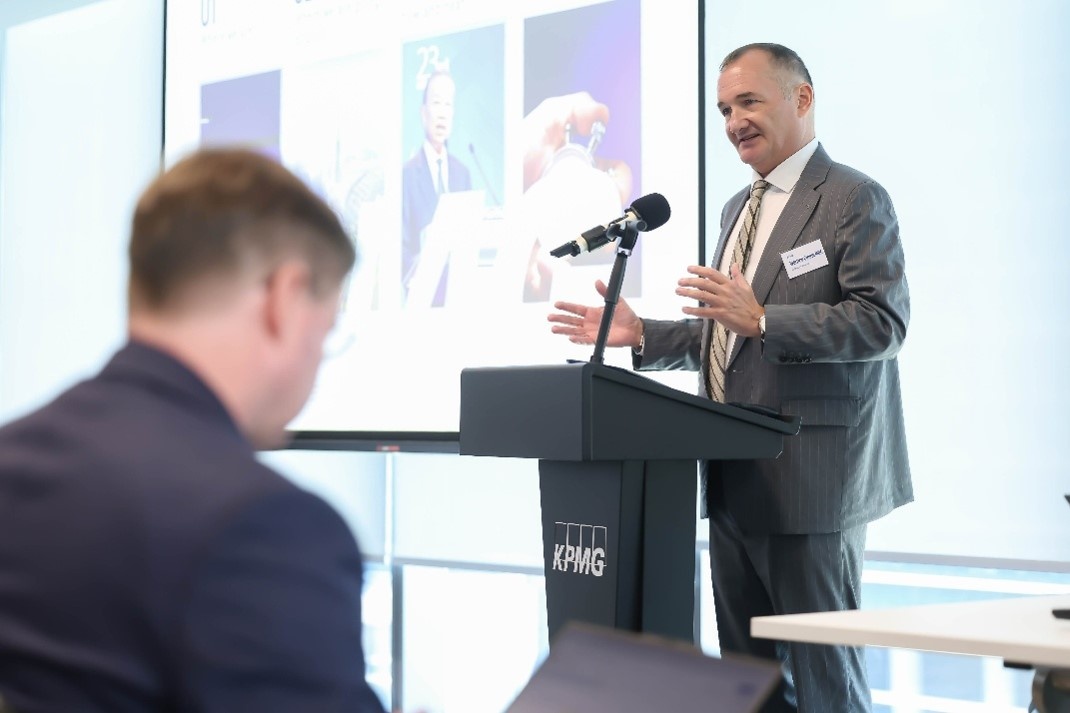 |
| Warrick Cleine MBE, chairman and CEO of KPMG in Vietnam and Cambodia, shared insights on Vietnam's evolving investment landscape, capital markets development and long-term growth ambitions. Photo courtesy of KPMG |
Manufacturing still anchors inflows, but the sector mix is broadening. Investors are increasingly targeting advanced manufacturing, semiconductors, AI, digital infrastructure, renewable energy, healthcare and financial services. Vietnam is moving from a low-cost production base to a more diversified investment ecosystem.
Vietnam is running one of the most ambitious reform programmes in its modern history. Politburo resolutions on private sector development, science and technology, foreign direct investment and institutional reform are reshaping the operating environment, with a stated objective of attracting not just more capital but higher-quality capital.
The targets are demanding. Under Resolution 68, the private sector is to contribute 55-58 per cent of GDP by 2030, rising above 60 per cent by 2045. Resolution 10 sets registered FDI of $200-300 billion for 2026-2030, with $150-200 billion disbursed. Government growth ambitions run at approximately 10 per cent a year over the same period, supported by a large-scale infrastructure programme spanning high-speed rail, airports, ports, digital infrastructure and renewable energy.
For investors, the practical implication is that Vietnam's policy direction is now legible enough to underwrite – while execution risk remains the live question. Yap Wee Kee, partner of Capital Markets Group and Private Enterprise at KPMG in Singapore, added that each member state in ASEAN brings its own distinct sectoral strength.
“The opportunity for Singapore enterprises lies in understanding those strengths and aligning their regional strategy accordingly,” he said.
The strongest message from the Singapore discussion was the growing role of M&A. Discussion participants highlighted increasing interest in growth capital, strategic partnerships, succession transactions and platform acquisitions as Vietnamese enterprises scale and international investors seek established positions.
Succession planning was identified as an important consideration for many founder-led businesses, while policy reforms are encouraging greater institutionalisation of the private sector. Together, these factors may create additional opportunities for investment and transaction activity.
The terms of access are also changing. Capital is no longer allocated on growth prospects alone. Investors want demonstrable governance frameworks, reliable reporting and a credible value creation plan. For Vietnamese companies, governance has become a financing issue, not a compliance one.
Warrick Cleine MBE, chairman & CEO of KPMG in Vietnam & Cambodia, said, “The opportunity in Vietnam is no longer just a growth story. As the market matures, investors are becoming increasingly selective about where they place capital and whom they partner with. Factors such as governance, transparency, talent, operational readiness, and the ability to execute at scale are becoming as important as market potential.”
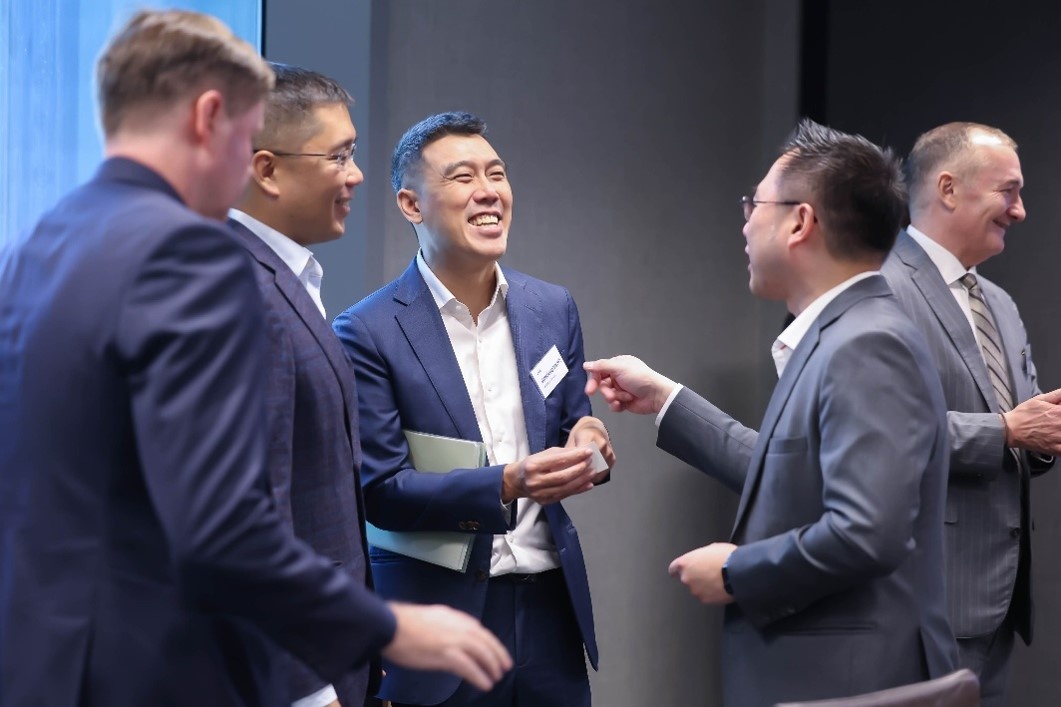 |
| Business leaders exchanged perspectives on investment trends, M&A opportunities and cross-border business partnerships between Singapore and Vietnam |
 | KPMG and Anthropic to redefine client services with artificial intelligence tie-up On May 20, KPMG and Anthropic announced the launch of the KPMG Digital Gateway powered by Claude, bringing Anthropic’s frontier AI directly into KPMG’s client delivery platform. |
 | KPMG announces appointment of Gary Wingrove as global chairman and CEO Gary Wingrove has been elected as the next global chairman and CEO of KPMG International, beginning a four-year term from October 1. |
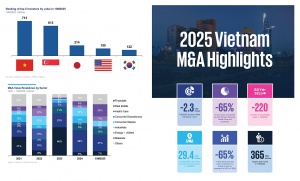 | Opportunities reshaped by disciplined capital aspects Across Southeast Asia, dealmaking remained relatively subdued for much of 2025, as tighter financial conditions, valuation gaps, regulatory uncertainty and geopolitical risks tempered investor sentiment. Vietnam, however, maintained a degree of resilience, supported by selective large transactions and steady participation from regional strategic investors. |
What the stars mean:
★ Poor ★ ★ Promising ★★★ Good ★★★★ Very good ★★★★★ Exceptional
 Tag:
Tag:Related Contents




Latest News



More News
- Partnerships streamline pathways for investors in Vietnam (September 08, 2026 | 08:58)
- Vietnam can lead the way in AI regulatory system (September 04, 2026 | 09:00)
- Significant steps made in related-party transactions (August 21, 2026 | 15:51)
- New challenges for workforce data and HR policy management with PIT changes (August 17, 2026 | 10:32)
- Leading in AI: from pilot initiatives to enterprise value (August 10, 2026 | 07:00)
- Programme launched to develop new Vietnamese business leaders (July 28, 2026 | 13:50)
- Vietnam must build talent and innovation to attract quality investment (July 09, 2026 | 08:00)
- AI-ready workforce key to Vietnam's next decade, analysts say (July 01, 2026 | 15:55)
- VIFC shouldn't try to be Dubai, says VinaCapital chief economist (June 24, 2026 | 14:17)
- Highly skilled workforce and fiscal incentives key to driving high-tech growth (June 17, 2026 | 16:17)







 Mobile Version