
Lung cancer breakthroughs take centre stage at medical conference

The Vietnam Medical Association and the Vietnam Young Physicians Association, in collaboration with the World Association for Lung Cancer Research, co-organised the three-day conference from October 9–11. The event brought together more than 500 delegates, including leading scientists and experts from the Ministry of Health (MoH), central hospitals, and medical associations, to exchange knowledge and discuss new approaches to lung cancer prevention and care.
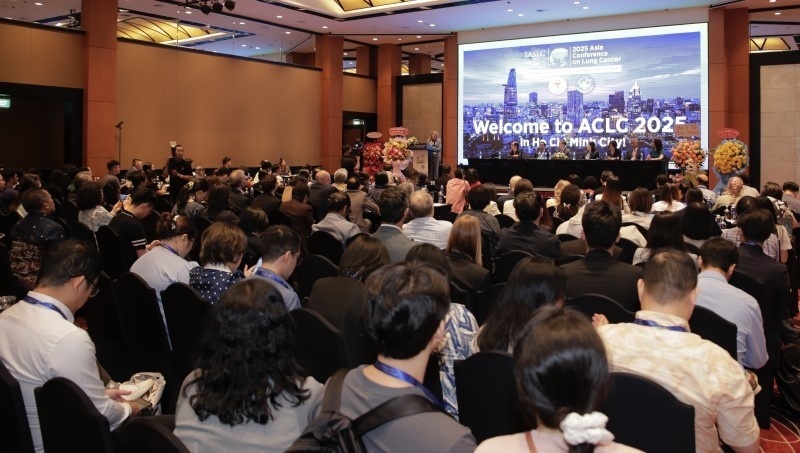 |
| Photo: MoH |
During his speech at the event, Prof. Dr. Tran Van Thuan, Deputy Minister of Health, who is also chairman of the National Medical Council, said, "In today’s rapidly changing world, Vietnam’s Party, state, and government continue to place people’s health at the very centre of national development. We’re pushing forward with policies that promote innovation in healthcare – from AI and big data to precision medicine – to strengthen our ability to detect, treat, and prevent diseases more effectively."
Thuan added that the MoH is actively implementing specific action programmes to realise this spirit, while at the same time linking with Vietnam's international commitments to the World Health Organisation in reducing mortality rates due to non-communicable diseases, improving life expectancy and quality of life of the people.
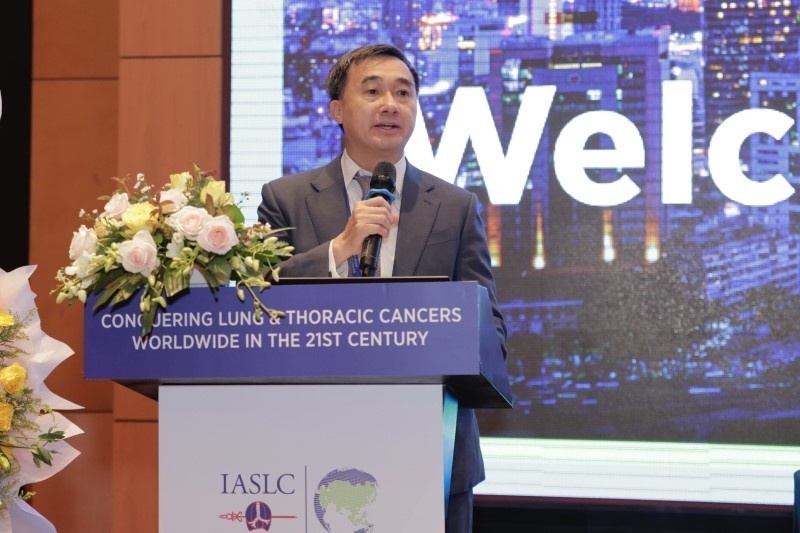 |
| Prof. Dr. Tran Van Thuan, Deputy Minister of Health. Photo: MoH |
Thuan stated that in the healthcare development strategy to 2030, the MoH is focussing on four main directions. First is strengthening preventive medicine, expanding screening and early detection of lung cancer in the community, especially in high-risk groups.
Second is promoting research and application of advanced science and technology, from molecular biology, genetics, immunology to AI, to personalise treatment and improve diagnostic efficiency.
Third is developing high-quality human resources, enhancing international cooperation in training, technology transfer and clinical research.
Fourth is building a comprehensive, equitable and interconnected care system, helping people in all regions access quality healthcare services.
Dr. Karen Kelly, CEO of the International Association for the Study of Lung Cancer (IASLC), said, "This event goes beyond a scientific conference – it’s a platform for experts to come together, exchange the latest scientific insights, share clinical experience, and strengthen collaboration. By working closely, we can advance the fight against lung cancer and deliver greater benefits to the community."
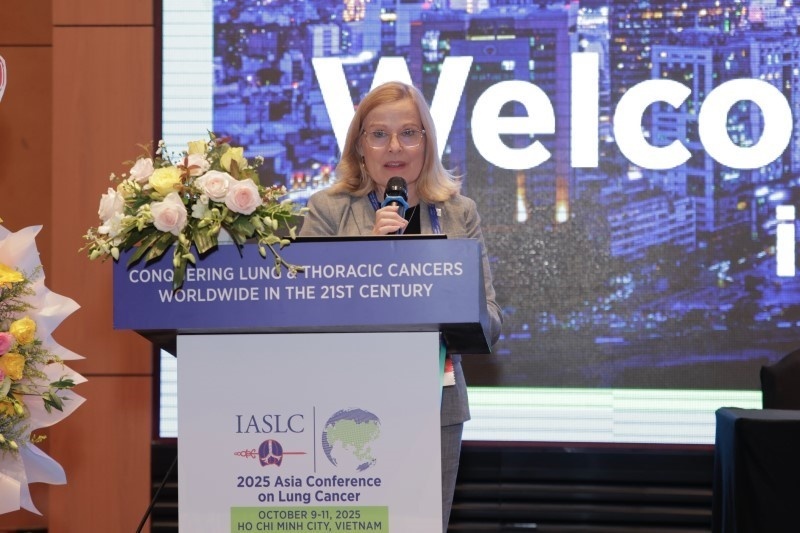 |
| Dr. Karen Kelly, CEO of the International Association for the Study of Lung Cancer. Photo: MoH |
Asian Lung Cancer Conference 2025 featured 30 sessions, including seminars and panel discussions, with more than 100 detailed reports covering all aspects of lung cancer prevention, early screening, diagnosis, and treatment. Topics included the use of low-dose spiral CT scans for early detection, advanced technologies such as proton radiotherapy and robotic endoscopic surgery, and the growing role of AI in everything from screening to personalised treatment.
The in-depth event also provided a platform for Vietnamese doctors and international experts to strengthen cooperation in clinical research, data sharing, and training – paving the way for joint initiatives to improve early detection and treatment outcomes. Discussions also delved into rare thoracic cancers such as pleural, mediastinal, and small-cell lung cancer, reflecting a shared commitment to advancing comprehensive cancer care.
With its comprehensive scientific content and strong international collaboration, the conference marked an important step forward in Vietnam’s ongoing efforts to reduce the burden of lung cancer and enhance the quality of care for patients nationwide.
 Lung cancer screening saves lives in Vietnam and Asia Lung cancer screening saves lives in Vietnam and Asia |
 AstraZeneca advances lung cancer portfolio AstraZeneca advances lung cancer portfolio |
 Cancer immunotherapy offers hope for lung cancer treatment Cancer immunotherapy offers hope for lung cancer treatment |
What the stars mean:
★ Poor ★ ★ Promising ★★★ Good ★★★★ Very good ★★★★★ Exceptional
 Tag:
Tag:Themes: Healthcare Platform
- Ho Chi Minh City Oncology Hospital signs MoU with Novartis Vietnam
- Driving early detection and integrated liver disease management
- GSK supports medical community in raising awareness of severe asthma in Vietnam
- Vaccinology training programme launched to boost preventive care capacity
- Opella and Hoan My Academy partner to advance medical education
Related Contents








Latest News




More News
- Financing options for shock-responsive social protection in Vietnam (July 30, 2026 | 14:59)
- HER2+ breast cancer carries $3.71 billion productivity burden in Vietnam (July 30, 2026 | 14:32)
- Party Resolution charts Vietnam’s development model through 2045 and beyond (July 30, 2026 | 12:29)
- STEM education evolves for AI era (July 21, 2026 | 09:38)
- Vietnam’s workforce ready for AI era (June 26, 2026 | 16:04)
- Why child online safety is now a business imperative (June 24, 2026 | 11:00)
- Hybrid work is reshaping Vietnam’s labour market (June 17, 2026 | 16:24)
- World's children exposed to at least three overlapping climate threats (June 17, 2026 | 15:54)
- Thai Nguyen event promotes safer food systems for World Food Safety Day (June 11, 2026 | 14:08)
- Vietnam emerges as rising hub for wealth creation (June 02, 2026 | 18:31)



Latest News







 Mobile Version