
Experts outline ways to sustain interest rate cuts

Since the beginning of this week, a series of banks have cut interest rates in response to directives from the government and the State Bank of Vietnam (SBV).
Experts, however, say that for interest rate reductions to be sustainable amid strong demand for capital, the critical task is to unlock non-bank funding channels, particularly the domestic capital market and international capital flows.
As of October 28, more than 20 commercial banks had announced cuts to deposit interest rates, generally by 0.5 percentage points for maturities of six months or longer.
They had also selectively reduced lending rates for priority borrowers following directives from the government and the SBV.
Cutting interest rates is an urgent priority under current conditions to support both businesses and banks. If rates remain elevated at levels approaching the peaks seen in 2022-2023, bad debts could rise rapidly.
 |
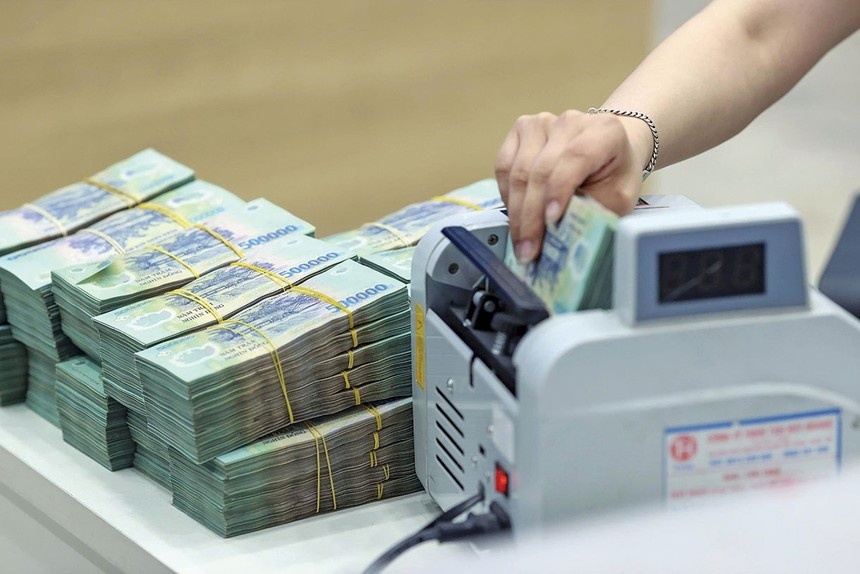
| Additional funding sources are needed to ensure sustainable rate reductions. Photo: Le Toan |
With the gap between outstanding loans and deposits still standing at approximately $60 billion and the annual peak credit season approaching in the fourth quarter, banks remain in acute need of capital.
Although preferential credit packages have had a positive impact on market sentiment, their scale remains small relative to total outstanding loans of more than $800 billion, and they are accessible only to priority sectors.
As a result, average lending rates across the market are unlikely to fall rapidly. More importantly, if deposit rates are cut too quickly, deposit inflows into the banking system could reverse.
Nguyen Thanh Tung, chairman of the Board of Directors at state major Vietcombank, acknowledged that the most enduring challenge at present is to lower banks' funding costs while ensuring that depositors' interests are protected.
“If adjustments are not appropriate, the policy could affect depositors' behaviour. The SBV and commercial banks need to work closely together to determine an appropriate level of deposit interest rates,” he said.
During the week from October 19 to 25, six-month deposit rates at smaller private lenders had climbed to 9.5-10 per cent per annum, approaching the peaks recorded in 2022-2023. This has prompted signs of deposit funds shifting from one bank to another within the banking system.
To bring down overall interest rates, the SBV has required banks to quickly cut deposit rates by 0.5 percentage points per annum for maturities of six months or longer and strictly refrain from competing to offer higher deposit rates.
Banks have also been instructed to reduce lending rates by 1.5-2 percentage points per annum for production, business activities and priority sectors.
In addition, penalties have been introduced, such as reductions in credit growth limits for the rest of the year, or lower assigned credit growth targets for 2027, among others.
To ensure sustainable interest rate reductions, Dr. Dao Minh Tu, vice chairman and secretary general of Vietnam Banks Association, said that, over the longer term, macroeconomic, fiscal and monetary policies need to be coordinated to bring interest rates to levels consistent with the profitability of the economy and businesses while meeting future investment needs.
“Achieving this objective requires coordinated policies and the development of capital markets. Banks must mobilise funds before they can extend loans, while pressure to raise funds may force them to increase deposit rates to attract money. As alternative funding sources develop and help meet the economy's capital needs, pressure on the money and credit markets will ease, creating room for interest rates to fall,” Tu said.
Another solution to easing domestic interest rate pressures is to step up international capital mobilisation. In recent months, an increasing number of banks have turned to international capital markets.
Last week, southern lender Nam A Bank signed a mandate letter for a $100 million international syndicated loan.
SHB Bank also successfully issued international bonds worth about $178.8 million in Singapore. The issuance comprised $100.6 million in three-year bonds carrying an annual interest rate of 2.9 per cent and $78.1 million in five-year bonds with an annual interest rate of 3.15 per cent.
The issuance's foreign exchange risk was hedged through a swap into US dollars arranged by Sumitomo Mitsui Banking Corporation's Singapore Branch.
Earlier, a number of banks, including HDBank, MB, VPBank and VIB, had also raised billions of US dollars from international capital markets.
Beyond commercial banks, the government is also considering a return to international bond issuance while accelerating efforts to upgrade Vietnam's sovereign credit rating to investment grade, which would improve the country's access to global capital markets.
Talking to VIR, Pham Phu Khoi, secretary general of Vietnam Bond Market Association, stressed the importance of reducing excessive reliance on the banking system, including by tapping international sources of capital.
“International interest rates are at their highest levels in five years, making overseas borrowing less favourable. Nevertheless, amid a shortage of medium- and long-term domestic funding, increasing foreign borrowing is necessary to ease pressure on the domestic capital market,” Khoi said.
Khoi added that if international tensions ease and inflation declines, the US Federal Reserve will cut interest rates, making international borrowing more favourable. While awaiting a clearer direction for US dollar interest rates, international borrowing will continue to play only a supplementary role in supporting domestic liquidity.
Under current conditions, the capital channel most expected to provide additional funding for the banking system is the capital market, particularly the bond market.
In addition, to ease funding pressures on the banking system, experts recommend that the state directly finance more infrastructure development through preferential loans backed by government guarantees.
 | Stock market positively responds to interest rate cuts The stock market has reportedly shown positive response to recent interest rate cuts. |
 | Banks adjust to balance and cut costs With simultaneous interest rate cuts and accelerated credit disbursement, banks are fuelling Vietnam’s economic breakthrough, driving towards the ambitious targets of 8 per cent GDP growth and 16 per cent credit expansion this year. |
 | Vietnam braces for financial headwinds with limited policy leeway The balance between VND mobilisation and credit in the banking system has tightened, raising concerns over macroeconomic stability in the months ahead. Despite efforts to ease borrowing costs, persistent inflationary pressures and a weakening local currency could stall further reductions in interest rates. |
 | Credit risks loom as banks battle rate-cut pressures The State Bank of Vietnam (SBV) has ordered all credit institutions to adopt measures to stabilise and reduce deposit rates, thereby maintaining monetary market stability and building capacity for lower lending rates. |
What the stars mean:
★ Poor ★ ★ Promising ★★★ Good ★★★★ Very good ★★★★★ Exceptional
 Tag:
Related Contents







Latest News
More News
- VIB reports nearly $294 million pre-tax profit in first nine months (October 28, 2026 | 14:09)
- Vietnam's stock market upgrade puts focus on corporate governance (October 28, 2026 | 12:37)
- Transparency and disclosure key to sustaining Vietnam's market upgrade (October 28, 2026 | 12:21)
- HCMC financial centre to issue investment fund regulations in November (October 27, 2026 | 17:40)
- AI helps pave way for autonomous banking (October 27, 2026 | 15:53)
- HSBC arranges EVNNPC's debut $105 million green loan (October 27, 2026 | 12:59)
- New liquidity rules set standards for banks (October 26, 2026 | 16:22)
- Policy credit helps women build economic independence (October 26, 2026 | 12:46)
- Citi wins approval for wholly owned securities firm in China (October 24, 2026 | 11:37)
- Banks face three-way test as AI reshapes digital finance (October 22, 2026 | 16:21)









 Mobile Version