
EuroCham confidence index holds at 78.3 despite operational hurdles

The European Chamber of Commerce in Vietnam (EuroCham) released the Business Confidence Index (BCI) on October 15. While the reading remains historically high, it masks a more complex business reality: respondents report an average of eight operational challenges constraining growth, with 93 per cent affected by regulatory and administrative issues, and an equal proportion by tax and financial administration.
 |
Conducted by DXL Research and Consulting, the Q3 BCI report points to a clear priority for Vietnam’s next growth chapter: ensuring that economic momentum is matched by more predictable, efficient conditions under which businesses operate, invest and create value.
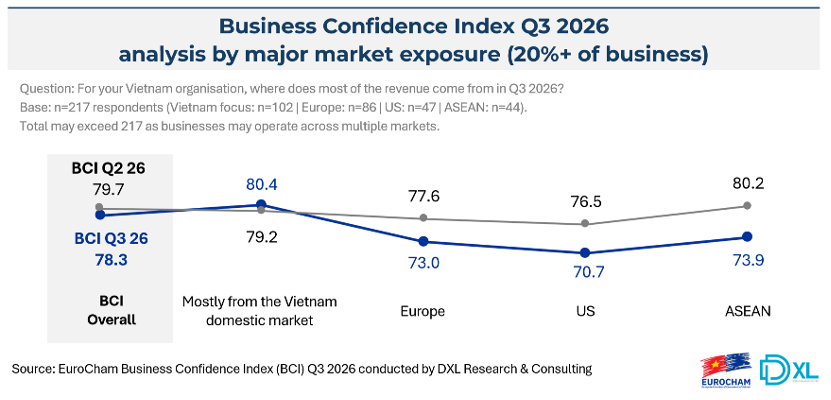
The BCI eased by 1.4 points from 79.7 in the second quarter, indicating a modest adjustment. While 64 per cent of respondents describe their current business situation as good or very good, a substantial neutral bloc (28 per cent) highlights a wait-and-see attitude as international demand remains plateaus and businesses look for policy momentum to translate into faster procedures and more predictable outcomes.
Sector analysis tells a more varied story. The agriculture and food value chain recorded the strongest improvement, rising 11.7 points to 83.9, despite continued pressure on input costs and competition from regional imports.
Trade, logistics and consumer goods also remained strong, reflecting Vietnam’s role in regional production and cross-border commerce. By contrast, tourism and hospitality fell 22.5 points to 67.9 after a strong previous quarter. Its decline highlights how quickly consumer-facing businesses can feel the effects of changing spending patterns, operating costs, and external disruption, including recent extreme weather.
Market exposure also shapes sentiment. Businesses focused on Vietnam recorded confidence of 80.4, compared with 73.2 among EU-focused firms, 70.7 among US-focused firms and 73.9 among ASEAN-focused firms. These differences are consistent with the uneven pressures facing businesses across markets, although the survey does not establish a single cause.
EuroCham Chairman Bruno Jaspaert commented that Vietnam’s is on a remarkable winning streak. With GDP growing by 9.95 per cent on-year in Q3 and by 9.01 per cent over the first nine months, the country is moving closer to its ambition of double-digit growth at a time of considerable global uncertainty.
“While we celebrate this momentum, national growth figures do not tell the whole story. Local supply chain managing rising raw material and salaries costs, manufacturing plants importing their next production line and re-engineering their sourcing grounds, or an F&B distributor facing weaker demand and new taxes: they all face pressures that can limit the businesses' ability to contribute to, and benefit from, growth. The important task now is to make growth more tangible across the economy: by improving predictability, strengthening resilience and consolidating reforms, enabling businesses to devote more of their energy to creating value,” he said.
Despite the challenges businesses face today, confidence in Vietnam’s future remains strong. Nine in 10 respondents would recommend Vietnam as an investment destination; 63 per cent plan their operations for more than five years, and 23 per cent look beyond a 20-year horizon.
Vietnam’s appeal is praised for a combination of practical strengths and long-term potential. Human capital (52 per cent), cost competitiveness (51 per cent) and political and macroeconomic stability (44 per cent) remain leading competitive advantages, complemented by its domestic market (42 per cent), the large network of free trade agreements (33 per cent) and its strategic position amid shifting global supply chains (30 per cent).
Sustainability is also emerging as part of the investment proposition: nearly one in five respondents recognise the government’s commitment to sustainable growth, with this consideration more prominent among large enterprises.
As businesses reconsider supply chains in response to global tensions and shifting trade relationships, Vietnam is increasingly positioned as more than a competitive production base: it has become a strategic hub connecting regional growth with global markets. The rise in registered foreign direct investment to close to $50.4 billion in the first nine months of 2026, alongside more than $21 billion in realised investment, a five-year-high, adds to this picture of sustained investor interest.
Yet confidence is not uniform across the business community. While 97 per cent of companies with more than 500 employees would recommend Vietnam as an investment destination, smaller firms are more cautious. This gap highlights an important priority for Vietnam’s next phase of growth: ensuring that businesses of every size can navigate the operating environment and contribute to the country’s development.
Resolution No.10/NQ-TW offers a timely opportunity to recognise and strengthen these complementary contributions. By emphasising investment quality, technology transfer, innovation and domestic supply chains, it encourages a broader measure of investment success; one that considers not only capital attracted, but also the capabilities, knowledge and opportunities created within Vietnam’s economy.
Businesses are clear about what would help them invest and operate with greater confidence. Faster administrative decisions are cited by 37 per cent of respondents, while 35 per cent call for better alignment with international standards and another 35 per cent prioritise faster, fully digitalised government services.
The priorities vary across sectors and company sizes. Faster decisions matter particularly in Agriculture, Business Services and Manufacturing; standards alignment is especially relevant to Healthcare and Trade; and digitalisation leads among Tourism businesses. Smaller firms place greater emphasis on faster decisions and more efficient tax and customs processes, while mid-sized and larger businesses also highlight digitalisation and meaningful regulatory consultation. The common thread is a desire for a business environment in which time and resources can be directed towards building the future, rather than navigating uncertainty.
Xavier Depouilly, general manager of DXL Research and Consulting, noted, “This quarter’s BCI once again highlights a persistent concern for businesses in Vietnam. Despite major administrative reforms and ongoing digitalisation, businesses continue to report overlapping requirements, with online procedures often accompanied by paperwork. Beyond the overall figures, the BCI reveals how these challenges differ across sectors and business sizes. By identifying where the main constraints lie, the research provides valuable evidence to help policymakers better understand the practical barriers facing investors and small- and medium-sized enterprises, and support more targeted improvements to Vietnam’s business environment.”
EuroCham Chairman Bruno Jaspaert concluded, “A strong partnership is much like a tree: its value lies not only in how tall it grows, but also in the roots it puts down and the shelter it offers beyond itself. Many European businesses see Vietnam as a place to put down roots for the long term, growing alongside Vietnamese partners and contributing to a future neither could build as strongly alone. But strong roots need a supportive environment to flourish. And in this particular case, we need to tell the world, especially Europe, how easily trees can take root in Vietnam.”
What the stars mean:
★ Poor ★ ★ Promising ★★★ Good ★★★★ Very good ★★★★★ Exceptional
 Tag:
Tag:Related Contents




Latest News
More News
- SCG and Prime Group add value to the ecosystem (October 15, 2026 | 15:55)
- Project readiness key to unlocking green finance (October 15, 2026 | 12:35)
- Sovereign AI and human oversight key to secure digital government (October 15, 2026 | 12:32)
- MEXC Ventures partners with Corelia Academy: Bringing digital asset education closer to Vietnamese students (October 15, 2026 | 09:00)
- Global design expertise meets a more sophisticated Vietnam market (October 15, 2026 | 09:00)
- Vietnam growth nears double digits, UOB raises forecast (October 14, 2026 | 17:39)
- Smart factories need skills, finance and trust to scale (October 14, 2026 | 17:33)
- Sanofi-Aventis Vietnam appoints new head of Vaccines and country lead (October 12, 2026 | 17:21)
- Measurable outcomes a must for businesses (October 12, 2026 | 09:27)
- Vietnam’s growth ambitions hinge on effective policy reforms (October 12, 2026 | 09:00)






 Mobile Version