

In Vietnam, Sunhouse operates more than 10 factories spanning over 100,000 square metres, with an annual production capacity exceeding 80 million units, a solid foundation for its journey from “Made in Vietnam” to “Made for the World”.
Beyond borders: Sunhouse and new era of Vietnamese brands on Amazon
Vietnamese manufacturers are increasingly embracing global markets through cross-border e-commerce, with Sunhouse emerging as one of the leading examples of this shift.
 |
| Sunhouse's microchip manufacturing plant |
Once known primarily as a domestic cookware brand, Sunhouse has expanded into global online marketplaces, reflecting Vietnam's growing participation in digital trade. The rise of cross-border e-commerce is transforming global commerce, with the market valued at $791.5 billion in 2024 and projected to grow by 30.5 per cent annually through 2031, according to Cognitive Market Research.
With a solid manufacturing foundation, rapid digital transformation, and a growing entrepreneurial ecosystem, Vietnam is becoming an increasingly competitive player in online exports. Capitalising on this trend, Sunhouse – after more than two decades serving Vietnamese consumers with locally made products – has begun expanding its brand presence globally through Amazon, marking a strategic step in its international growth.
Even as a leading domestic brand, Sunhouse faces major challenges breaking into the highly competitive US e-commerce market.
In the early phase (2022-2023), the company deals with a misaligned product strategy, offerings that did not align with US consumer tastes, rising warehouse costs, and inefficiencies in logistics. Limited use of Amazon's advertising and analytics tools also meant its performance fell short of expectations.
“Our annual sales ranged between $400,000 and $700,000, which did not reflect the scale of our group,” said Nguyen Xuan Minh, Sunhouse's director of e-commerce. “We failed in choosing products and the way of approach. Our team relied on international e-commerce expertise and didn't fully understand US consumer habits. For example, a pot or pan that sells well in Vietnam doesn't automatically succeed on Amazon.”
Rather than scaling back, Sunhouse undertook a comprehensive transformation to strengthen its position in the US market. The company refined its product portfolio, moving from a limited range of high-volume items to a wider selection of models and sizes to better gauge consumer demand. This marks a strategic shift from a production-driven approach to one focused on market responsiveness.
“We analysed competitors, demand capacity, and market gaps using Amazon's data tools to discover product opportunities and search trends. Instead of entering saturated categories, we targeted niche segments with moderate size and moderate competition, where Sunhouse's manufacturing and supply chain strengths could shine,” Minh explained.
"A niche seller on Amazon can generate $50-70 million a year. By choosing the right niche, we avoid competing directly with major brands and building our own identity. This approach tripled our sales in a year, with some items breaking into Amazon's Top 3 Best Seller Rankings. Our flagship pan alone brought in over 3,000 orders, accounting for up to 80 per cent of total sales and driving strong ad and organic performance," he added.
At the same time, Sunhouse restructured its entire e-commerce division, bringing in experts in operations, logistics, and product development. The company also digitized its internal processes to accelerate decision-making and market responsiveness.
Moreover, Sunhouse redesigned its products and packaging to reduce transportation costs. One notable example was shortening the pan handle by just 0.5 inches, changing its shipping classification from 'oversize' to 'standard', which significantly reduced fulfilment by Amazon fees. The introduction of detachable handles further cuts logistics costs by 15-20 per cent.
“A small tweak makes a big difference,” Minh noted. “By reducing the package volume, we lower total costs, from storage and shipping to fulfilment, from about $12 to just $8 per pan. Saving $4 per unit gives us two choices: lower the selling price to boost conversions, or maintain the price for higher profit margins. At tens of thousands of units, this becomes a sustainable competitive advantage.”
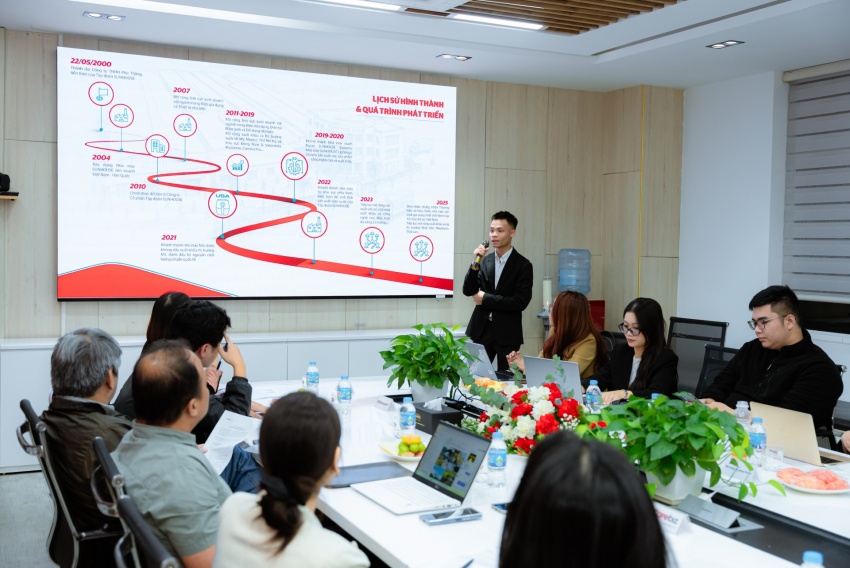 |
| Nguyen Xuan Minh, Sunhouse's director of e-commerce |
Commenting on the broader lesson for Vietnamese businesses expanding abroad, Khanh Ha, communications director at Amazon Vietnam, remarked, “Selling on Amazon isn't easy. Having production capability doesn't guarantee success. Sunhouse exemplifies a company willing to change its mindset, from original equipment manufacturer to brand builder, from intuition-driven to data-driven decisions.”
"Amazon provides many tools to identify product opportunities, niche markets, supply-demand gaps, competition levels, and search behaviour. But those tools only work when companies invest in the right people, the right processes, and can connect data insights with manufacturing capability to create products that truly meet market demand," she added.
Following this comprehensive transformation, Sunhouse's revenue has tripled since its initial stage. In the steamer cookware category, its products climbed into the top three Amazon bestsellers, with over 2,000 units sold per month. Newly launched lines like StockPot and SaucePan also broke into the top 10-20 within just three months.
“These key products have become growth anchors that strengthen Sunhouse's position in the global kitchenware market,” said Le Tung, Sunhouse's chief strategic officer. “Since then, we're expanding into small home appliances, proving the creative capacity and global ambition of a Vietnamese brand.”
Sunhouse's journey on Amazon is not merely a business success story, it's a model of Vietnamese enterprises daring to change and reaching global heights. "If we can succeed in the US, that's our passport to go anywhere. The US market is the toughest test, once we meet its standards, we hold the passport that opens doors to the world," Tung said.
Today, Sunhouse products are available in over 20 international markets, from Southeast Asia (Laos, Cambodia, Myanmar, Indonesia) to more demanding destinations such as the US, South Korea, Japan, Canada, and Brazil. Each year, the company exports over 13 million products, ranging from cookware and knives to modern home appliances.




What the stars mean:
★ Poor ★ ★ Promising ★★★ Good ★★★★ Very good ★★★★★ Exceptional
 Tag:
Tag:Related Contents







Latest News



More News
- Expanding education partnerships to drive mutual growth (October 06, 2026 | 16:04)
- VTG 2026 to showcase textile and footwear innovation in Ho Chi Minh City (October 06, 2026 | 16:00)
- Infineon boosts Vietnam footprint with Ho Chi Minh City office (October 06, 2026 | 10:02)
- Vietnam Customs expands priority enterprise scheme to 74 firms (October 03, 2026 | 08:00)
- ASL Law opens Danang office (October 02, 2026 | 22:12)
- Project ACTIVE 2.0 launches in Vietnam to boost cervical cancer care (October 02, 2026 | 22:02)
- Vietnam launches first embodied AI conference to advance robotics ecosystem (October 02, 2026 | 17:00)
- DKSH Performance Materials – A trusted partner in Vietnam’s evolving personal care landscape (October 02, 2026 | 14:28)
- Ghanaian delegation reviews PSL Machinery’s cashew factory-management and implementation roadmap (October 02, 2026 | 10:18)
- People living with chronic kidney disease and diabetes should be aware of infectious disease risks (September 30, 2026 | 18:00)


Latest News



 Mobile Version