
Vietnam sets pace for dual transition in industry and trade

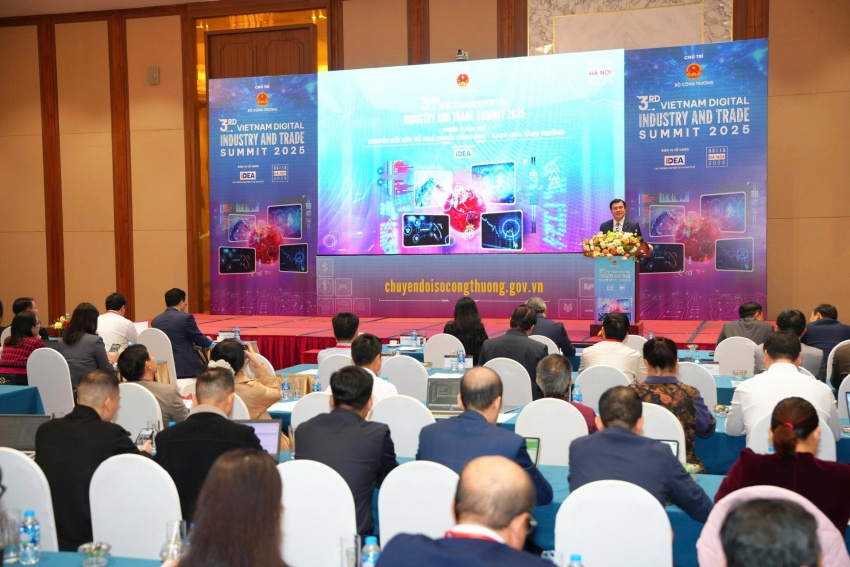 |
The Ministry of Industry and Trade (MoIT) hosted the Industry and Trade Digital Transformation Forum 2025 on December 3 in Hanoi, marking a strategic attempt to align digitalisation with sustainability as Vietnam enters a critical phase of economic restructuring.
Opening the forum, Deputy Minister of Industry and Trade Nguyen Sinh Nhat Tan said that the global economy continues to grow, driven largely by the expansion of services, digital consumption, and innovation, placing increasing pressure on countries to reform their production and governance models. He noted that Vietnam's digital economy is emerging as a new pillar of growth, supporting productivity improvements, market expansion, and economic resilience.
“The digital economy is no longer a supporting element but a structural driver of national development,” Tan said. “Retail e-commerce is expected to exceed $25 billion and continue serving as a core pillar of the internet economy.”
According to Tan, the government has designated 2025 as a pivotal year for accelerating digital transformation under Resolution 57, which defines digitalisation as a foundation for developing productive forces and improving national competitiveness. However, the challenge for the industry and trade sector, he added, is no longer digital adoption alone but digital transformation in parallel with environmental reform.
He stressed that the sector must move beyond fragmented solutions to a more comprehensive approach. "Digital transformation and green transition must be implemented together, not separately. This is no longer a choice but a requirement if we are to sustain growth," he said.
Representing the Department of E-commerce and Digital Economy, deputy head Hoang Ninh reiterated that digital transformation remains a strategic mission of the sector through 2030, closely linked with sustainable development. He reported considerable progress in the development of digital government, including 224 public services now available in full online format and a digitisation rate exceeding 95 per cent for administrative records.
“These results reflect a shift from administration-centred governance to a user-centred public service model,” Ninh said. “More importantly, they have laid a foundational database for the comprehensive digital transformation of the industry and trade sector.”
He added that over 691,000 sets of electronic documents were exchanged through the ASEAN Single Window in 2024, serving more than 52,500 national enterprises. The ministry also ranked among the top government agencies in terms of public service satisfaction during the year.
In economic terms, Ninh said e-commerce continues to act as the main growth engine, with Vietnam's business-to-consumer market reaching approximately $25 billion in 2024, accounting for 10 per cent of total retail revenue. Industrial transformation is also accelerating, with the industrial production index increasing by 8.4 per cent, the highest rise in five years.
“Roughly 90 per cent of manufacturing enterprises have implemented at least one digital solution, 35 per cent are applying robots and sensors, and about 10 per cent have reached smart factory level 3.0,” he noted.
Energy transformation was identified as another key pillar of the agenda. According to Ninh, digital technologies are now being applied across the energy system through smart meters, real-time operational data, AI-based load forecasting, and enterprise energy management systems.
Looking forward, Ninh stated that 2026 will mark a critical turning point. “Our priorities include standardising national e-commerce data, expanding smart manufacturing models, and rolling out intelligent energy management systems on a national scale,” he said. “These efforts must generate measurable value, from cleaner energy to lower production costs.”
From a business perspective, Dang Thuy Trang, public affairs director of Grab Vietnam, said digital platforms are increasingly serving as bridges between local economies and national digital infrastructure.
"Digital transformation at the local level is not only about technology, but also redesigning how services, logistics, and markets operate," she said, and highlighted a cooperation agreement between Grab and local governments, including Hue and Danang
She noted that Grab has deployed navigation tools, data analytics, and digital order management systems to support drivers and merchants, while also promoting local cuisines through multichannel marketing.
“We are helping local businesses digitalise operations, reach new customers, and stabilise income through digital tools,” she said. “This is how digital platforms contribute to socioeconomic development at grassroots level.”
The forum concluded with a panel discussion featuring industry leaders, who agreed that digital transformation will only have tangible impacts when paired with environmental responsibility and system-wide coordination.
As Vietnam's industry and trade sector faces growing pressure from green standards, supply chain transparency requirements, and cyber risks, the forum made clear that digital transformation is no longer a policy aspiration but a decisive factor in shaping competitiveness and sustainability over the coming decade.
What the stars mean:
★ Poor ★ ★ Promising ★★★ Good ★★★★ Very good ★★★★★ Exceptional
 Tag:
Tag:Related Contents





Latest News



More News
- JBIC considers new financing options for Vietnam’s energy projects (October 03, 2026 | 08:00)
- Vestas to supply 16 turbines for two new Vietnam wind farms (October 01, 2026 | 07:00)
- Inter-sectoral cooperation on Montreal protocol (September 30, 2026 | 17:20)
- EV battery recycling rate proposed at 8 per cent from 2029 (September 29, 2026 | 16:00)
- Bankability remains hurdle for Vietnam's JETP projects (September 29, 2026 | 12:08)
- Binh Minh Plastics extends clean water project to border communities (September 29, 2026 | 10:57)
- Coca-Cola Vietnam expands packaging collection programme (September 25, 2026 | 08:15)
- Pacifico Energy secures sea survey licence for offshore wind project in Lam Dong (September 24, 2026 | 18:02)
- Vietnam secures $221 million in UN development programmes for 2027-2031 (September 23, 2026 | 17:39)
- Carlsberg Vietnam shows how resource efficiency can shape green industrial growth (September 18, 2026 | 09:03)


Latest News




 Mobile Version