

High targets, hard choices: companies weigh risks in 2026

At a recent investor meeting, Taseco Real Estate Investment JSC (Taseco Land) said it estimates 2025 revenue at around $153 million, 2.3 times higher than the previous year, with after-tax profit approximating $24.6 million.
On that basis, the company has set targets for 2026 of $480 million in revenue and about $120 million in after-tax profit, equivalent to roughly three times and five times its 2025 performance, respectively.
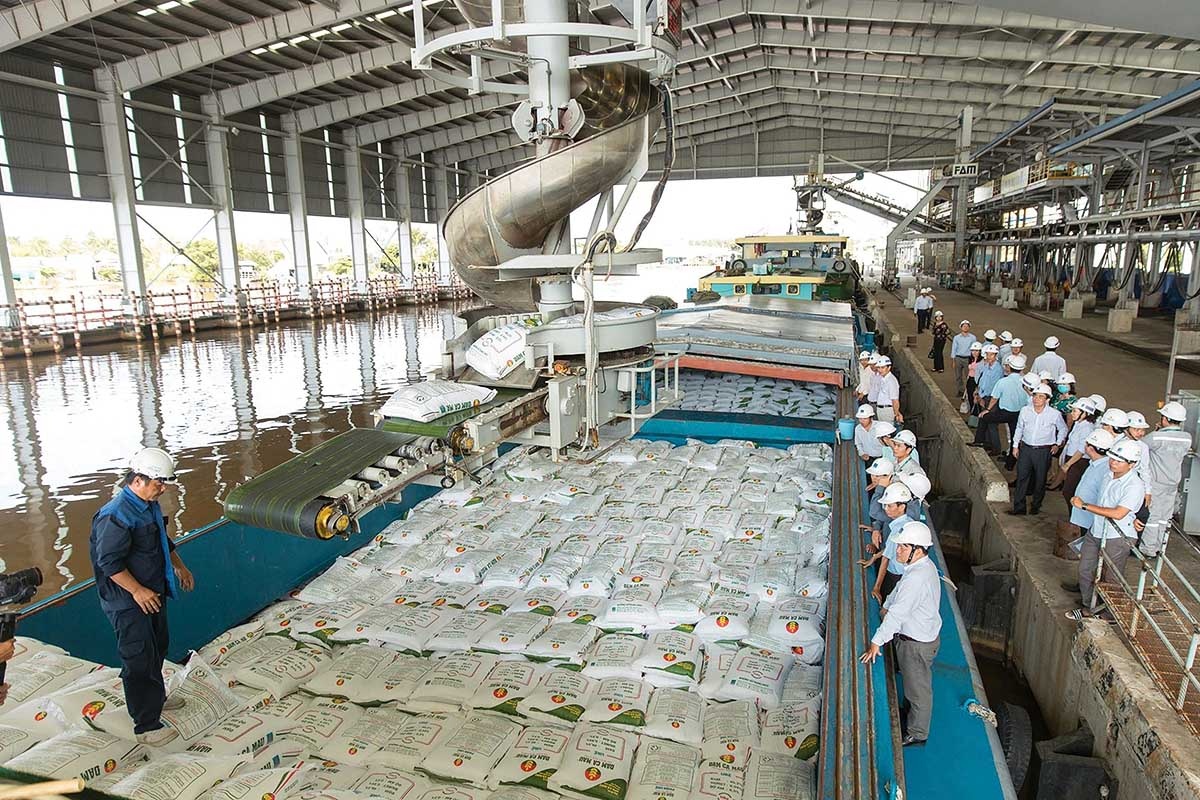
In the fertiliser and chemicals sector, Petrovietnam Ca Mau Fertiliser Corporation (PVCFC) has approved its 2026 plan with consolidated revenue of around $704.6 million and consolidated after-tax profit of about $47.28 million.
 |
| Firms' caution in crafting business plans reflects their maturity in development |
The parent company is expected to post revenue of approximately $644.6 million and after-tax profit of around $46.9 million, pay a 10 per cent dividend, and allocate $29.3 million for capital expenditure and asset procurement.
Meanwhile, Vietnam Rubber Group (VRG) has chosen for a more cautious approach. After estimating 2025 consolidated revenue of around $1.28 billion and pre-tax profit of around $277.2 million, both posting double-digit growth, the group has set its 2026 plan with an increase of about 5 per cent, corresponding to revenue of approximately $1.34 billion and pre-tax profit of about $291 million.
At a smaller but still notable scale, Petroleum Packaging JSC, a member of PVCFC, has set 2026 targets of around $16.44 million and $360,000 million in after-tax profit, up 34 per cent and 20 per cent, respectively, compared with its 2025 plan.
Looking at these figures, it is clear that a growth mindset has returned across many businesses. However, behind the impressive plans lie major questions about execution capacity.
For real estate companies, sharp growth hinges heavily on legal progress, project implementation capability, and market absorption.
For industrial and agricultural enterprises, commodity price volatility, input costs, and export demand remain hard-to-predict variables. Even large groups such as VRG have chosen to set “moderate” targets to preserve safety margins amid lingering market uncertainty.
The common thread is that 2026 business planning is no longer a simple arithmetic exercise, but a careful balancing act between growth ambition, financial capacity, and risk tolerance.
One notable shift in this year's planning season is the return of cash flow to centre stage. Many companies are willing to accept lower profit margins in exchange for faster capital turnover, inventory reduction, and less reliance on debt financing.
At the same time, pressures related to environmental, social, and governance standards and digital transformation are quietly reshaping business plan structures.
Many investments are aimed not only at scaling up operations, but also at meeting environmental standards, occupational safety requirements, and supply chain transparency- the factors that increasingly have a direct impact on access to capital and markets.
Domestically, demand is recovering but uneven across sectors, meanwhile input costs remain unpredictable. These realities are forcing companies to scrutinise every underlying assumption, from market prospects and cash flows to execution capacity.
According to a newly released forecast by Vietcombank Securities, many companies could record profit growth in the fourth quarter of 2025 of several tens of per cent, or even securing multiple-fold increases on-year. Bright spots span banking, securities, real estate, industrial parks, steel, energy, and retail.
Adding a broader market perspective, SSI Research estimates that Q4/2025 profits of 47 companies within its observation rose by about 20 per cent on-year, higher than the growth recorded in the first nine months of the year.
Overall, corporate profits are showing a clearer recovery trend in the final quarter of the year. However, the pronounced divergence also serves as a reminder that entering 2026, growth will no longer follow a straight line, forcing businesses to approach the new planning season with greater caution and more meticulous calculations than ever before.
 | Banpu reveals green business plan strategy Leading global energy provider Banpu Pcl. has kicked off its 5-year business plan to drive a greener and smarter strategy forward by leveraging technology and digital tools across the organization, accelerating the growth and transition towards green energy to embrace future trends. |
 | Six must-have steps for your business plan now As the world begins to reactivate and reimagine itself from the impact of the pandemic, it is time to take a deep breath and assess the situation. To use a sporting analogy, we are in the tunnel ahead of what could be the biggest game of our lives. With the right strategy in place, there are great victories to be won. Without it, failure is unavoidable. |
 | Securities firms falling short of business plans Securities firms are testifying gloomy business results in the year to date due to unfavorable market developments. |
What the stars mean:
★ Poor ★ ★ Promising ★★★ Good ★★★★ Very good ★★★★★ Exceptional
 Tag:
Tag:
Related Contents











Latest News






More News
- Sojitz in Vietnam: 40 years from individual projects to a business cluster 'KATAMARI' (October 08, 2026 | 09:00)
- Coteccons targets 'Quality Growth' with 25 per cent dividend plan (October 07, 2026 | 13:00)
- Vietnam Education Forum opens UK Education Mission's Hanoi visit (October 07, 2026 | 12:27)
- Tax authorities deactivate TINs of nearly 180,000 businesses (October 07, 2026 | 12:08)
- World Bank raises Vietnam's 2026 GDP growth forecast to 7.4 per cent (October 07, 2026 | 11:41)
- Vietstock 2026 to spotlight livestock innovation and green transition (October 07, 2026 | 09:00)
- Vietnam’s GDP grows over 9 per cent in first nine months (October 05, 2026 | 18:45)
- Vietnam earns $56.3 billion from agro-forestry-fishery exports (October 05, 2026 | 18:32)
- DSV balances resilience and decarbonisation in supply chains (October 05, 2026 | 18:20)
- Electronics exports reach $175.4 billion in the first nine months (October 05, 2026 | 18:12)



Latest News






 Mobile Version