
Vietnam and Queensland deepen education ties to power innovation

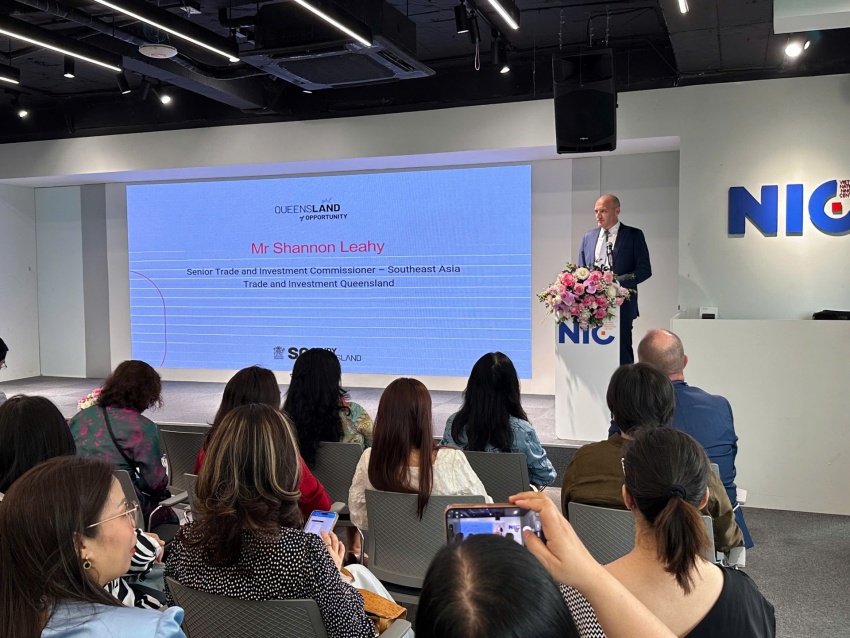 |
| Shannon Leahy, senior trade and investment commissioner for Southeast Asia at TIQ |
The event gathered leading Queensland institutions alongside Vietnamese partners to explore collaboration in priority sectors such as agricultural technology, healthcare and tourism.
Participants emphasised the importance of strengthening international cooperation in education and workforce development. Queensland, recognised as a global education hub, reported education export revenues of approximately $6.89 billion in 2024, underscoring its capacity to deliver high-quality training aligned with industry needs.
At the same time, the Australian state holds a leading position in tropical and subtropical agriculture, offering relevant expertise for Vietnam, where agriculture remains a key pillar of the economy and a major contributor to global food exports. This alignment creates opportunities for knowledge exchange and joint development, particularly in sustainable and high-productivity farming systems.
Speaking at the event, NIC deputy director Do Tien Thinh highlighted that deeper engagement with international partners, especially Queensland’s education and research institutions, would help improve training quality, foster innovation and support Vietnam’s comprehensive digital transformation.
“As Vietnam’s national innovation hub, NIC aims to connect talent, promote collaboration among government, academia and industry, and translate ideas into practical outcomes,” Thinh said. “Australia remains a trusted and strategic partner. Queensland, in particular, offers strong research capabilities and industry-linked education across fields such as medicine, agriculture, biomedical science, robotics and environmental science.”
Shannon Leahy, senior trade and investment commissioner for Southeast Asia at TIQ, stressed that the education and research ecosystem is designed to integrate academic training with real-world business demands. Leahy expressed interest in expanding partnerships in Vietnam while providing broader opportunities for Vietnamese students and professionals in study, research and career development.
Vietnam has already become an increasingly important partner for Queensland. The country is now the third-largest source of international students from Southeast Asia to the state, with more than 3,400 enrolments last year, over 20 per cent higher than pre-pandemic levels. More than 36 active university partnerships are currently in place between the two sides, with recent MoUs signed between the University of Queensland, the University of Southern Queensland and Vietnam’s Ministry of Education and Training.
Phuong Hoang from TIQ pointed to agriculture, tourism and health technology as priority sectors where education-industry partnerships can deliver immediate, practical gains for Vietnam.
"Vietnam’s agricultural workforce, estimated at around 13 million people, faces a significant skills gap, with only a small proportion formally trained,” she said. “If we want to move up the value chain, we must invest in skills. The goal is not cheaper products, but higher-quality, competitive exports. Training is also critical in post-harvest stages, including packaging and traceability.”
A practical example cited was the Mekong Sustainable Rice project, a $6.8 million initiative funded by the Australian Centre for International Agricultural Research and SunRice, led by the University of Queensland in partnership with Vietnamese institutions. The project has helped quadruple yields and increase farmers’ income by around 25 per cent per kilogramme of rice, illustrating how research and education can directly support agricultural transformation.
In tourism, Vietnam’s rapid growth presents both opportunity and pressure, Hoang added. “Despite strong demand, the sector currently meets only about half of its workforce needs, while just 10 per cent of workers have formal training. Without improvements in skills, language proficiency and service quality, Vietnam risks losing competitiveness to regional peers such as Thailand and Malaysia,” she said.
Hoang highlighted growing connectivity between Vietnam and Queensland, including rising visitor flows and direct air links between Ho Chi Minh City and Brisbane. With Queensland preparing to host the 2032 Olympic Games, demand for skilled labour in tourism, hospitality and related services is expected to surge, opening further avenues for collaboration in training and student mobility.
In healthcare and health technology, Queensland’s strengths in biomedical research and hospital systems were seen as highly relevant to Vietnam, where the healthcare system faces mounting pressure. With relatively low ratios of doctors and nurses per capita, expanding access and improving service quality will require both workforce development and digital solutions.
Technologies such as telehealth, digital consultation platforms and pharmaceutical innovation can help extend care to underserved areas and manage growing patient demand. However, Hoang stressed that the real challenge lies in building a workforce capable of deploying and scaling these technologies effectively.
“Technology on its own does not create value,” Phuong concluded. “It is the people, trained, skilled and connected to industry, who turn innovation into real impact.”
During the programme, delegates took part in thematic presentations and discussions on Queensland’s education system and Vietnam’s human capital development strategy. A key panel session on cross-border collaboration examined how education and innovation can generate tangible impacts for industry, offering a platform for stakeholders to share experiences and propose practical cooperation models.
Business matching activities were also held, enabling universities, research organisations and companies from both sides to identify concrete opportunities in training, research and workforce development.
Following the Hanoi event, the programme will continue in Ho Chi Minh City on April 16, aiming to broaden connections and deepen engagement between stakeholders.
 | Forum outlines pathways to accelerate green transition The Vietnam-Australia Green Transition Forum 2026, organised in Ho Chi Minh City on April 9, highlighted the urgent need to bridge the gap between macro policies and business practices to accelerate the nation’s green transition. |
 | Australia deepens fintech ties with Vietnam On April 14, the Australian Trade and Investment Commission led a delegation of nine Australian fintech and regulatory technology firms to Vietnam to support the country’s digital banking transformation and expand bilateral cooperation. |
 | NIC partners with TU Berlin to boost Vietnam innovation ties The National Innovation Centre has partnered with a leading technical university in Berlin to strengthen innovation and startup linkages between Vietnam and Germany. |
What the stars mean:
★ Poor ★ ★ Promising ★★★ Good ★★★★ Very good ★★★★★ Exceptional
 Tag:
Tag:Related Contents






Latest News



More News
- Expanding education partnerships to drive mutual growth (October 06, 2026 | 16:04)
- VTG 2026 to showcase textile and footwear innovation in Ho Chi Minh City (October 06, 2026 | 16:00)
- Infineon boosts Vietnam footprint with Ho Chi Minh City office (October 06, 2026 | 10:02)
- Vietnam Customs expands priority enterprise scheme to 74 firms (October 03, 2026 | 08:00)
- ASL Law opens Danang office (October 02, 2026 | 22:12)
- Project ACTIVE 2.0 launches in Vietnam to boost cervical cancer care (October 02, 2026 | 22:02)
- Vietnam launches first embodied AI conference to advance robotics ecosystem (October 02, 2026 | 17:00)
- DKSH Performance Materials – A trusted partner in Vietnam’s evolving personal care landscape (October 02, 2026 | 14:28)
- Ghanaian delegation reviews PSL Machinery’s cashew factory-management and implementation roadmap (October 02, 2026 | 10:18)
- People living with chronic kidney disease and diabetes should be aware of infectious disease risks (September 30, 2026 | 18:00)


Latest News



 Mobile Version