

Smart cities, factories critical to national competitiveness

On May 15, Hanoi's National Innovation Centre (NIC), under the Ministry of Finance, in collaboration with Arup Ventures, hosted a forum on innovation in developing smart cities and smart factories in Vietnam.
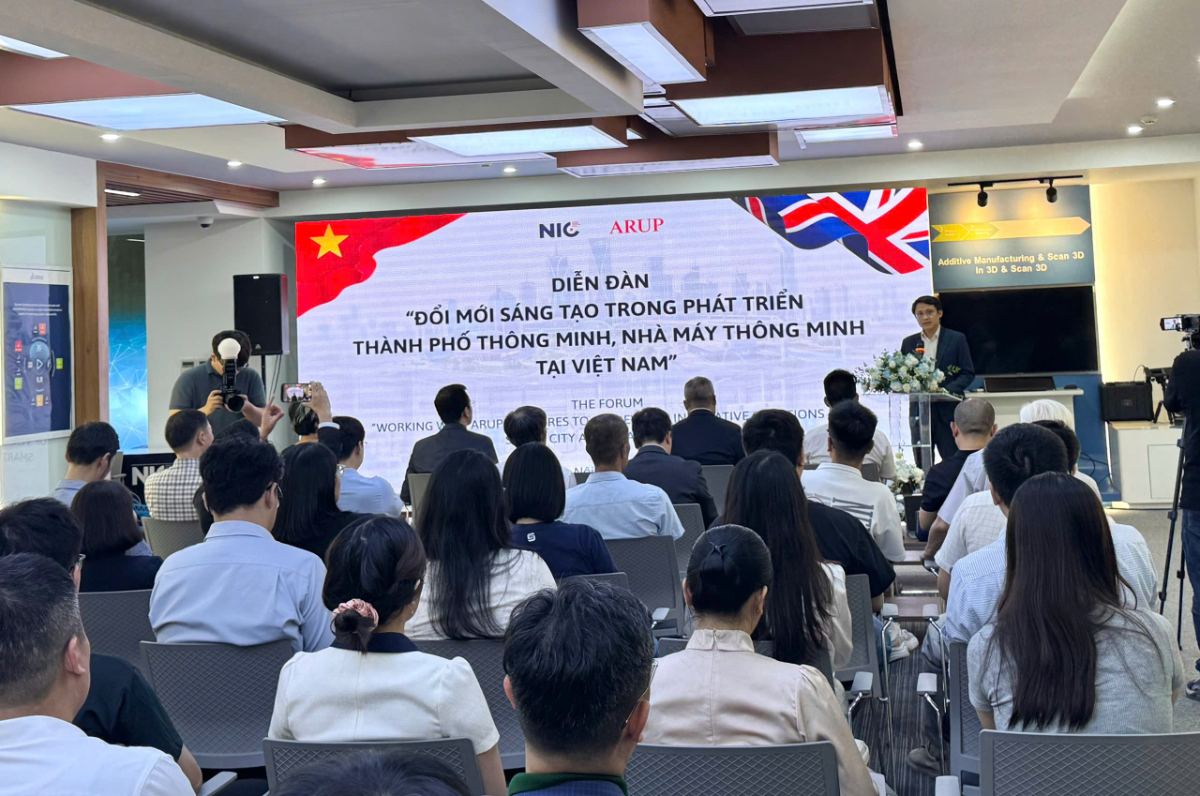 |
| Vo Xuan Hoai, deputy director of NIC |
Experts at the event said smart cities and smart factories are no longer experimental concepts, but are becoming key drivers of the digital and green economy. While smart cities integrate data and technology to optimise urban governance, resource efficiency, quality of life and climate resilience, smart factories represent the core of next-generation manufacturing, where AI, big data, the Internet of Things (IoT), automation, and Digital Twin technologies are deeply integrated to improve productivity, product quality and participation in global value chains.
Vo Xuan Hoai, deputy director of NIC, stressed that national competitiveness is increasingly determined by a country's ability to integrate data, connect infrastructure systems, and master core technologies – as much as by market size or natural resources.
Vietnam is facing a major opportunity to accelerate its development as many localities have begun implementing next-generation urban planning strategies, while domestic technology and industrial enterprises are gradually developing smart manufacturing complexes powered by AI, Digital Twin technologies, and advanced automation.
"Developing Vietnamese smart city and smart factory platforms will enhance governance capacity and labour productivity, while creating a foundation for Vietnam to achieve double-digit growth, strengthen technological self-reliance, and build globally competitive strategic industries," he said.
Dao Thi Nhu from the Urban Development Agency under the Ministry of Construction shared the government’s orientation toward building a synchronised policy framework for smart urban development based on interoperable data systems and citizen-centric governance.
At the same time, Resolution No.57-NQ/TW, issued by the Politburo in 2024, sets a target for Vietnam to complete the development of smart urban systems in centrally governed cities and qualified localities by 2030 as part of the country’s broader agenda on sci-tech and digital transformation.
She noted that one of the most urgent requirements today is to transform urban planning and management from traditional administrative models to real-time, data-driven digital governance. Such an approach, she said, would help optimise infrastructure operations and improve the management of transport, energy, environmental systems and urban public services.
“Smart urban development must be closely aligned with urban planning and sustainable development goals. Urban data should serve as the core foundation, while people and businesses must remain at the centre of the development process, alongside ensuring information safety and cybersecurity,” she said.
From an international perspective, Ricky Tsui, director and head of Investment and Business Development for Asia-Pacific at Arup, shared experiences in implementing smart urban and intelligent infrastructure models across developed economies.
Tsui explained that as cities face growing pressures from population growth, environmental sustainability, and energy demand, digital technologies and real-time data systems will function as the 'central nervous system' of smart cities. "By continuously collecting, analysing, and processing data, these systems enable governments to monitor operations, forecast risks, and make more accurate and timely decisions in infrastructure, transportation, energy, and environmental management," he said.
"Digital Twin technology supports infrastructure planning and operational simulations, while helping cities anticipate risks, optimise resources, and improve resilience against socioeconomic disruptions and climate change," Tsui added.
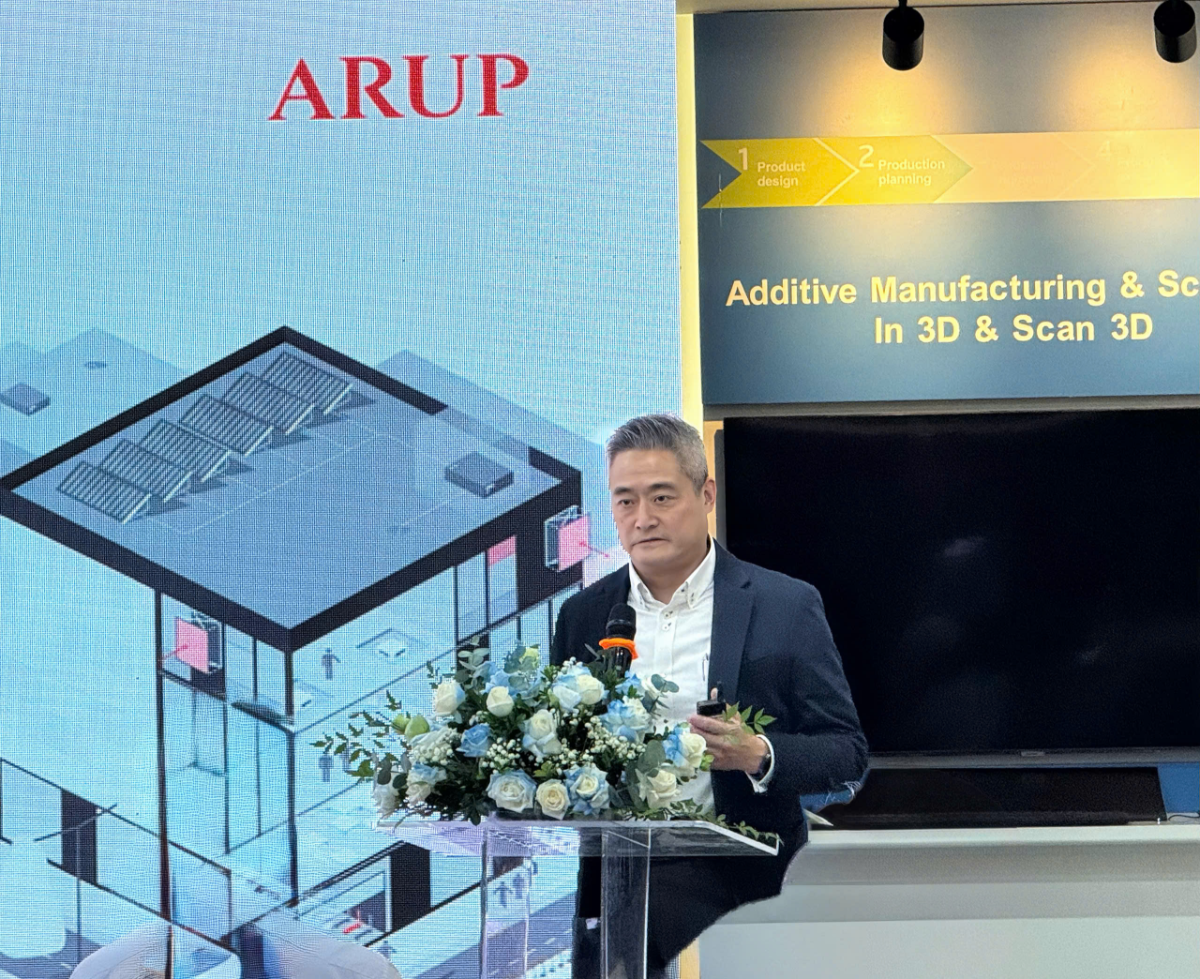 |
| Ricky Tsui, director and head of Investment and Business Development for Asia-Pacific |
Experts at the forum also noted that Vietnam has strong potential to master core technologies in AI, cybersecurity, and IoT if supported by long-term investment strategies and a robust innovation ecosystem. As data increasingly becomes a strategic asset, ensuring cybersecurity and protecting critical infrastructure systems will be a prerequisite for future smart city models.
The forum featured in-depth presentations from leading domestic and international technology corporations on strategic solutions supporting the dual transformation of urban digitalisation and smart industrial manufacturing.
Representatives from Dassault Systèmes highlighted the role of Digital Twin technology in connecting the physical and digital worlds, enabling real-time simulations of the entire lifecycle of cities, factories, and industrial infrastructure. The company described Digital Twin as a foundational technology of the next industrial revolution, helping reduce operational costs, optimise manufacturing processes, save energy, and improve data-driven decision-making.
Tran Tuan Anh, vice president and chief product officer of FPT IS, focused on the data challenges facing Vietnam’s smart city development. "The greatest challenge is not a lack of data, but fragmented systems, limited interoperability and the absence of unified data governance platforms across sectors and government agencies," he said.
Drawing on practical experience in deploying large-scale digital platforms, FPT proposed the concept of an 'Urban Digital Twin' as a next-generation governance tool capable of synchronising data related to planning, transport, construction, energy and environmental management to support real-time urban operations and decision-making.
At the same time, Doan Manh Ha, CEO of BKAV, underscored the importance of developing Vietnamese-made AI and IoT platforms to support smart urban development while safeguarding national technological security.
Under its 'AI City' vision, BKAV believes future cities will operate on integrated AI platforms deeply connected with sensor networks, converged data systems and intelligent connectivity infrastructure.
A panel discussion on advancing digital transformation in cities and smart factory development brought together representatives from universities, research institutes, technology firms, and international experts to discuss building innovation ecosystems for strategic technology sectors.
Participants agreed that the development of smart cities and smart factories is not solely a technological challenge, but a comprehensive restructuring of socioeconomic development models in which people, data and innovation play central roles. They also stressed the need to strengthen linkages between scientific research, workforce training, technology enterprise development and the commercialisation of Vietnamese-made solutions, while expanding international cooperation to absorb advanced knowledge and technologies and improve global competitiveness.
 | Partnership advances climate-smart rice value chains The Australian Centre for International Agricultural Research, the University of Queensland, and SunRice Group on March 12 announced an extension of their research partnership to advance climate-smart rice production in the Mekong Delta. |
 | Smart factories or bust: decision time in 2026 In many Vietnamese factories, transformation does not begin with a robot arm or a fully automated line but starts with the simple realisation that the old model no longer scales. |
 | Vietnam to increase IoT application in transport Vietnam’s construction sector will strengthen the application of the Internet of Things in smart transport in line with national digital transformation. |
What the stars mean:
★ Poor ★ ★ Promising ★★★ Good ★★★★ Very good ★★★★★ Exceptional
 Tag:
Tag:
Related Contents







Latest News



More News
- Sojitz in Vietnam: 40 years from individual projects to a business cluster 'KATAMARI' (October 08, 2026 | 09:00)
- Coteccons targets 'Quality Growth' with 25 per cent dividend plan (October 07, 2026 | 13:00)
- Vietnam Education Forum opens UK Education Mission's Hanoi visit (October 07, 2026 | 12:27)
- Tax authorities deactivate TINs of nearly 180,000 businesses (October 07, 2026 | 12:08)
- World Bank raises Vietnam's 2026 GDP growth forecast to 7.4 per cent (October 07, 2026 | 11:41)
- Vietstock 2026 to spotlight livestock innovation and green transition (October 07, 2026 | 09:00)
- Vietnam’s GDP grows over 9 per cent in first nine months (October 05, 2026 | 18:45)
- Vietnam earns $56.3 billion from agro-forestry-fishery exports (October 05, 2026 | 18:32)
- DSV balances resilience and decarbonisation in supply chains (October 05, 2026 | 18:20)
- Electronics exports reach $175.4 billion in the first nine months (October 05, 2026 | 18:12)



Latest News




 Mobile Version