
Vietnam and Poland target $6 billion in bilateral trade

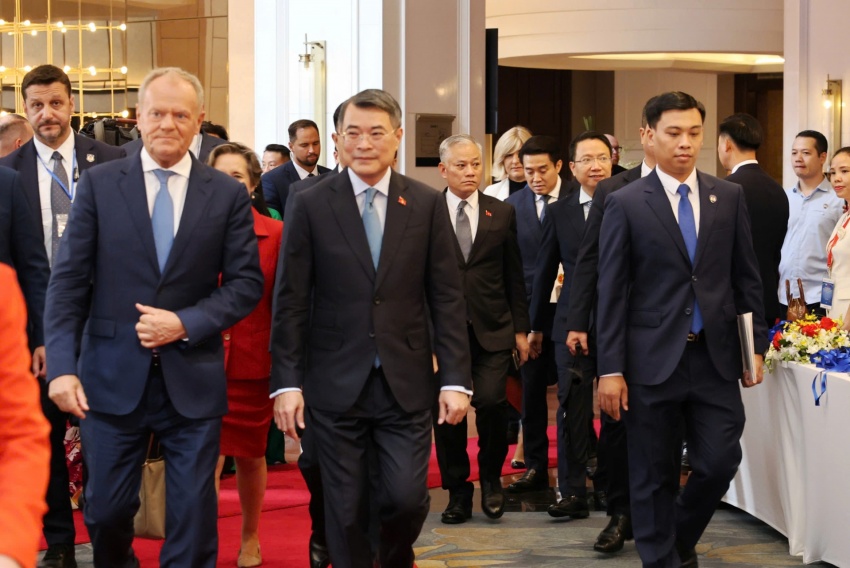 |
| Prime Minister Le Minh Hung and Polish Prime Minister Donald Tusk arrive at the Vietnam-Poland Business Roundtable in Hanoi. Photo: MoIT |
The ambition was highlighted at the Vietnam-Poland Business Roundtable held at the Melia Hanoi Hotel on October 26, attended by Prime Minister Le Minh Hung and his Polish counterpart Donald Tusk during the latter's official visit to Vietnam. The event took place shortly after the two countries announced the establishment of their strategic partnership, opening a new chapter in bilateral economic relations.
Organised by the Ministry of Industry and Trade in coordination with Poland's Ministry of Economic Development and Technology, the roundtable brought together government representatives and businesses to explore opportunities in trade, investment, manufacturing, pharmaceuticals, aviation, defence, and space technology.
In terms of investment, Poland ranked 36th among 154 countries and territories investing in Vietnam as of September, with 35 active projects and total registered capital of approximately $412 million.
Addressing the roundtable, PM Hung welcomed the event's organisation immediately after the two countries upgraded their diplomatic relationship, describing the new strategic partnership as a reflection of strong political trust, shared vision, and determination to advance longstanding bilateral ties.
He expressed hope that the discussions would translate commitments reached during talks between the two prime ministers into concrete initiatives, programmes, and projects capable of generating long-term economic benefits.
The Vietnamese prime minister highlighted the complementary strengths of the two economies, pointing to Poland's expertise in pharmaceuticals, healthcare, defence, renewable energy, digital transformation, smart agriculture, railways, shipbuilding, and environmental technologies.
Vietnam, meanwhile, offers manufacturing capabilities, an extensive seaport network, a sizeable workforce, and a network of 18 free trade agreements covering more than 60 partners.
Many sectors in which Poland enjoys competitive advantages are also priorities in Vietnam's development strategy, creating opportunities for businesses to establish integrated production networks and higher-value supply chains.
"If we connect effectively, the two economies can create highly competitive joint production and value chains. The target agreed by our leaders of raising bilateral trade to $6 billion in the near future is entirely achievable if the governments and businesses of both countries are determined to act," Hung said.
He outlined four priorities for strengthening economic ties: improving the quality of cooperation, reviewing and removing institutional barriers, enhancing transport connectivity to facilitate market access, and promoting stronger business linkages and sustainable operations.
Polish PM Tusk shared the assessment, describing Vietnam as one of Asia's most dynamic economies and an important link in global supply chains.
He noted that Vietnam's economic reforms, industrial development, and export expansion had created a foundation for its transition towards more technologically advanced and higher-value production.
Poland had undergone a similarly profound economic transformation, developing modern industries, a highly skilled workforce, and internationally competitive enterprises, he added.
According to the PM, these experiences and capabilities complement each other exceptionally well, providing a foundation for closer economic and industrial cooperation.
He identified three particularly promising areas for expanding bilateral ties: pharmaceuticals and healthcare, defence and dual-use technologies, and the space industry and advanced technologies.
Rather than focusing solely on conventional trade, the two countries should encourage joint investment, research, product development, and manufacturing, he suggested.
In pharmaceuticals, PM Tusk pointed to Polish pharmaceutical group Adamed's investment in Vietnam as an example of how Polish capital, technology, and expertise could be combined with Vietnamese professionals and domestic market opportunities. Such partnerships could expand into new ventures, pharmaceutical research, manufacturing, and exports to other regional markets.
In defence and dual-use technologies, cooperation could extend beyond equipment transactions to encompass production, services, training, and technology development.
Meanwhile, space technology offers opportunities in Earth observation, satellite data analysis, and applications supporting agriculture, water management, environmental protection, and infrastructure management.
Tusk also highlighted the potential to integrate space technologies with AI, creating new possibilities for technological development and commercial applications.
"We want Polish and Vietnamese businesses to supply technology to each other and jointly develop new products, build capabilities, and commercialise solutions in international markets. This is an opportunity to establish modern industrial linkages that benefit both sides," he said.
Opening the roundtable, Minister of Industry and Trade Le Manh Hung explained the importance of creating a transparent and stable business environment while addressing administrative procedures, technical standards, and logistics barriers that could hinder market access.
He called for stronger cooperation in trade, investment, manufacturing, technology transfer, and supply chain development, alongside more effective use of bilateral cooperation mechanisms and business associations to connect potential partners.
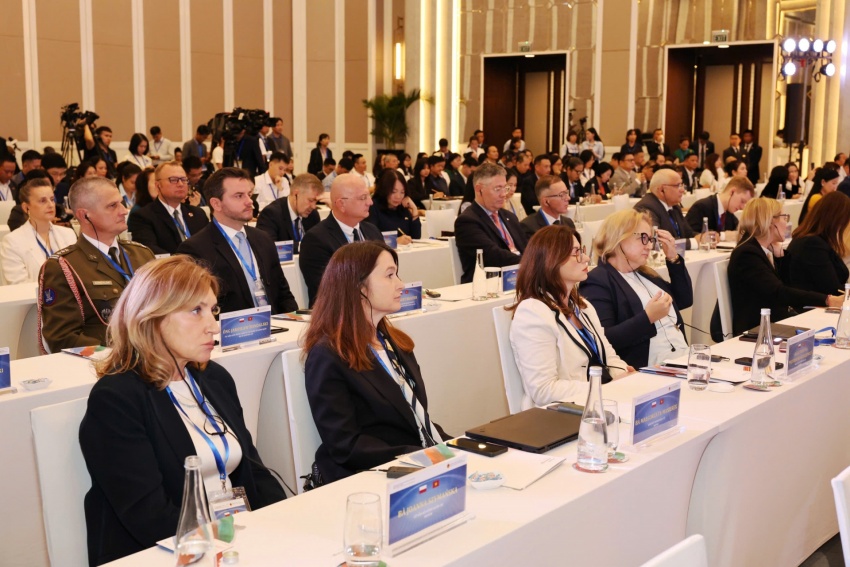 |
| Delegates attend the Vietnam-Poland Business Roundtable in Hanoi. Photo: MoIT |
The roundtable also featured discussions involving representatives of Polish companies and organisations, including PGZ, Rosomak, Cenzin, WB Group, Adamed Pharma, TZF Polfa, and the Polish Space Agency.
Participants explored opportunities in defence manufacturing, aviation connectivity, pharmaceuticals, healthcare, and space technology, reflecting the increasingly diversified scope of bilateral economic engagement.
Deputy Minister of Industry and Trade Phan Thi Thang stressed the importance of maintaining regular exchanges between government agencies, organisations, and businesses, identifying suitable partners, and advancing feasible cooperation proposals.
The discussions underscored both countries' intention to translate their newly established strategic partnership into practical commercial opportunities, with stronger business connectivity and technology cooperation expected to support the next phase of bilateral economic relations.
What the stars mean:
★ Poor ★ ★ Promising ★★★ Good ★★★★ Very good ★★★★★ Exceptional
 Tag:
Related Contents



Latest News
More News
- Vua Nem's profit jumps 127 per cent in first nine months of 2026 (October 27, 2026 | 08:30)
- Vietnam and Belgium to expand trade and investment projects (October 26, 2026 | 17:11)
- Autumn Economic Forum 2026 highlightes cooperation in a new era (October 26, 2026 | 12:49)
- DKSH to bring GNT plant-based food colouring to Vietnam (October 23, 2026 | 18:37)
- Omnichannel distribution helps Vietnamese businesses expand market reach (October 23, 2026 | 18:22)
- AEON Vietnam steps up recruitment (October 23, 2026 | 18:16)
- Vietstar partners with Indiana University on AI-era leadership (October 23, 2026 | 12:44)
- Hanoi conference to explore AI, resilience, and integration (October 23, 2026 | 10:19)
- BPC Roundtable Conference 2026 to open in Ho Chi Minh City (October 21, 2026 | 14:46)
- AMATA congratulates Kao Vietnam on 30 years (October 21, 2026 | 14:17)






 Mobile Version