
Quantum hackathon opens in Gia Lai to tackle social challenges

 |
The Politburo's Resolution No.57-NQ/TW identifies sci-tech and digital transformation as key drivers of rapid and sustainable economic growth. Prime Minister's Decision No.21/2026/QD-TTg also classifies cybersecurity and quantum technologies as strategic technologies, with quantum computing, quantum communications, and quantum sensing designated as priority technologies for development.
Party General Secretary and State President To Lam has reiterated the need for Vietnam to pursue quantum technology with a long-term strategic vision, describing it as a critical foundation for advancing science, technology, innovation, national competitiveness, and technological self-reliance.
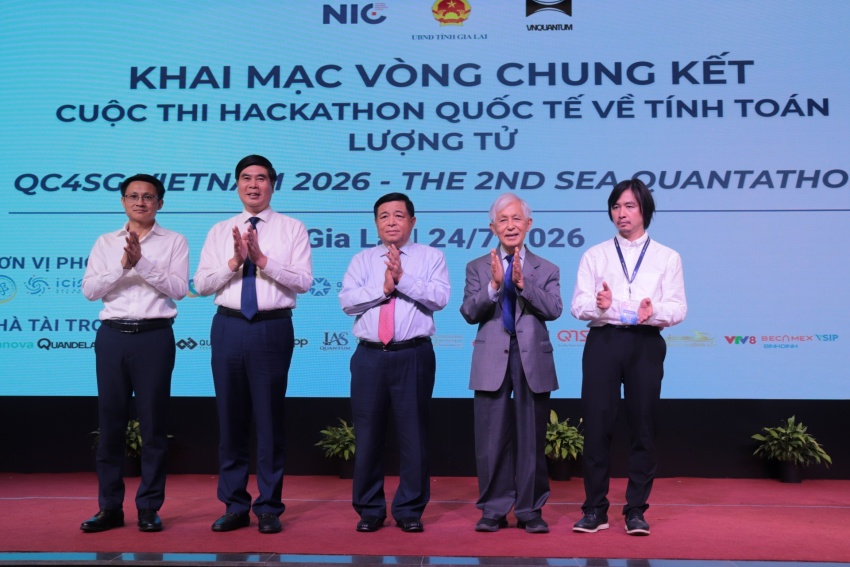
Against this backdrop, the finals of the 2026 Quantum Computing for Social Good International Hackathon opened on July 24, bringing together researchers, developers, and students to explore real-world applications of quantum technology. Organised by the National Innovation Centre (NIC), Gia Lai People's Committee, and the Vietnam Quantum Innovation and Technology Experts Network (VNQuantum), the event is supported by a wide range of domestic and international partners.
The event aims to connect scientists, technology companies, startups, experts, and young innovators from Vietnam and abroad to develop quantum computing solutions to address socioeconomic challenges. Beyond a technology competition, the programme follows a 'training–mentorship–investment matching–incubation' model designed to help promising ideas evolve into commercially viable projects.
After nearly six months of global recruitment, the competition attracted more than 500 applications from 30 countries and territories, making it the largest quantum hackathon of its kind in the region to date. Organisers selected 27 finalist teams, comprising nearly 100 contestants, to compete in Gia Lai under the guidance of around 50 domestic and international experts and mentors.
Speaking at the ceremony, former Deputy Prime Minister Nguyen Chi Dung said the participation of scientists, experts, and young talent from around the world reflected Vietnam's ambition to play an active role in frontier technologies. He recognised the NIC's role in bringing together the quantum innovation ecosystem, praised Gia Lai's commitment to hosting the Gia Lai Quantum Year 2026, and acknowledged the contributions of VNQuantum and ICISE in developing Vietnam's quantum research community.
"Quantum technology is creating opportunities across multiple industries. Competition in this field extends beyond technology itself to talent, research capability, and innovation ecosystems. Vietnam must engage early, gradually master these technologies, and build competitive advantages through Vietnamese innovation and expertise," he said.
The competition focuses on applying quantum computing to challenges in AI, cybersecurity, logistics, finance, energy, agriculture, healthcare, and sustainable development. These problem statements are based on real-world industry and societal needs, encouraging teams to develop practical solutions that contribute to achieving the United Nations Sustainable Development Goals.
Vo Xuan Hoai, deputy director of the NIC, said quantum technology is becoming a core enabling technology for many strategic industries. He noted, "Vietnam must simultaneously strengthen fundamental research, talent development, application-driven research, and collaboration among government agencies, businesses, universities, research institutes, and international partners to participate more effectively in global value chains."
"The hackathon serves as a platform connecting education, research, incubation, and investment while supporting the growth of Vietnam's quantum technology ecosystem," he added.
As Vietnam's national innovation hub, the NIC has established and supported 15 domestic and overseas expert networks with more than 2,000 members, while expanding partnerships with leading global technology companies, universities, and research institutions. It also runs programmes on talent development, startup incubation, investment promotion, and technology transfer.
In the quantum sector, the NIC has supported the establishment of VNQuantum, creating a platform that connects researchers, businesses, and international partners to accelerate the development of Vietnam's quantum ecosystem.
Lam Hai Giang, Vice Chairman of the Gia Lai People's Committee, said hosting the Gia Lai Quantum Year 2026 and the hackathon finals reflects the province's commitment to working with the government and the NIC to advance strategic technologies.
"Gia Lai aims to become a destination for science, technology, and innovation activities while attracting researchers, technology companies, and highly skilled talent to support the development of a knowledge-based economy," he said.
From July 24 to 28, finalist teams will participate in intensive training, technical mentoring, solution development, and product demonstrations before an expert judging panel during Demo Day. Alongside the competition, the VNQuantum Dealroom will connect teams, research groups, and startups with corporations, investors, and technology partners to foster research collaboration, investment opportunities, and commercialisation.
Following the finals, the NIC and VNQuantum will continue supporting promising projects through the end of 2026, helping teams refine their technologies, strengthen business models, and connect with enterprises, investors, and domestic and international partners to accelerate real-world deployment.
 | Vietnam AI Innovation Challenge 2026 finals open The final round of the Vietnam AI Innovation Challenge 2026 will take place from July 17-19 at the FPT Tower in Hanoi. |
 | VAIC 2026 honours new generation of 'AI builders' The 2026 Vietnam AI Innovation Challenge has concluded, recognising a new generation of AI builders whose solutions address real-world challenges. |
What the stars mean:
★ Poor ★ ★ Promising ★★★ Good ★★★★ Very good ★★★★★ Exceptional
 Tag:
Tag:
Related Contents






Latest News




More News
- French business delegation meets MoF to discuss investment cooperation (October 14, 2026 | 11:37)
- Friso promotes global scientific collaboration on children’s gut health in Vietnam (October 13, 2026 | 16:18)
- Germany and Vietnam look to expand strategic cooperation and investment (October 13, 2026 | 16:14)
- Vietnam-Australia forum boosts AI and digital technology cooperation (October 13, 2026 | 11:30)
- Digital transformation shifts focus to added value (October 09, 2026 | 18:00)
- Melatec Dental Clinic - accompanying international clients on their smile care journey (October 09, 2026 | 17:25)
- 12 localities achieve double-digit growth in first nine months (October 09, 2026 | 17:00)
- CYE 2026 announces top 5 finalists (October 09, 2026 | 16:55)
- Robotics inspires Vietnam’s next generation of engineers (October 08, 2026 | 15:18)
- Vietnam among fastest AI adopters, Pearson-AWS study finds (October 07, 2026 | 12:26)






 Mobile Version