
Nestlé Vietnam beefs up production capacity for coffee exports

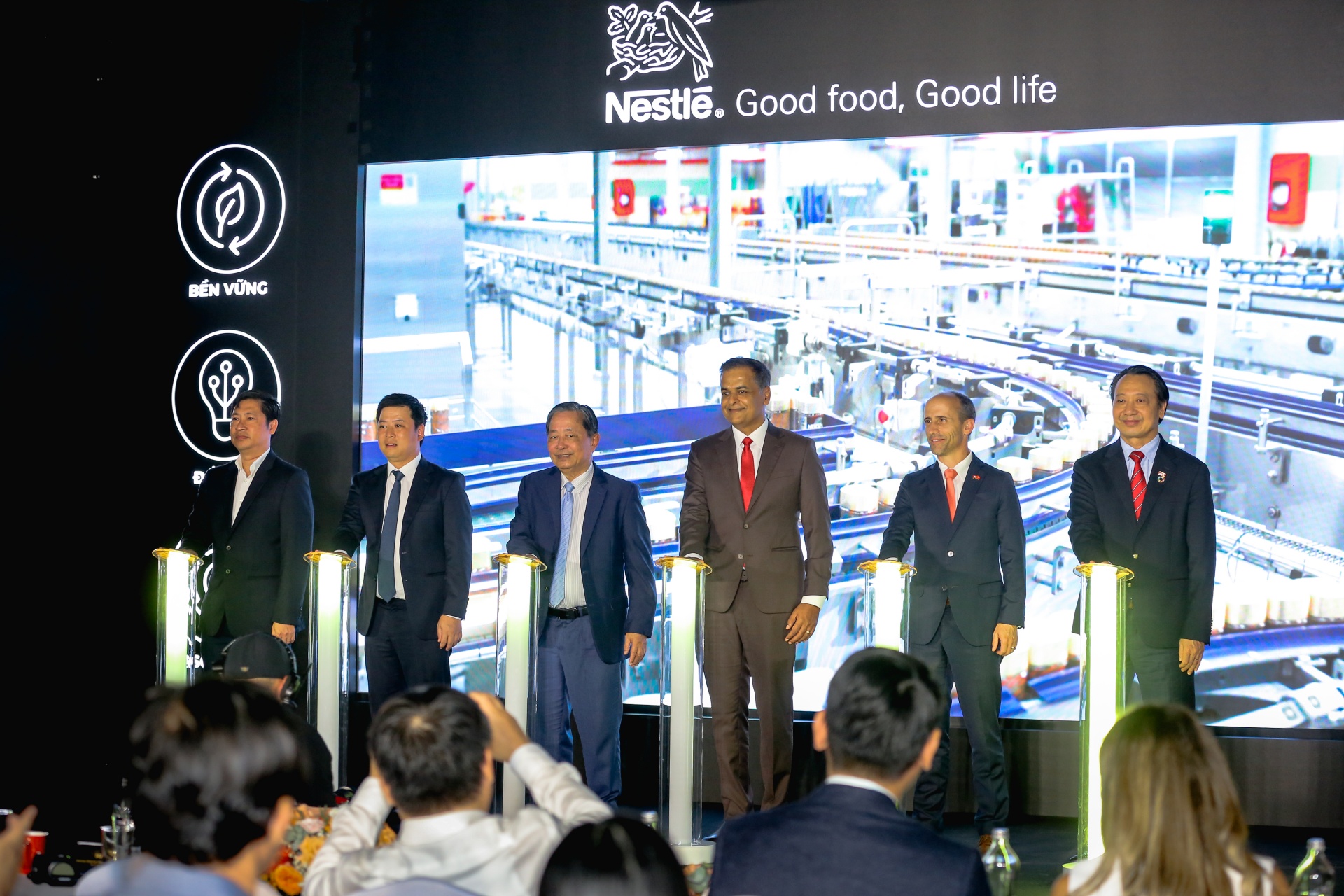 |
| Photo courtesy of Nestlé Vietnam |
The production line aims to enhance operational capacity and increase the value added to coffee beans.
The commissioning of the new line reflects Nestlé’s commitment to supporting Vietnam’s socioeconomic development goals, promoting technology transfer, developing suitable personnel, and strengthening links with the domestic business ecosystem, the company said.
The glass jar production line is designed with a high level of automation and seamless operation from raw material intake to finished products. The closed-loop production model helps improve productivity, ensure operational stability, and maintain consistent product quality in accordance with Nestlé’s global standards.
The line is capable of flexibly handling multiple Nescafé Gold and Nescafé Classic product lines, meeting various packaging specifications tailored to the requirements of each market. The state-of-the-art production line boasts an initial capacity of over 350,000 jars per day, significantly expanding Vietnam’s instant coffee production and packaging capacity.
The line also represents a step forward in the digital transformation of the Nestlé Tri An factory. Its sensors, cameras, and real-time data management systems enable comprehensive monitoring of the production process, supporting faster decision-making and improving data-driven operational efficiency.
Instant coffee products packaged in glass jars will be exported to 11 international markets, with further expansion expected in the future.
Binu Jacob, CEO of Nestlé Vietnam, said the project reflects the company's strategic direction of promoting technology adoption and developing people.
"It demonstrates our commitment to combining the application of technology with knowledge transfer, human resource development, and innovation. It also provides a foundation for further enhancing the value of the coffee industry and contributing to Vietnam’s position in the global value chain,” Jacob said.
Before the operation of the production line, Vietnamese engineers and employees participated in training programmes in the UK, Spain, and Australia, while also working directly with international experts during installation, commissioning, and process standardisation. To date, the team at the Nestlé Tri An factory has been able to operate and manage the line independently in accordance with Nestlé’s global standards.
The project also opens up additional opportunities for cooperation with domestic enterprises in areas including packaging, raw materials, logistics, equipment maintenance, and product quality inspection, the company added.
 | Nestlé Vietnam's Lunar New Year campaign reframes how Tet is counted As Lunar New Year draws closer, brands are rethinking how Tet is framed for a younger, more digitally connected audience. Nestlé Vietnam’s latest campaign suggests the festival is defined less by the calendar than by shared moments. |
 | Nestlé MILO backs Vietnam's oldest marathon in Nha Trang Nestlé MILO has continued its sponsorship of the Tien Phong Marathon National Championship, the oldest running event in Vietnam, first held in 1958. |
 | Regenerative agriculture helps Vietnamese coffee tackle green barriers In light of stricter requirements on sustainability, traceability, and carbon emissions, regenerative agriculture could enhance the competitiveness of Vietnam’s coffee industry while improving livelihoods. |
What the stars mean:
★ Poor ★ ★ Promising ★★★ Good ★★★★ Very good ★★★★★ Exceptional
 Tag:
Tag:Related Contents


Latest News



More News
- EFTA–Vietnam Free Trade Agreement opens up opportunities to enhance supply chain (October 20, 2026 | 15:56)
- Dong Thap province steps up industrial expansion and infrastructure connectivity (October 19, 2026 | 08:56)
- Vung Ang LNG Terminal looks for candidates for $1 billion EPC contract (October 16, 2026 | 17:53)
- Work on digital technology building begins in Hanoi (October 16, 2026 | 17:46)
- Vietnam CFA showcase highlights $120m funding need for climate ventures (October 16, 2026 | 17:14)
- Long-delayed LNG power projects may be replaced in revised PDP VIII (October 14, 2026 | 11:59)
- Foreign investors seeking a synchronised manufacturing ecosystem (October 14, 2026 | 11:51)
- Localities report breakthrough results in FDI in first nine months (October 14, 2026 | 11:45)
- Why Asian FDI is flowing into northern Vietnam’s industrial parks (October 14, 2026 | 09:03)
- Hung Yen unveils adjusted master plan with three economic zones (October 13, 2026 | 11:30)










 Mobile Version