
Ho Chi Minh City accelerates shift to electric bikes for delivery drivers

At a press briefing on July 17, Le Thanh Hai, director of the Centre for Economic Application Consultancy under the Ho Chi Minh City Institute for Development Studies, said the transition would initially focus on the city and nearby provinces such as Binh Duong and Ba Ria-Vung Tau, where over 85 per cent of affected vehicles are based in Ho Chi Minh City.
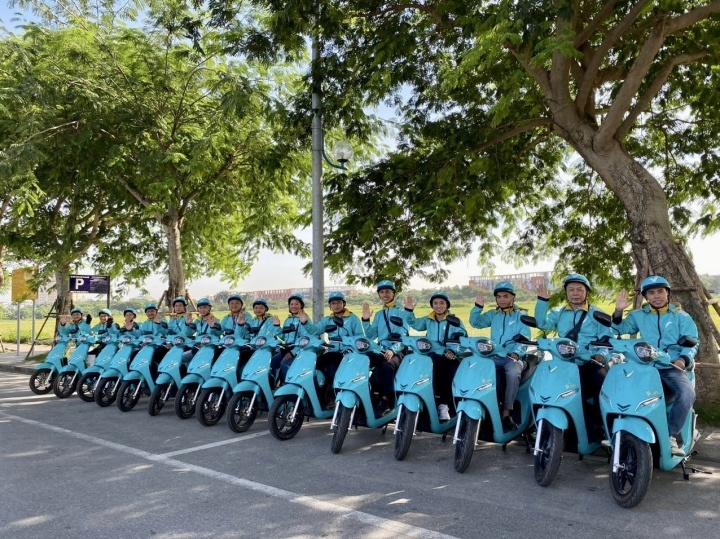 |
The plan would see 80 per cent of drivers, about 320,000 vehicles, shift to electric bikes between 2026 and 2027. The remaining 20 per cent would convert in 2028, with a full ban on petrol-powered two-wheelers operating in app-based transport services in effect by 2029.
However, the transition poses a significant challenge for the city in dealing with the large number of decommissioned petrol motorbikes. Hai stressed the need for a detailed classification system based on vehicle depreciation and condition.
"Older bikes require costly repairs to meet emission checks and are no longer economically viable. These should be either repurposed or scrapped to minimise pollution and maintenance costs," he said.
For motorbikes still in good working condition, there is concern they could be relocated to other provinces with less stringent emission controls, as Ho Chi Minh City and Hanoi tighten testing requirements.
"While it’s not ideal to shift emissions from cities to rural areas, urban centres face extreme vehicle density and emissions levels beyond human tolerance, seriously affecting public health," Hai added.
According to the Ho Chi Minh City Institute for Development Studies, annual average levels of fine particulate matter (PM2.5) in the city exceed the World Health Organisation’s recommended threshold by 2.5 to 4.7 times. The city’s transport sector is identified as one of the primary contributors to this alarming air pollution.
Supporting this, data from the Centre for Air Pollution and Climate Change Research under Vietnam National University in Ho Chi Minh City indicates that motorbikes alone are responsible for around 29 per cent of total nitrogen oxide emissions, 90 per cent of carbon monoxide, 37.7 per cent of coarse particulate matter (PM10), and 31 per cent of PM2.5 in the southern metropolis.
These figures underscore the urgency of transitioning to cleaner alternatives, especially within the high-mileage ride-hailing segment, which forms a significant share of the city’s vehicle activity.


What the stars mean:
★ Poor ★ ★ Promising ★★★ Good ★★★★ Very good ★★★★★ Exceptional
 Tag:
Tag:Related Contents





Latest News




More News
- HER2+ breast cancer carries $3.71 billion productivity burden in Vietnam (July 30, 2026 | 14:32)
- Party Resolution charts Vietnam’s development model through 2045 and beyond (July 30, 2026 | 12:29)
- STEM education evolves for AI era (July 21, 2026 | 09:38)
- Vietnam’s workforce ready for AI era (June 26, 2026 | 16:04)
- Why child online safety is now a business imperative (June 24, 2026 | 11:00)
- Hybrid work is reshaping Vietnam’s labour market (June 17, 2026 | 16:24)
- World's children exposed to at least three overlapping climate threats (June 17, 2026 | 15:54)
- Thai Nguyen event promotes safer food systems for World Food Safety Day (June 11, 2026 | 14:08)
- Vietnam emerges as rising hub for wealth creation (June 02, 2026 | 18:31)
- Danang launches DIFF 2026 with world-class performances (May 31, 2026 | 08:00)


Latest News





 Mobile Version