The Ho Chi Minh City People’s Committee officially launched the Vietnam International Financial Centre (VIFC) on February 11, signalling a major institutional step in building a modern and transparent financial ecosystem. The centre is designed to attract international capital flows, enhance market competitiveness, and support economic development.
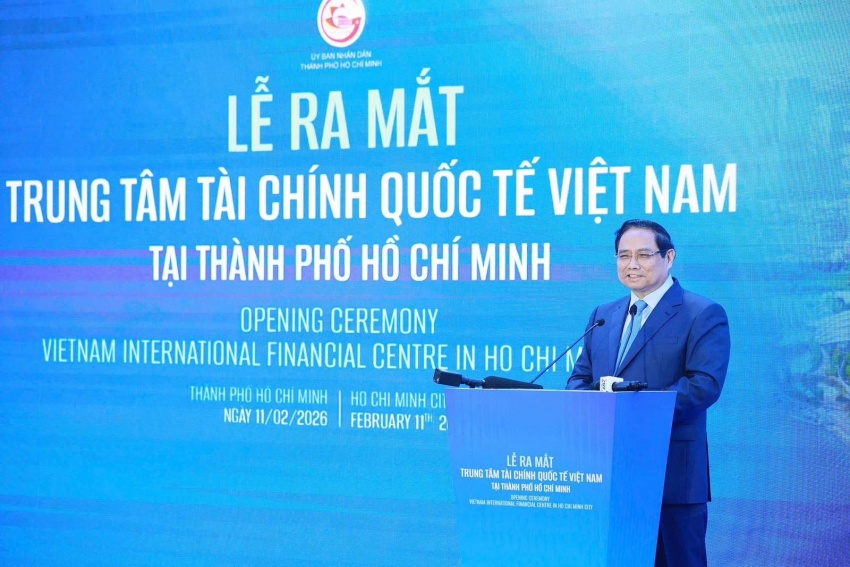 |
| Prime Minister Pham Minh Chinh speaking at the launch of the VIFC in Ho Chi Minh City on February 11 |
The ceremony was attended by the Prime Minister, the Permanent Deputy Prime Minister, leaders of ministries and central agencies, leaders of Ho Chi Minh City, representatives of international organisations, financial institutions, banks, investment funds, major domestic and foreign corporations, along with numerous experts, scholars, and executives from the business community.
In his keynote remarks, Prime Minister Pham Minh Chinh said that amid rapid global economic restructuring, intensifying strategic competition, and shifting capital flows towards emerging centres, establishing an IFC in Vietnam was a necessary and strategic move.
“An IFC serves as a hub for capital flows and a form of soft economic infrastructure, playing a central role in resource allocation, providing modern financial instruments, enhancing national competitiveness, and helping Vietnam gradually transition from a capital recipient to a market-shaping participant,” Chinh said.
Chairman of Ho Chi Minh City People’s Committee Nguyen Van Duoc said the VIFC was central to the city’s long-term strategic vision, aligning with its ambition to strengthen Ho Chi Minh City’s standing on the global financial map.
“The city recognises that sustaining its role as the country’s economic locomotive and strengthening its contribution to national growth requires new development drivers, particularly modern financial platforms, capital markets, and financial products and services,” Duoc said.
The VIFC in Ho Chi Minh City is envisioned as an open financial ecosystem closely connected to the real economy, supporting capital demand for infrastructure, industry, logistics, green transition, innovation, and smart urban development both locally and nationwide.
According to Stephen Glynn, an expert with extensive experience in developing IFCs who contributed to establishing the Dubai International Financial Centre and served as the first CEO of the Astana Financial Services Authority in Kazakhstan, several foundational factors will shape Ho Chi Minh City’s success in building an IFC.
“First, Ho Chi Minh City is already Vietnam’s economic and financial hub, supported by a rapidly developing professional services ecosystem that can sustain the IFC’s long-term growth. Second, population scale is a key advantage. Ho Chi Minh City has more than 14 million residents, while Vietnam’s population exceeds 100 million, creating strong demand for goods, services, and financial products,” Glynn said.
"Another critical foundation is the development of logistics and port infrastructure. Ho Chi Minh City is emerging as a major tourism hub, while Saigon Port will serve as key infrastructure supporting the development of trade finance initiatives. Vietnam’s international trade relationships will continue to expand, especially as the new legal and regulatory framework for Ho Chi Minh City's IFC is developed and refined."
At the ceremony, certificates recognising founding and strategic members were presented to leading domestic and international organisations in the financial sector. Founding members include Sovico Group, MB, TPBank, SHB, SonKim Capital, VinaCapital, and Nasdaq.
Strategic members comprise Nam A Bank, the Ho Chi Minh City State Financial Investment Company, the University of Economics Ho Chi Minh City, the On-chain Economy Alliance, Gemadept Corporation, and TikTok.
These institutions are joining from the outset, forming a core group to help shape market structure, product ecosystems, human capital development, operational standards, and the international standing of the VIFC.
A distinctive feature of the VIFC’s membership model is that founding and strategic members will participate as independent legal entities while simultaneously contributing their broader ecosystems, including global client networks, fintech partners, operational experience from major international financial centres, and financial and risk management capabilities. These ecosystems are expected to generate strong spillover effects, enabling the VIFC to rapidly develop a deep and competitive market.
At the ceremony, VIFC's development model was introduced, built around key strategic pillars including an aviation finance centre, maritime finance centre, a high-tech commodity exchange and clearing and settlement centre, a fintech and digital banking ecosystem, a regulatory sandbox for emerging fintech models, green and sustainable finance, and modern financial market infrastructure aligned with international exchanges.
Ho Chi Minh City’s leadership has emphasised that the VIFC must be developed and operated through practical implementation, with measurable outcomes as the ultimate benchmark rather than broad vision statements or conceptual frameworks.
The establishment of the VIFC goes beyond resolutions, decrees, or ceremonial milestones. The focus is on swift operational rollout, effective implementation, and delivering tangible results within a compressed timeframe.
In practice, before the official launching, several meaningful outcomes were achieved that lay the foundation for long-term development.
Among these are the establishment of the Aviation Finance Centre with $6.1 billion in committed capital, reflecting early confidence from international investors, developing the Maritime Finance Centre to support trade finance and logistics, mobilising $2 billion for smart-city data infrastructure and financial programmes serving Ho Chi Minh City’s development, establishing an investment fund for the City’s on-chain economy with $1 billion in committed capital, focusing on blockchain, asset tokenisation, and next-generation digital-finance models, and billions of dollars in cross-border commercial transactions of TikTok are expected to be processed through VIFC-HCMC’s interbank-financial systems in the near future
The official launch of the VIFC-HCMC marks the beginning of a long-term journey to position Ho Chi Minh City as a new convergence point for global financial capital flows and contributing meaningfully to Vietnam’s rapid and sustainable growth as it enters a new phase of development.



 Tag:
Tag:












 Mobile Version