
Hanoi hosts high-level talks on global cybercrime cooperation

On October 26, the Signing Ceremony and High-Level Conference on the United Nations Convention on Countering Cybercrime in Hanoi continued its plenary session at the National Convention Centre. Representatives from 62 countries and international organisations joined discussions, emphasising that the growing complexity of cybercrime requires a unified global response. Delegates urged all nations to sign and ratify the Convention to strengthen cooperation and build a safer, more inclusive digital environment.
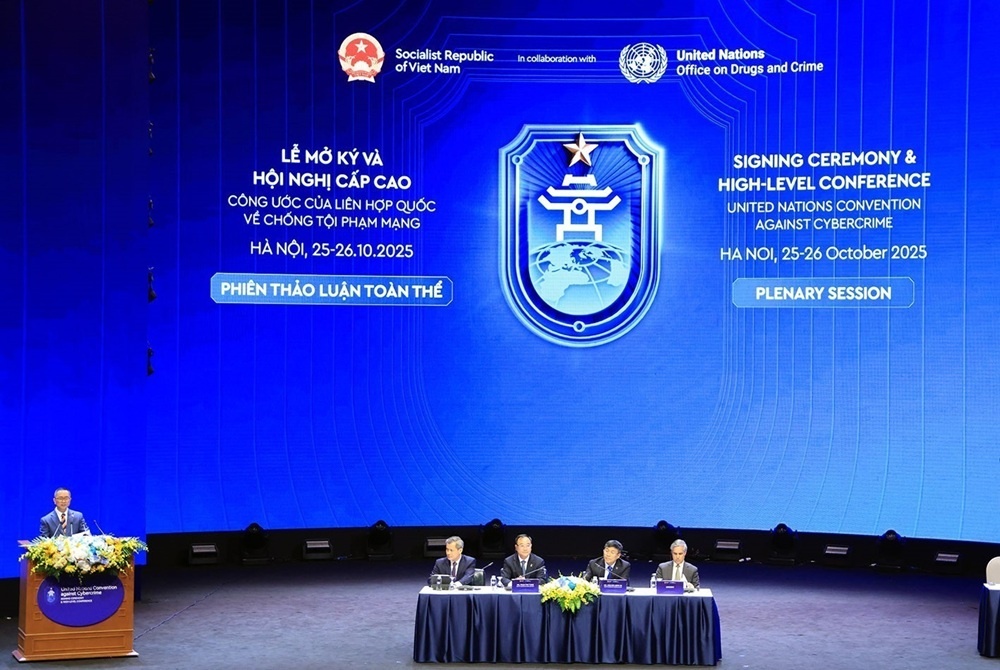 |
| Photo: Duc Thanh |
The historic signing ceremony gathered over 1,000 delegates from more than 110 national and international delegations, marking a pivotal milestone as representatives from 69 countries formally signed the Hanoi Convention.
"The event symbolises a shared commitment to strengthen international collaboration and promote a global legal framework to prevent and combat cybercrime," said Senior Lieutenant General Pham The Tung, Deputy Minister of Public Security of Vietnam.
High-level speeches delivered by General Secretary To Lam, President Luong Cuong, and Prime Minister Pham Minh Chinh underscored Vietnam’s determination to ensure the Convention’s early implementation with the participation of all nations, reaffirming the country’s vision of solidarity in building a secure, ethical, and sustainable cyberspace.
At the plenary session on the afternoon of October 25, the conference heard 19 national statements, each recognising the Convention as a crucial milestone in establishing the world’s first global legal framework to coordinate collective efforts against cybercrime.
“Many countries have expressed readiness to commit to cybercrime prevention and international cooperation in information and evidence sharing, as well as in developing common standards for cyber governance,” Tung said.
 |
| Photo: Duc Thanh |
Over 60 speakers registered to share insights on their national experiences and perspectives on the fight against cybercrime, highlighting the Convention’s significance in reinforcing global unity and determination in addressing this growing challenge.
Delegates unanimously agreed that the adoption of the Hanoi Convention represents a major step forward in shaping international norms for cyberspace governance, paving the way for a comprehensive global framework to combat cybercrime and facilitate the exchange of digital evidence in serious cross-border cases.
With 68 articles, the Convention aims to encourage international cooperation in preventing and addressing cybercrimes, which continue to pose complex and far-reaching threats worldwide, while ensuring equal opportunities for all nations to participate in the collective effort to build a safer digital future.
What the stars mean:
★ Poor ★ ★ Promising ★★★ Good ★★★★ Very good ★★★★★ Exceptional
 Tag:
Tag:Related Contents






Latest News






More News
- Petronas, Petrovietnam to expand energy cooperation (October 21, 2026 | 12:13)
- AI in customer experience: Finding the right level of automation (October 21, 2026 | 09:03)
- Fresh graduates fall short on soft skills, employers say (October 19, 2026 | 13:14)
- Ford innovations continue towards sustainable growth (October 19, 2026 | 09:40)
- Preparing professionals for a new business environment (October 19, 2026 | 09:13)
- KN Holdings honoured for ESG efforts in Vietnam (October 18, 2026 | 11:00)
- APEA 2026 Vietnam honours 65 outstanding leaders and enterprises (October 17, 2026 | 10:00)
- MEXC highlights AI-driven trading and broader market access at TOKEN2049 (October 17, 2026 | 09:00)
- EuroCham confidence index holds at 78.3 despite operational hurdles (October 16, 2026 | 17:27)
- Shrimp and rice firms face rising standards in export markets (October 16, 2026 | 09:00)









 Mobile Version