
Vietnam’s industrial output hits seven-year high in 2025

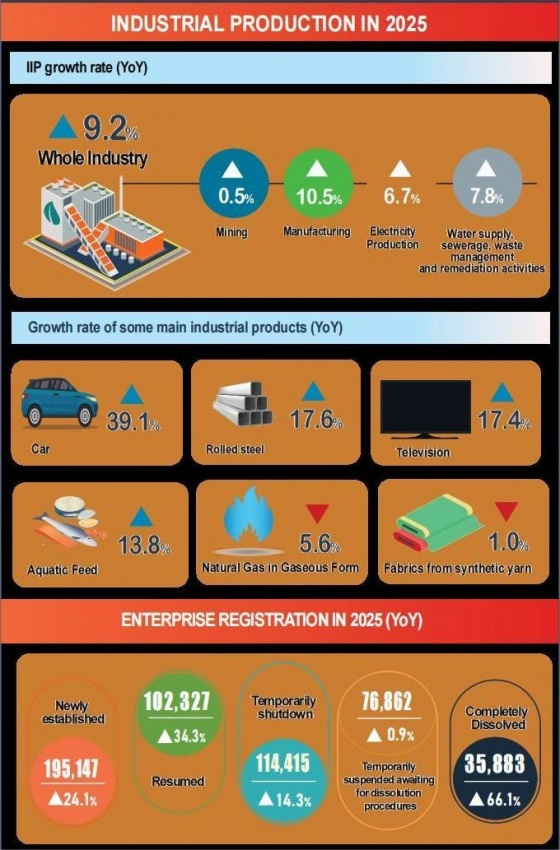
According to data released on January 5 by the National Statistic Office under the Ministry of Finance, the industrial production index (IIP) rose an estimated 9.2 per cent in 2025 compared with the previous year, up from an 8.2 per cent increase in 2024. This marked the highest annual growth rate since 2019, confirming a clear acceleration in industrial momentum.
The recovery gained further traction in the final quarter of the year, when the IIP was estimated to have increased by 9.9 per cent on-year. The fourth quarter surge was attributed largely to accelerating production and supply efforts towards the year-end, as enterprises sought to meet both domestic consumption and export demand during the peak season.
 |
| Source: National Statistic Office |
Manufacturing remained the primary growth engine. In 2025, the manufacturing and processing sector expanded by 10.5 per cent, compared with 9.5 per cent a year earlier, contributing 8.4 percentage points to overall IIP growth. Electricity production and distribution rose by 6.7 per cent, adding 0.6 percentage points, while water supply and waste management activities increased by 7.8 per cent, contributing 0.1 percentage points. Mining recorded a modest rise of 0.5 per cent after contracting sharply in 2024, also adding 0.1 percentage point to the overall increase.
At a more granular level, several key second-tier industries posted double-digit growth, reflecting a broad-based recovery in industrial activity. Motor vehicle manufacturing led the expansion with a 22 per cent increase, followed by non-metallic mineral products at 16.2 per cent. Rubber and plastic products rose by 15.7 per cent, basic metals by 15.4 per cent, and garment production by 13.2 per cent.
Other notable performers included fabricated metal products, excluding machinery and equipment, which grew by 12.5 per cent, chemicals and chemical products at 12.4 per cent, leather and related products at 11.1 per cent, and food processing at 11 per cent. Output of coke and refined petroleum products rose by 10.8 per cent, paper and paper products by 10.4 per cent, furniture by 9.4 per cent, and electronics, computers, and optical products by 8.3 per cent.
By contrast, a small number of sectors recorded slower growth or contraction. Hard coal and lignite mining rose by just 2.5 per cent, while crude oil and natural gas extraction declined by 2.5 per cent compared with the previous year, continuing the downward trend.
The industrial upturn was also reflected across localities. The IIP increased on-year in all 34 provinces and centrally governed cities reporting industrial activity in 2025. Several localities achieved particularly strong growth, driven by rapid expansion in manufacturing and electricity generation. Meanwhile, provinces with more modest increases were those where manufacturing, power production, or mining grew slowly or declined.
Output of major industrial products strengthened markedly during the year. Automobile production surged by 39.1 per cent, while rolled steel increased by 17.6 per cent and television output by 17.4 per cent. Aquaculture feed and everyday clothing both rose by 13.8 per cent, cement by 13.6 per cent, leather footwear by 13.3 per cent, processed seafood by 11.1 per cent, and NPK compound fertilisers by 10.7 per cent.
However, not all products shared the upward trend. Natural gas in gaseous form fell by 5.6 per cent, fabrics made from man-made fibres declined by 1 per cent, and monosodium glutamate output edged down by 0.2 per cent.
Consumption indicators also pointed to sustained demand. In December 2025, the consumption index of the manufacturing sector slipped by 0.4 per cent from the previous month but rose by a strong 12.2 per cent on-year. For the full year, manufacturing consumption increased by 9.9 per cent compared with 2024, although this was slightly lower than the 11.4 per cent growth recorded a year earlier.
Inventory levels rose alongside expanding production. As of December 31, inventories in the manufacturing sector were estimated to be 6.2 per cent higher than at the end of November and 13.1 per cent higher than a year earlier. The average inventory ratio for manufacturing in 2025 stood at 81.1 per cent, up from 77.1 per cent in 2024, reflecting both higher output and stock accumulation in certain industries.
Labour indicators reinforced the positive outlook. As of December 1, employment in industrial enterprises had increased by 0.8 per cent compared with the previous month and by 2.4 per cent on-year. Employment rose across state-owned, non-state, and foreign-invested enterprises, with the strongest annual growth of 3.3 per cent recorded in the foreign-invested sector.
By industry, employment in manufacturing rose by 0.9 per cent on-month and 2.4 per cent on-year, while power generation and distribution saw a 2.9 per cent annual increase. These trends highlight the role of industrial expansion in supporting job creation and economic stability.
Taken together, the strong performance of industrial production, consumption, and employment in 2025 highlights a broad-based recovery and sets a favourable foundation for industrial growth in the year ahead.
What the stars mean:
★ Poor ★ ★ Promising ★★★ Good ★★★★ Very good ★★★★★ Exceptional
 Tag:
Tag:Related Contents





Latest News




More News
- Sojitz in Vietnam: 40 years from individual projects to a business cluster 'KATAMARI' (October 08, 2026 | 09:00)
- Coteccons targets 'Quality Growth' with 25 per cent dividend plan (October 07, 2026 | 13:00)
- Vietnam Education Forum opens UK Education Mission's Hanoi visit (October 07, 2026 | 12:27)
- Tax authorities deactivate TINs of nearly 180,000 businesses (October 07, 2026 | 12:08)
- World Bank raises Vietnam's 2026 GDP growth forecast to 7.4 per cent (October 07, 2026 | 11:41)
- Vietstock 2026 to spotlight livestock innovation and green transition (October 07, 2026 | 09:00)
- Vietnam’s GDP grows over 9 per cent in first nine months (October 05, 2026 | 18:45)
- Vietnam earns $56.3 billion from agro-forestry-fishery exports (October 05, 2026 | 18:32)
- DSV balances resilience and decarbonisation in supply chains (October 05, 2026 | 18:20)
- Electronics exports reach $175.4 billion in the first nine months (October 05, 2026 | 18:12)



Latest News






 Mobile Version