
Cultural tourism as a full-fledged industry

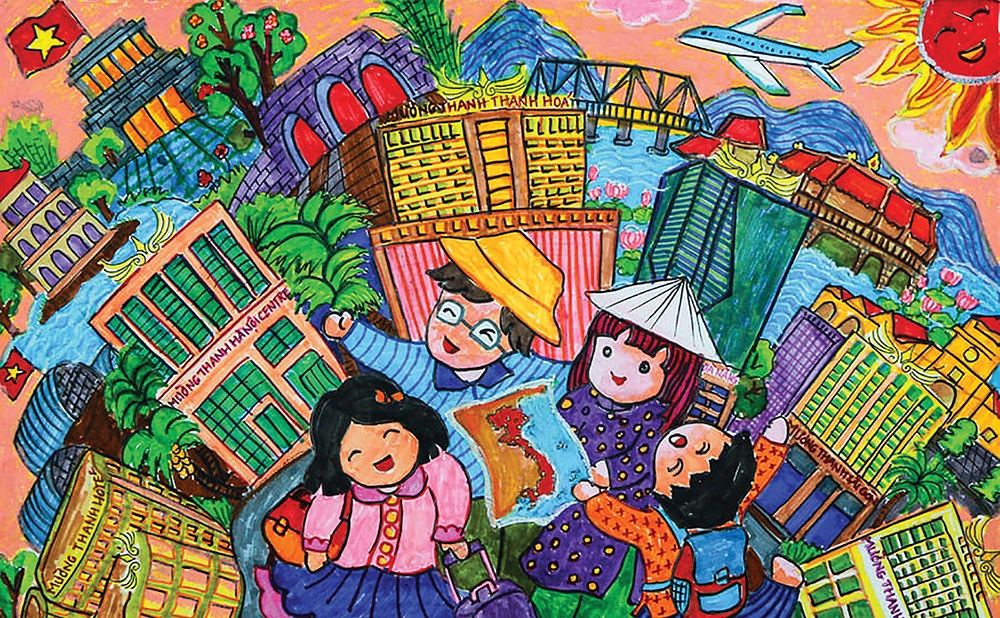
The first World Cultural Festival in Hanoi will take place from October 10-12, not only to honour the cultural beauty of Vietnam, but also to affirm the role and contribution of culture in achieving the sustainable development goals of the United Nations.
 |
| Cultural tourism as a full-fledged industry |
As of early October, 48 embassies, international organisations, and foreign cultural centres in Vietnam have registered to participate in the festival, including 45 national cultural spaces, 33 food stalls, 16 domestic and foreign art troupes, 12 units showcasing books, and 20 countries sending films to participate in the film screening programme.
Le Hai Binh, Deputy Minister of Culture, Sports and Tourism, said that the event is an important initiative to honour cultural values, connect countries and ethnic groups in the context of global challenges such as conflicts, pandemics, and climate change.
“The cultural values blend together without losing the identity of each nation, but also contribute to fostering the spirit of solidarity, and collectively contribute to global development,” Binh said.
In Vietnam, some products that creatively exploit cultural content have emerged, contributing to diversifying Vietnam’s tourism products.
According to statistics from the Ministry of Culture, Sports, and Tourism, Vietnam currently has about 40,000 inventoried historical sites. Of these, approximately 10,000 sites are classified at the provincial and city level, over 3,460 sites at the national level, 107 special national sites, and 164 national treasures.
There are also eight heritages recognised by UNESCO as World Cultural and Natural Heritage, and 14 heritages recognised by UNESCO as Intangible Cultural Heritage of Humanity.
In the UNESCO Memory of the World Programme, Vietnam has seven documentary heritages listed by UNESCO and nine world biosphere reserves. Many cultural heritages have become comprehensive cultural and tourism products, serving as the driving force and the target for the development of the key tourism economy.
Some localities in Vietnam have successfully developed unique cultural tourism products, becoming highlights that attract international visitors. In Hue, the imperial heritage system along with court music has been recognised by UNESCO, combined with the experience of wearing ao dai and enjoying imperial cuisine to create a distinctive mark.
Hoi An, with its ancient town, Japanese Bridge, and lantern festival on the Hoai River, has long been a symbol according to tourists. In the Central Highlands, the gong culture space and traditional festivals of indigenous ethnic groups have become attractive cultural products. Meanwhile, the Mekong Delta stands out with the floating market of Cai Rang, traditional music, and garden ecotourism.
In 2024, the Hanoi Department of Tourism announced 15 night tourism products, mostly based on strengths in culture and heritage. Among these, standout products include night tours of Hoa Lo Prison, the Imperial Citadel exploration tour, overnight experiences at the Temple of Literature, and light shows at Hoan Kiem Lake.
However, experts evaluate that the cultural tourism products with local identity, capable of positioning the destination brand in Vietnam, are not yet diverse enough.
According to Dr. Nguyen Anh Tuan, director of the Institute for Tourism Development Research, cultural tourism products in Vietnam are still lacking in creativity, and there is a lack of distinctive products among localities and regions.
“Many valuable cultural tourism resources have not been invested and exploited in line with their potential. Many cultural heritage sites have not been developed into tourism products,” Tuan said. “The development of cultural tourism lacks coherence and linkage in product development, as well as collaboration between localities in the exploitation of cultural resources, thus failing to create sustainable quality tourism products.”
A directive just over a year ago regarding the development of Vietnam’s cultural industries emphasised the importance of accelerating exploitation of technical achievements along with business skills, creativity, cultural capital, and intellectual property rights to create cultural and economically valuable products and services.
Vietnam strives for the cultural tourism sector to account for 15-20 per cent of total revenues of $40 billion from tourism by 2030.
Vu The Binh, chairman of the Vietnam Tourism Association, stated that the goal of the cultural industry is to find a market for products, and tourism will contribute to the consumption of cultural industry products.
“Tourism needs to collaborate with entertainment, software, and technology to create products that appeal to modern tourists, especially young tourists, with a particular focus on leveraging fashion and cuisine elements to create vibrant local products,” Binh said.
Cultural industrial products have been exploited and developed by many countries around the world to create competitive advantages, position national brands and strongly attract tourists.
With the strong spread of K-pop on an international scale, South Korea has developed many unique cultural discovery tours, attracting the interest of a large number of tourists. Singapore has also been very successful in its strategy to position itself as a leading cultural and artistic destination in the region.
Similarly, the tourism industry in Japan has also recorded an increase in visitors from exploiting products within the artistic ecosystem such as writing and publishing comics, and creating souvenirs from cultural works with an average revenue of around $2 billion.
And in Hong Kong, 85 per cent of the national income comes from entertainment services, television, and advertising revenues.
What the stars mean:
★ Poor ★ ★ Promising ★★★ Good ★★★★ Very good ★★★★★ Exceptional
 Tag:
Tag:Related Contents




Latest News



More News
- TAT signs tourism deals with Vietjet and four Vietnamese travel firms (June 17, 2026 | 16:07)
- Vietnam's regional aviation sector yet to take off (June 15, 2026 | 15:09)
- ATR sees strong potential for regional air connectivity in Vietnam (June 10, 2026 | 13:11)
- Vietjet's cabin crew: ambassadors of hospitality and pioneering spirit (June 01, 2026 | 10:38)
- TAT and Vietnam Airlines agree to boost travel links (May 29, 2026 | 12:24)
- CNN and Vietnam discuss deeper cooperation to promote national image (May 26, 2026 | 08:00)
- Rewiring tourism for the digital traveller era (May 14, 2026 | 09:00)
- Hoan Kiem Lake emerges as outdoor classroom for students (May 12, 2026 | 12:13)
- Vinpearl partners with three Indian travel firms (May 08, 2026 | 09:00)
- Sustainable tourism to shape Vietnam’s growth path (April 30, 2026 | 12:41)






 Mobile Version