
A cultural development pillar for the new period

The goal by 2030 is to make culture a truly solid spiritual foundation and an intrinsic strength. The aim is for cultural industries to contribute 7 per cent of GDP, to attract at least 50 million international tourists, and for high-performance sports to maintain a top three ranking in the SEA Games and top 20 in the ASIAD.
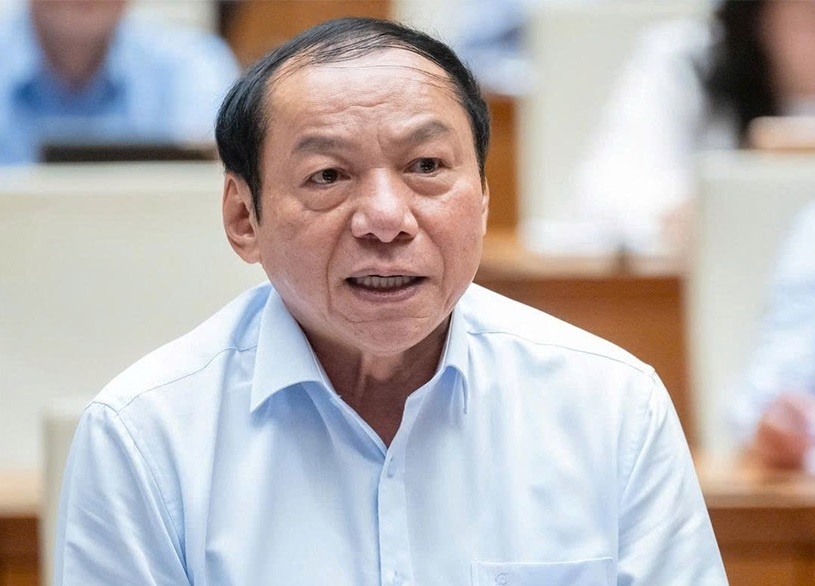 |
| Nguyen Van Hung, Minister of Culture, Sports, and Tourism |
To realise these goals, the Ministry of Culture, Sports, and Tourism (MoCST) and the entire sector must act and implement major reforms, continuing to vigorously deploy institutions, infrastructure, and human resources in culture, sports, and tourism within the context of a digital government, environment, economy, and society.
We must focus on effectively implementing the National Target Programme on Cultural Development pver the next decade, and continue to improve the legal system, including proposing amendments to the Tourism Law and the Law on Physical Education and Sports to suit new realities.
In terms of culture, the goal is to build a digital cultural environment, form a healthy cultural ecosystem, preserve heritage values linked to community livelihoods, and strive for all provincial-level administrative units to have all three basic cultural institutions. The strategy for developing the cultural industry will be implemented, bringing Vietnamese culture to the world through contemporary works of art.
Another goal is to redraw the tourism map of Vietnam, focusing on quality and economic efficiency, striving to become one of the top 30 countries in the world in terms of tourism competitiveness. This includes digital transformation and developing a smart tourism ecosystem.
In terms of sports, we need to prepare the best possible team for the 2026 Asian Games in Japan. We need to innovate our thinking about high-performance sports and invest strategically in Olympic sports.
The MoCST requests that ministries, sectors, and localities continue to cooperate and focus on implementing three major groups of issues.
Firstly, it is urgent to develop an action plan to implement the 14th National Party Congress’ Resolution on culture. The focus should be on creating a cultural space for development based on administrative boundaries and new development spaces. The diverse potential of each locality should be redefined to form axes of identity, ranging from urban and creative, indigenous and ethnic, historical and revolutionary, and maritime and ecological culture.
Second is a focus on removing policy impediments. In the coming period, the ministry will submit amendments to the Tourism Law, and at the same time develop the Performing Arts Law and the Cultural Industry Law.
Next, we must build an environment where culture truly permeates social life. Based on the national target programme, we must encourage decentralisation and delegation of power, selecting fundamental issues within the subprojects for priority investment.
The sector is facing new opportunities, while achievements in 2025 are vivid evidence of the unity and tireless efforts of the entire sector. Last year, the MoCST submitted for approval the National Target Programme on Cultural Development for 2025-2035, unlocking resources and creating the necessary infrastructure for sustainable cultural development.
In 2025, Vietnam received a series of good news from UNESCO when the Yen Tu-Vinh Nghiem-Con Son and Kiet Bac complex of historical sites and scenic spots were recognised as a world cultural heritage site. In particular, the Phong Nha-Ke Bang National Park and the Hin Nam No National Park became the first multinational natural heritage sites of Vietnam and Laos to be recognised by UNESCO. The total number of UNESCO-listed heritage sites in Vietnam reached 37, contributing to positioning the nation on the world cultural map.
The cultural industry has made significant strides. Vietnamese cinema in 2025 marked a special milestone with the film Mua Do (Red Rain), produced by the People’s Army Film Studio, achieving nearly $32 million in revenue, a record for a state-funded film. Large-scale Vietnamese music festivals, attracting as much as 80,000 attendees, not only showcase artists but also demonstrate the immense appeal and potential of the domestic entertainment market. The estimated average production value contributed by the cultural industries reached $42.36 billion.
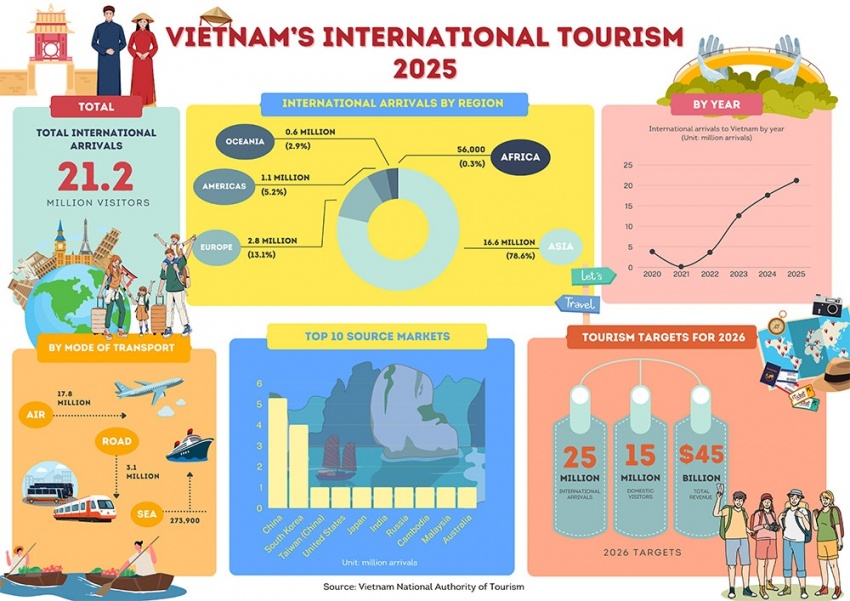 |
Following continuous efforts, Vietnam’s tourism industry has fully recovered and achieved impressive growth, further cementing its role as a key economic sector. In 2025, the tourism industry welcomed approximately 23 million international visitors and served up to 130 million domestic tourists, with total revenue reaching around $40-43 billion.
According to the UN Tourism, Vietnam was among the countries with the highest growth rate of international tourists in the world in 2025, with an increase of 21 per cent. Notably, Vietnam’s tourism competitiveness has increased by 28 ranks, placing it 59th out of 119 global economies. This result was achieved thanks to innovation in promotional methods and strong digital transformation.
On the cultural diplomacy front, Vietnam shone at the EXPO 2025 World Exhibition in Osaka, winning a silver award in the Exhibition Design category and a bronze award in the Best Team category. Vietnam’s initiative on the International Decade for Culture for Sustainable Development was also adopted by the UNESCO General Assembly, demonstrating its leading role in building a peaceful and prosperous future based on enhanced global cultural cooperation.
With renewed enthusiasm and determination, the culture, sports, and tourism sector is confident that it will excellently fulfill its mission, contributing to the nation’s steady progress into a new era of national development.
What the stars mean:
★ Poor ★ ★ Promising ★★★ Good ★★★★ Very good ★★★★★ Exceptional
 Tag:
Tag:Related Contents






Latest News


More News
- Russian and Indian tourists drive international arrivals (September 08, 2026 | 09:03)
- Beaches drive Vietnam’s domestic tourism boom (August 20, 2026 | 12:07)
- Spalba makes foray into Vietnamese market (August 20, 2026 | 09:41)
- CAAV signs deal with Turkey to strengthen aviation cooperation (August 10, 2026 | 15:15)
- Major Asian airlines survey Long Thanh International Airport (August 10, 2026 | 08:51)
- Vietnam ranks in top four Asian destinations for European tourists (August 07, 2026 | 08:00)
- Vietnam's commercial aircraft fleet expands to 251 planes (August 03, 2026 | 23:13)
- LOT Polish Airlines is set to launch Warsaw–Hanoi route (July 31, 2026 | 11:22)
- Vietnam tops Saudi tourists' summer holiday searches (July 30, 2026 | 12:41)
- Ninh Binh province steps up mission to acquire UNESCO landscape nomination (July 17, 2026 | 14:02)








 Mobile Version