
Over 100 businesses train on GHG inventory reporting

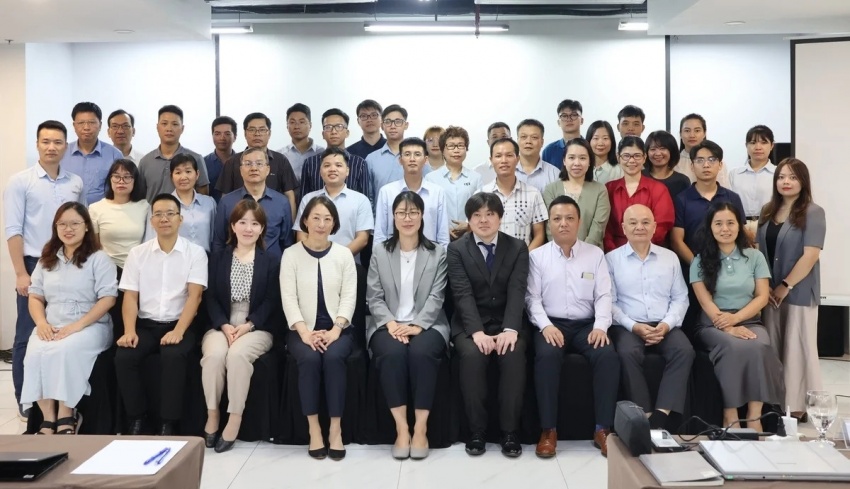 |
| Over 100 businesses trained on GHG inventory reporting work |
On June 29-30, the Department of Climate Change (DCC) under the Ministry of Agriculture and Environment organised the workshop entitled "Training on the facility-level GHG inventory reporting system and GHG emission mitigation for thermal power, cement and iron and steel sectors".
The workshop took place in the context of Vietnam highlighting the roadmap for building a carbon market, including completing the measurement-reporting-verification (MRV) system, allocating emission quotas, and establishing a carbon credit trading mechanism.
Dr Luong Quang Huy, head of the Greenhouse Gas Emissions Management and Ozone Layer Protection Division at the DCC said, “The goal of GHG inventory is to comply with regulations, and to help businesses clearly identify their “emission footprint” throughout the entire production chain, thereby building an emission reduction roadmap suitable to their actual conditions.”
“Although the legal framework and basic technical tools have been completed, the foundation of the emission quota and carbon credit trading system remains GHG inventory and emission reduction at each facility. The most important thing is to conduct accurate inventories, ensuring that emission figures accurately reflect reality,” Huy said.
Makiko Inamori, project formulation advisor, the Japan International Cooperation Agency (JICA), said, “Besides establishing a GHG reporting system and preparing for the Emission Trading System, Vietnam is also implementing a domestic carbon market. With these efforts, we recognise that the country is playing a leading role in carbon pricing in the ASEAN region.”
“Japan, with its extensive experience in managing facility-level reporting and implementing energy-saving measures for the thermal power, cement, and steel industries, is always ready to cooperate and share useful lessons with Vietnam. This will be a useful reference source, helping Vietnam transition to a low-carbon economy," he added.
The training session consisted of two parts. The first part focused on updating the core legal framework. The representatives of state management agencies presented a specialised topic on updated legal regulations.
Technical experts on GHG emission reduction planning from JICA shared international lessons learned on emission cataloguing. In addition, technical experts guided the process of developing and implementing grassroots-level GHG emission reduction plans, helping to transform raw data into mitigation solutions.
Vietnam's legal system is strictly implemented, including Article 91 of the 2020 Law on Environmental Protection, Decree No.06/2022/ND-CP, and Decree No.119/2025/ND-CP amending and supplementing regulations, creating a mandatory legal framework shifting from voluntary to strict compliance.
The second session focused on practical guidance on the GHG Inventory Reporting System at the grassroots level. JICA's technical expert on the online greenhouse gas inventory system introduced the interface and features of the online GHG inventory reporting system at the grassroots level.
This electronic system integrates calculation methods that have been validated by ministries and sectors, simplifying the calculation process for businesses. Through the practical session, delegates practised step-by-step, from accessing the system, entering specific industry-specific operational data, to generating reports and submitting trial applications.
Previously, the prime minister issued Decision No.263/QD-TTg approving the total greenhouse gas emission quota for the pilot phase during 2025–2026. The Ministry of Agriculture and Environment continued to issue Decision No.699/QD-BNNMT allocating quotas to 110 facilities in three major emitting sectors: thermal power, cement, and iron and steel.
According to the regulation, by 2025-2026, 110 facilities will participate, including 34 thermal power plants, 25 iron and steel production facilities, and 51 cement facilities.
 | Agricultural enterprises focus on emissions mitigation Many agricultural enterprises, especially food exporting and processing enterprises, are working to save energy, contributing to meeting the country’s greenhouse gas (GHG) emissions target. |
 | Training on GHG emissions for private cement companies 50 cement manufacturers joined a 2-day training course on greenhouse gas (GHG) emissions inventory and mitigation from December 14 to 15. |
 | Vietnam operates greenhouse gas reporting system online A reporting system for facilities to upload their greenhouse gas (GHG) emissions data online has been completed, and will be updated when the Ministry of Industry and Trade, the Ministry of Construction, and the Ministry of Transport issue detailed guidance for their respective areas, according to a recent consultation meeting. |
What the stars mean:
★ Poor ★ ★ Promising ★★★ Good ★★★★ Very good ★★★★★ Exceptional
 Tag:
Tag:Related Contents


Latest News



More News
- JBIC considers new financing options for Vietnam’s energy projects (October 03, 2026 | 08:00)
- Vestas to supply 16 turbines for two new Vietnam wind farms (October 01, 2026 | 07:00)
- Inter-sectoral cooperation on Montreal protocol (September 30, 2026 | 17:20)
- EV battery recycling rate proposed at 8 per cent from 2029 (September 29, 2026 | 16:00)
- Bankability remains hurdle for Vietnam's JETP projects (September 29, 2026 | 12:08)
- Binh Minh Plastics extends clean water project to border communities (September 29, 2026 | 10:57)
- Coca-Cola Vietnam expands packaging collection programme (September 25, 2026 | 08:15)
- Pacifico Energy secures sea survey licence for offshore wind project in Lam Dong (September 24, 2026 | 18:02)
- Vietnam secures $221 million in UN development programmes for 2027-2031 (September 23, 2026 | 17:39)
- Carlsberg Vietnam shows how resource efficiency can shape green industrial growth (September 18, 2026 | 09:03)


Latest News




 Mobile Version