
Advancing the circular economy: opportunities for Germany-Vietnam cooperation

Delivering opening remarks at the event, Andrea Sühl, German consul general in Ho Chi Minh City, highlighted the growing importance of Germany-Vietnam cooperation in fostering innovation, technology transfer, and sustainable production models.
"Vietnam is entering a new stage of development characterised by stronger economic growth and an increasingly important role in global manufacturing supply chains. Germany remains a long-standing partner of Vietnam, sharing a common commitment to sustainable development and long-term growth,” Sühl said.
She reaffirmed Germany’s commitment to supporting Vietnam’s green transition through technology transfer, the sharing of industrial expertise, and the promotion of long-term business partnerships.
Alexander Ziehe, chairman of the German Business Association in Vietnam, noted that Ho Chi Minh City was well positioned to integrate circular economy principles into its next phase of industrial development.
“Building sustainable supply chains, strengthening the capabilities of domestic suppliers, and accelerating technology transfer will enable Vietnamese enterprises to participate more deeply in global value chains,” Ziehe said.
He added that German companies were ready to support Vietnam not only as investors but also as long-term partners in industrial development, innovation, and sustainable growth.
Peter Kompalla, chief representative of AHK Vietnam, noted that for German businesses operating in Vietnam, the circular economy is no longer viewed solely as a sustainability initiative but has become a key component of competitiveness and market access strategies.
“New requirements relating to supply chain transparency, traceability, and digital product passports are increasingly becoming prerequisites for accessing international markets, particularly the European Union,” Kompalla said.
According to him, companies that embrace circular economy principles will be better positioned to meet evolving regulatory standards, strengthen their resilience, and enhance their competitiveness in global value chains.
One of the key topics raised include how Vietnamese enterprises can deepen their participation in global supply chains as environmental, social, and governance standard increasingly become mandatory across international markets.
According to Nguyen Trong Luat, vice chairman of the Ho Chi Minh City Association of Supporting Industries, businesses are facing mounting pressure not only to enhance their technological capabilities but also to comply with emerging requirements related to carbon emissions, supply chain traceability, and transparency.
“In this context, the biggest gap for many Vietnamese enterprises lies in management capacity, technical human resources, and their ability to connect with overseas funding,” Luat said. “Technology transfer, skills development, and the establishment of stronger supplier linkage mechanisms will be critical to helping domestic companies upgrade their competitiveness and meet the increasingly stringent requirements of global markets.”
Meanwhile, Erick Contreras, managing director of BASF Vietnam, cited that the circular economy was emerging as a new growth driver for the manufacturing sector.
“As companies face increasing pressure related to raw materials, energy consumption, emissions, and compliance with international standards, circular business models can transform these challenges into opportunities to improve resource efficiency, foster innovation, and create new sources of value,” Contreras said.
Beyond the circular economy, digital transformation and automation are also being recognised as critical enablers of sustainable manufacturing, helping businesses enhance productivity, optimise resource use, and accelerate their transition towards more resilient and environmentally responsible operations.
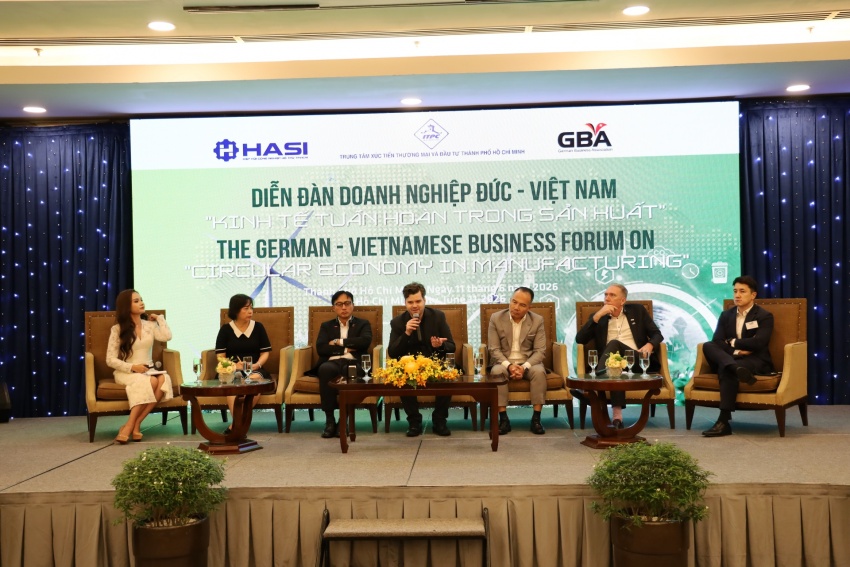 |
| The Germany-Vietnam Business Forum 2026 in Ho Chi Minh City on June 11 |
 | DPM Nguyen Chi Dung meets Vietnamese experts in Germany to boost innovation ties Deputy Prime Minister Nguyen Chi Dung has met with Vietnamese experts and intellectuals based in Germany and across Europe to discuss cooperation in key technology and economic sectors. |
 | NIC partners with TU Berlin to boost Vietnam innovation ties The National Innovation Centre has partnered with a leading technical university in Berlin to strengthen innovation and startup linkages between Vietnam and Germany. |
 | Smart factories or bust: decision time in 2026 In many Vietnamese factories, transformation does not begin with a robot arm or a fully automated line but starts with the simple realisation that the old model no longer scales. |
What the stars mean:
★ Poor ★ ★ Promising ★★★ Good ★★★★ Very good ★★★★★ Exceptional
 Tag:
Tag:Related Contents

Latest News


More News
- JBIC considers new financing options for Vietnam’s energy projects (October 03, 2026 | 08:00)
- Vestas to supply 16 turbines for two new Vietnam wind farms (October 01, 2026 | 07:00)
- Inter-sectoral cooperation on Montreal protocol (September 30, 2026 | 17:20)
- EV battery recycling rate proposed at 8 per cent from 2029 (September 29, 2026 | 16:00)
- Bankability remains hurdle for Vietnam's JETP projects (September 29, 2026 | 12:08)
- Binh Minh Plastics extends clean water project to border communities (September 29, 2026 | 10:57)
- Coca-Cola Vietnam expands packaging collection programme (September 25, 2026 | 08:15)
- Pacifico Energy secures sea survey licence for offshore wind project in Lam Dong (September 24, 2026 | 18:02)
- Vietnam secures $221 million in UN development programmes for 2027-2031 (September 23, 2026 | 17:39)
- Carlsberg Vietnam shows how resource efficiency can shape green industrial growth (September 18, 2026 | 09:03)


Latest News




 Mobile Version