

Leading in AI: from pilot initiatives to enterprise value

PwC’s 29th Global CEO Survey underscores this disconnect: more than half of CEOs report that their organisations have yet to realise either meaningful revenue growth or cost reduction from AI in the past year. This is not due to a lack of activity. On the contrary, most organisations are actively experimenting, running pilots and deploying new tools.
 |
| Mai Viet Hung Tran, general director, PwC Vietnam |
As AI reshapes business, PwC is exploring the leadership priorities that increasingly define success, from enterprise transformation and workforce readiness to governance, trust, and data foundations. The starting point is perhaps the most fundamental: turning AI pilots into measurable enterprise value.
Why many AI programmes stall at pilot stage
The explanation lies in the way AI is currently being approached. Across many organisations, AI adoption remains fragmented, with individual use cases developed in isolation from core business priorities. These efforts often deliver incremental gains, efficiency improvements and faster processing, but rarely scale to transform how the business operates.
At the same time, the market is beginning to draw a sharper distinction between those who are succeeding and those who are not. PwC’s 2026 AI Performance Study finds that approximately 20 per cent of organisations are capturing nearly 74 per cent of AI-driven value, creating a widening gap between a small group of leaders and a much larger group that remains stuck in experimentation mode.
This divergence reflects not a technology gap, but an execution gap. For those that can scale AI effectively, the difference is substantial: our research shows that the most “AI‑fit” companies deliver AI‑driven financial performance more than seven times higher than their peers, underlining how quickly advantage can compound once AI is embedded across the business.
Many organisations have essentially optimised for experimentation rather than transformation. As a result, AI remains adjacent to the business, rather than integral to it. The challenge is therefore one of integration.
From experimentation to reinvention
By contrast, organisations that are realising meaningful returns from AI are shifting from incremental improvement to business reinvention. They are not treating AI as a set of tools layered onto existing processes, but as a catalyst for rethinking how those processes should work in the first place.
Our research highlights this distinction clearly. Leading organisations are significantly more likely to use AI to drive growth, redesign workflows and pursue new revenue opportunities, rather than focusing solely on productivity gains. This is consistent with PwC’s broader concept of the “AI-native enterprise”, in which AI becomes part of core operations rather than a collection of standalone initiatives.
The implications are profound. When AI is embedded in this way, it does not merely accelerate existing processes; it reshapes them. It changes how decisions are made, how customers are served, and how organisations compete. It also creates the conditions for sustained advantage, rather than one-off gains.
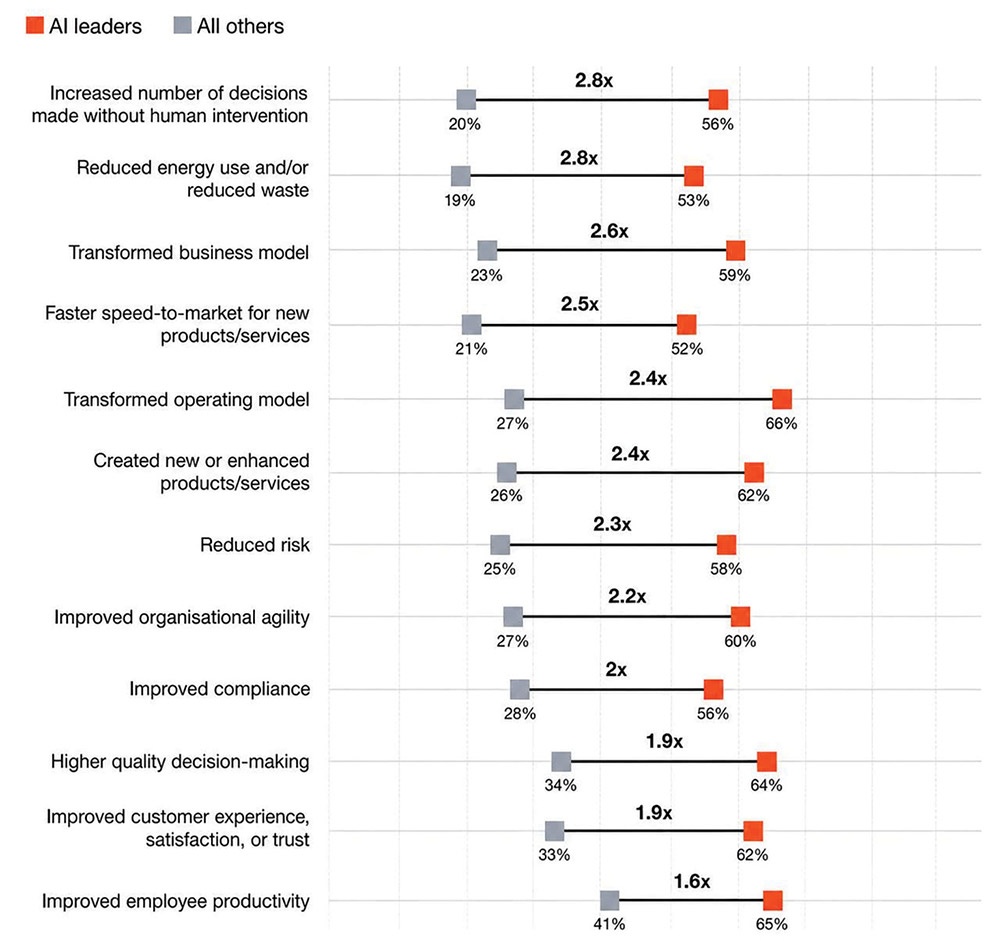 |
| For the AI-driven performance leaders, AI improves a wide range of factors that drive superior financial results Q. To what extent has your company’s full AI portfolio improved the following outcomes? Showing only “To a very large extent” and “To a large extent” responses. Source: PwC’s AI performance study |
What Vietnamese businesses must do next
For Vietnam, the opportunity is immense. Encouragingly, leaders in Vietnam are already demonstrating a strong understanding of AI’s role in shaping business outcomes, particularly in areas such as growth, customer experience and operational efficiency. The next phase of the journey must therefore shift from exploration to execution. This transition cannot be delivered through technology alone. Enterprise-wide value requires reliable data, clear governance and a deliberate effort to build AI fluency across the workforce.
Data needs to be viewed as a strategic asset rather than a technical input. Scaling AI depends not only on the volume of data available, but on how consistently it is structured, shared and used across the organisation. As AI moves closer to decision-making, the ability to connect data across functions becomes a defining advantage.
Governance is evolving from a compliance requirement into an enabler of scale. As AI becomes embedded in business processes, organisations that establish clear ownership, decision frameworks and risk boundaries early can move faster with greater confidence. In this context, governance supports progress rather than slowing it down.
Equally important is how work itself is changing. Organisations that are seeing sustained impact are not simply introducing new tools but embedding AI into everyday workflows and decision-making. This requires moving beyond pockets of expertise and ensuring that teams across the business can use AI effectively and consistently as part of their roles.
AI will not transform organisations simply because they adopt it. It will transform those that embed it at the core of how they operate and compete. For Vietnamese businesses, in this next phase, success will depend not just on how quickly organisations adopt AI, but on how effectively they build the foundations that allow it to scale with trust and consistency. In the end, AI is an enterprise transformation and leadership story. And those who treat it as such will define the next era of growth.
What the stars mean:
★ Poor ★ ★ Promising ★★★ Good ★★★★ Very good ★★★★★ Exceptional
 Tag:
Tag:Related Contents




Latest News


More News
- Programme launched to develop new Vietnamese business leaders (July 28, 2026 | 13:50)
- Family businesses face succession hurdles (June 30, 2026 | 17:05)
- Global shocks and tightening cash for Vietnamese business (June 22, 2026 | 06:00)
- Data and governance key hurdles to AI scaling for Vietnamese firms (June 17, 2026 | 16:55)
- Vietnam second fastest growing automotive market in ASEAN‑6 (April 20, 2026 | 20:34)
- Vietnam’s green push requires further hurdles to clear (March 30, 2026 | 08:00)
- The use of artificial intelligence to advance ESG goals for businesses (March 06, 2026 | 11:50)
- Vietnam a strategic growth engine for Asia-Pacific: CEO survey (March 05, 2026 | 17:12)
- PwC launches global workforce survey (February 09, 2026 | 17:42)
- Delivering urban railways and transit-oriented development (January 26, 2026 | 10:25)


Latest News







 Mobile Version