

AI-ready workforce key to Vietnam's next decade, analysts say

AI is reshaping industries from banking to manufacturing, making workforce adaptability a critical factor in Vietnam’s competitiveness. The country needs to foster cross-functional skills and career mobility, as human capital is becoming as important to foreign investors as infrastructure, energy supply, and tax incentives. Without an adaptable workforce, investment quality will ultimately be constrained.
 |
| (L-R) Prof. Dr. Andreas Stoffers, FOM University of Applied Sciences and Quynh Nguyen, consultant, Hoa Sen University |
The classic career ladder once assumed stable, promotion-based career advancement as well as increases in salary and status. However, the emergence of AI as a general-purpose technology is fundamentally altering the above calculus.
AI is beginning to flatten organisational hierarchies and make domain-specific expertise susceptible to being displaced by technology. AI doesn’t simply destroy jobs. Rather, it breaks with cherished routines. At the same time, those who combine sound judgement and adaptability will come out on top.
According to the World Economic Forum's Future of Jobs Report 2025, 92 million jobs will be displaced globally by 2030, while 170 million new jobs will be created, resulting in a net gain of 78 million jobs. Additionally, job disruption will equate to 22 per cent of jobs by 2030.
Like other countries around the world, Vietnam’s labour force is also impacted by these pressures. However, the country’s current talent development system continues to focus on vertical career advancement within a static organisational structure.
The issue of human resources is now at the heart of Vietnam’s next phase of development. The next stage must now also reform the skills architecture. Vietnam’s industrialisation target for 2045 requires a workforce that is practice-oriented, adaptable and digitally competent, and able to work across traditional functional boundaries.
An alternative to traditional vertical career advancement is lateral career movement, where professionals intentionally move across functions, industries or organisations to build what we call 'career resilience'. Unlike job hopping, these moves are strategic and help individuals develop diverse skills that span traditional boundaries.
For example, a financial analyst moving into fintech gains expertise in finance, technology and organisational dynamics. Such cross-functional capabilities make professionals more adaptable and resilient, enabling them to continue creating value even as AI automates specific roles.
Vietnam has structural strengths that position it as particularly well-suited to lead in this change. According to projections by the National Statistics Office, the working-age population will increase steadily from 65.4 million in 2024 to 69.5 million in 2038.
Vietnam has been remarkably successful in attracting foreign direct investment, with the quality of growth having improved significantly in recent times compared to mere quantity.
In the next phase, however, the focus will be on further increasing the domestic value added of these projects. This requires engineers, technicians, finance specialists, logistics managers and middle managers who can work across traditional functional boundaries.
However, Vietnam’s talent ecosystem still largely prepares students and employees for vertical career progression. University degree programmes are generally designed to prepare students for specialisation in a particular field. This mismatch between potential opportunities and current practice poses a strategic risk. As AI accelerates globally, countries that successfully transform their talent ecosystems into ones capable of facilitating lateral career movement will be rewarded disproportionately.
For all investors, this has a direct impact on project implementation, productivity, localisation rates, technology transfer and the ability of Vietnamese companies to move up the value chain. The creation of horizontal talent architecture requires systemic changes in four main areas.
Firstly, universities and vocational schools must equip graduates with systems thinking, technological literacy, and collaborative problem-solving skills to thrive amid constant technological change. Businesses, especially in export and technology sectors, should therefore play a direct role in shaping curricula and training standards.
Secondly, corporate need to facilitate lateral career paths by implementing organisational structures that allow professionals to follow their interests without harming career prospects. Companies must also be willing to invest in programmes that enable employees to gain new sets of skills that will help the company stay ahead of rapidly changing technological trends
Thirdly, Vietnam’s reform agenda lays a solid foundation for this transformation. The challenge now is to translate reform momentum into effective policies and implementation, recognising talent development as a national competitiveness strategy rather than solely an education issue.
Lastly, some Vietnamese companies are already promoting lateral career development, particularly in the financial sector. The future belongs to professionals with cross-functional skills who can combine expertise in business, technology and regulation. In an AI-driven economy, employees who can adapt across roles and disciplines will be far more resilient than narrowly focused specialists.
Implementation will require coordination between government, companies, universities, vocational schools and professional associations.
Vietnam could consider crating a national talent architecture taskforce made up of government, educational, and professional association representatives, which would provide the leadership needed to establish competency standards and design career paths consistent with Vietnam’s economic growth objectives.
In addition, corporations must be organised around managing talent. This will require transforming the traditional hierarchical systems for paying compensation. Corporations need to transform into competency-based systems of compensation that pay individuals as they grow in competency – not in position.
With its demographic advantage, growing economy and increasing opportunities for foreign investment, Vietnam is in a unique position to develop a cross-sector, lateral career structure. The next wave of competitiveness will be shaped by people who can move between disciplines, technologies, and sectors without losing their professional identity.
For anyone keeping a close eye on Vietnam’s economic development, particularly investors, the message is clear: Vietnam’s next competitive advantage will be the ability to build a workforce that can learn, develop, and create added value across all sectors in an AI-driven economy.
 | Highly skilled workforce and fiscal incentives key to driving high-tech growth As Vietnam seeks to move up global value chains, workforce quality is becoming a key competitive advantage. Assoc. Prof. Nguyen Dinh Tho examines how fiscal policy can help build a skilled workforce to support the country's high-tech ambitions. |
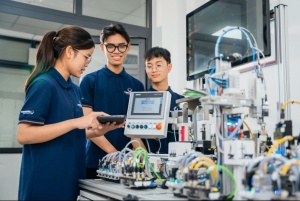 | Vietnam’s workforce ready for AI era As Vietnam’s workforce becomes increasingly AI-ready, businesses need to accelerate their transformation to remain competitive. |
What the stars mean:
★ Poor ★ ★ Promising ★★★ Good ★★★★ Very good ★★★★★ Exceptional
 Tag:
Tag:Related Contents


Latest News




More News
- Significant steps made in related-party transactions (August 21, 2026 | 15:51)
- New challenges for workforce data and HR policy management with PIT changes (August 17, 2026 | 10:32)
- Leading in AI: from pilot initiatives to enterprise value (August 10, 2026 | 07:00)
- Programme launched to develop new Vietnamese business leaders (July 28, 2026 | 13:50)
- Vietnam must build talent and innovation to attract quality investment (July 09, 2026 | 08:00)
- VIFC shouldn't try to be Dubai, says VinaCapital chief economist (June 24, 2026 | 14:17)
- Highly skilled workforce and fiscal incentives key to driving high-tech growth (June 17, 2026 | 16:17)
- KPMG and Anthropic to redefine client services with artificial intelligence tie-up (May 25, 2026 | 08:00)
- FDI a crucial component to double-digit growth (May 15, 2026 | 11:38)
- Practical issues to be addressed for TV and radio regulations (May 12, 2026 | 14:48)


Latest News




 Mobile Version