

Vietnam’s business aviation growth fuels rising demand for MRO support

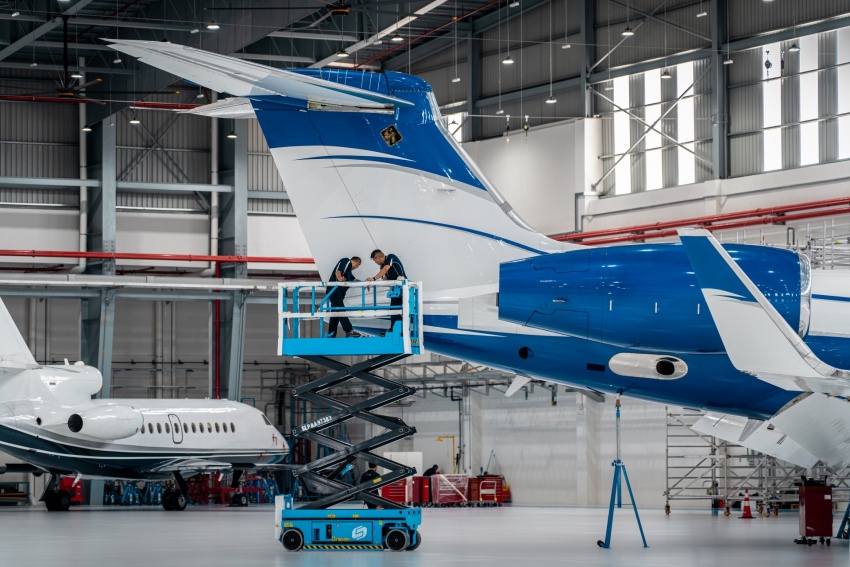 |
| Technicians working on an aircraft at ExecuJet MRO Services Malaysia |
According to Asian Sky Group, the number of business jets based in Vietnam rose by 67 per cent last year, from nine to 15 aircraft. A decade ago, the country had virtually no business jets.
“Vietnam is an important and fast-growing market for business aviation in Southeast Asia,” said Ivan Lim, regional vice president Asia at ExecuJet MRO Services. “The growth is supported by strong economic expansion and increasing outbound business activity as Vietnamese companies expand domestically and internationally.”
The country’s economic trajectory has played a central role. With GDP growth reaching around 8 per cent last year, alongside Vietnam’s rise as a regional hub for manufacturing and IT, demand for more efficient and flexible travel solutions is increasing. At the same time, the number of high-net-worth individuals continues to grow, further underpinning demand for private aviation.
“Business jets are increasingly viewed as productivity tools rather than luxury assets,” Lim said. “They enable secure, flexible and time-efficient travel, which is critical for executives operating across multiple markets.”
Vietnam’s business jet fleet stands out for its composition. Nearly all aircraft, except two, are large-cabin, ultra-long-range models designed for intercontinental travel. This differs from more mature markets, where fleets typically include a mix of light, mid-size and large jets. In Vietnam, the dominance of long-range aircraft reflects demand for direct connections to Europe and North America.
“Eighty-seven per cent of the fleet consists of large-cabin, ultra-long-range aircraft,” he added. “This suggests that operators are primarily using these jets for long-haul international missions.”
The structure of the fleet has direct implications for MRO demand. Larger aircraft require more complex maintenance, but the relatively small fleet size limits the feasibility of building full-scale domestic capabilities.
“With just 15 aircraft across different types, the fleet is still relatively small to justify heavy maintenance facilities in-country,” Lim explained. “Heavy checks typically occur once every eight to ten years, and MRO providers need consistent volume to sustain investment in tooling, certifications and workforce training.”
As a result, heavy maintenance for business jets in Southeast Asia remains concentrated in a few established hubs.
Against this backdrop, Vietnam continues to rely on regional MRO centres, particularly in Malaysia and Singapore. In late April, the Civil Aviation Authority of Vietnam certified ExecuJet MRO Services Malaysia to perform line and base maintenance on Vietnam-registered Gulfstream G650ER aircraft.
The approval allows the company to carry out maintenance checks up to 4C or 48-month inspections, as well as engine maintenance for the Rolls-Royce BR725 engines that power the aircraft. “This certification enhances our capability to support Gulfstream G650ER operators in Vietnam with high-quality, reliable maintenance services,” Lim said.
Beyond regulatory approval, proximity plays a practical role. Malaysia’s geographic closeness to Vietnam reduces ferry flight time and associated costs for operators. “Operators will see significant savings from not having to reposition aircraft outside the region,” he said. “At the same time, they benefit from greater flexibility in slot availability and turnaround times.”
ExecuJet’s facility in Malaysia, spanning nearly 150,000 square feet, can accommodate up to 15 aircraft simultaneously and is certified by 17 aviation authorities globally. The company also offers integrated services beyond standard maintenance. “Customers often require more than just airframe checks,” he added. “We provide a one-stop solution, including engine changes, cabin refurbishments, avionics upgrades and connectivity installations.”
While regional reliance is expected to continue in the near term, Vietnam’s rapid growth is beginning to create conditions for future domestic MRO development. “The MRO business is fundamentally driven by volume,” Lim said. “To justify investment in infrastructure and training, a country needs a sufficiently large and active fleet.”
Currently, Vietnam ranks sixth in Southeast Asia by fleet size, behind Singapore, Indonesia, the Philippines, Thailand and Malaysia. However, the trajectory points upward. As the fleet expands, so too will demand for maintenance services. “As the number of aircraft grows, we can reasonably expect MRO demand to increase in tandem,” Lim said. “That will gradually open up opportunities for more capabilities to be developed in-country.”
Beyond international travel, business aviation could also play a larger role within Vietnam itself. A study by Transport Engineering Design Inc. found that 90 per cent of domestic air traffic is concentrated at just 10 out of the country’s 22 airports, leaving many regional airports underutilised.
“Business aircraft are well-suited to serving these underutilised routes,” he said. “They offer flexibility that commercial aviation cannot always provide.” This suggests that future growth in business aviation, and by extension MRO demand, may not be limited to international routes, but could increasingly extend to domestic connectivity.
 | Vietjet signs agreement for finance lease of 10 COMAC aircraft Vietjet and SPDB Financial Leasing, a subsidiary of Shanghai Pudong Development Bank, have agreed on a finance lease of 10 COMAC C909 aircraft, expanding financial and aviation cooperation between Vietnam and China. |
 | EU to Vietnam flights face mounting pressure as jet fuel supply tightens Airlines across Europe and Vietnam are scaling back flights amid a tightening jet fuel supply, driven by ongoing disruptions in the Middle East. |
 | Vietnam’s aviation authority pushes shift to greener operations The Civil Aviation Authority of Vietnam has instructed aviation stakeholders to study alternative fuels and gradually deploy sustainable aviation fuel, aiming to reduce greenhouse gas emissions and accelerate the sector’s energy transition. |
What the stars mean:
★ Poor ★ ★ Promising ★★★ Good ★★★★ Very good ★★★★★ Exceptional
 Tag:
Tag:Related Contents






Latest News





More News
- Expanding education partnerships to drive mutual growth (October 06, 2026 | 16:04)
- VTG 2026 to showcase textile and footwear innovation in Ho Chi Minh City (October 06, 2026 | 16:00)
- Infineon boosts Vietnam footprint with Ho Chi Minh City office (October 06, 2026 | 10:02)
- Vietnam Customs expands priority enterprise scheme to 74 firms (October 03, 2026 | 08:00)
- ASL Law opens Danang office (October 02, 2026 | 22:12)
- Project ACTIVE 2.0 launches in Vietnam to boost cervical cancer care (October 02, 2026 | 22:02)
- Vietnam launches first embodied AI conference to advance robotics ecosystem (October 02, 2026 | 17:00)
- DKSH Performance Materials – A trusted partner in Vietnam’s evolving personal care landscape (October 02, 2026 | 14:28)
- Ghanaian delegation reviews PSL Machinery’s cashew factory-management and implementation roadmap (October 02, 2026 | 10:18)
- People living with chronic kidney disease and diabetes should be aware of infectious disease risks (September 30, 2026 | 18:00)


Latest News





 Mobile Version