


Region boasts major potential for aviation-related businesses

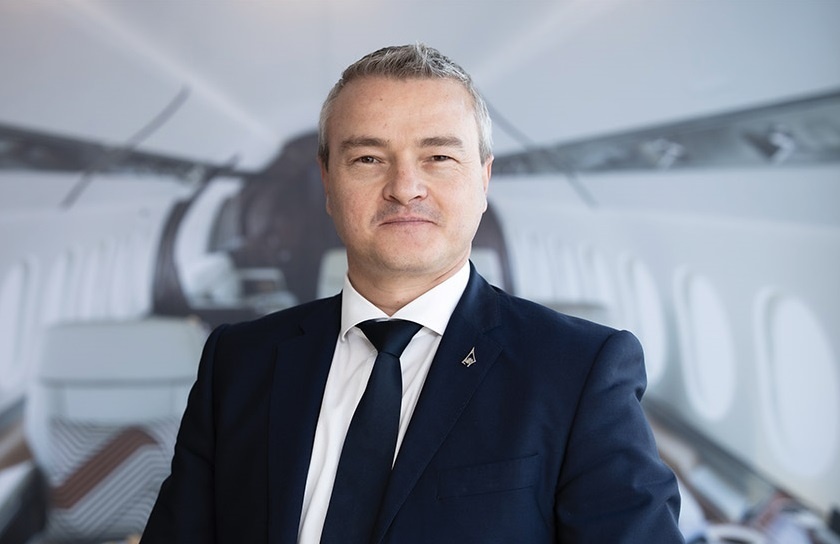 |
| Didier Raynard, senior vice president of sales for Asia-Pacific at Dassault Aviation |
What are the most outstanding advantages of the Falcon 10X compared to other aircraft in the same segment, and the challenges it may face to compete?
The 10X is our future Falcon. What we are doing with the 10X is positioning ourselves in the ultra-long-range segment of business aviation. It’s an aircraft that will propose a 7,500 nautical mile range, able to fly from Southeast Asia to Europe non-stop or the US West Coast. This is a segment where we are not there yet.
Dassault Aviation is one of the oldest family-owned companies in business aviation, over 100 years old, and we’ve been in this business for over 60 years. Today we have several aircraft in our family: the Falcon 2000, the 6X, and 8X. The 10X will allow us to be in this segment which is very important for us, especially in Southeast Asia due to the distances you need to achieve to reach Europe, Africa, or the United States.
What we are proposing with the 10X is something very different. We are proposing the biggest cabin in that segment. That’s extremely important because you are supposed to fly long hours, so you need the most comfortable cabin. We are proposing something very different compared to what already exists.
We have the most advanced entertainment system, and the cabin is flexible; you can have up to four different lounges, as well as a crew rest compartment to accommodate a bigger crew for long hours of flight.
Do you think Asia-Pacific is a good market for Falcons?
Of course. We have around 100 aircraft in all of Asia-Pacific. We see very strong demand from our clients and we see as well growth from other segments, what we call “concept buyers.” We see new buyers coming into business aviation, so the market is growing in all of Asia-Pacific.
Also, we have the existing clientele that are sometimes upgrading to a bigger aircraft, a longer-range aircraft, or a newer aircraft. But we also see newcomers, concept buyers, that didn’t have any aircraft and come into business aviation to develop their business.
How much is the market share of Dassault aircraft in the region compared to other brands like from the United States or Canada?
The biggest market is in the US. But here in Asia-Pacific, without going into too much detail, we have aircraft in almost all countries in Southeast Asia. We have been able to sell aircraft in Australia, the Pacific, North Asia, among others. What is important for us is to really develop the market, get a share of the growth, and be able to support our clients and our aircraft.
A big part of our business is not only to develop the sales, but also to support our clients. Dassault Aviation has invested a lot in customer service in Asia-Pacific with the acquisition of ExecuJet MRO in 2019, and we have developed the team of technicians to support our aircraft. That’s a crucial part of our business and a commitment from us to support our clients.
Who are these prospective clients and what types of companies or families are they?
There is no minimum, but what is important for a business jet owner is to participate in the growth of their own business. In Asia, it’s very often a mix between professional and family usage. At the end of the day, a business jet is a business tool in order to save time, to be more efficient, and to develop the business internationally.
If you want a profile of a business jet owner, it’s a company or an individual who has to travel for their own business, and the jet is a tool to optimise their time, going to different places in a day whereas commercial aviation would not allow that.
We see younger buyers, especially in Asia, where the next generation is taking over the business. In Asia, there are a lot of big family groups in all countries. We see that the new generation, the children or nephews part of the business, are involved. They see things a bit differently with technology and their exposure in terms of education.
It adds excellent points to develop our business because this new generation wants to grow the business internationally. They need to travel. Even if you have technology to do meetings through different means, meeting people face-to-face is still significant in business.
How do you see the growth of the business aviation market in Asia-Pacific over the next decade?
If you look at perspectives from aviation consultancy companies, they see Asia as having big opportunities. Strong economic growth in most of the countries is helping a lot. What is important as well for our business is to probably have better infrastructure.
We see that in different countries in Southeast Asia, for instance, in Vietnam, the development of new airports in two major cities. We need more modern infrastructure and more airports.
To strengthen the market in Southeast Asia, what is important is to have personal relationships with our owners. That’s number one. It takes time to build the relationship. That’s why we have been in Asia for more than 25 years now. We have very low turnover in our staff and excellent loyalty. Beyond that, it is vital to be able to support our clients with the best organisation. We have invested a lot in maintenance, repair, and overhaul facilities. We have a superb network of facilities across Asia-Pacific to be able to help our clients wherever they are based.
What the stars mean:
★ Poor ★ ★ Promising ★★★ Good ★★★★ Very good ★★★★★ Exceptional
 Tag:
Tag:Related Contents



Latest News




More News
- Sojitz in Vietnam: 40 years from individual projects to a business cluster 'KATAMARI' (October 08, 2026 | 09:00)
- Coteccons targets 'Quality Growth' with 25 per cent dividend plan (October 07, 2026 | 13:00)
- Vietnam Education Forum opens UK Education Mission's Hanoi visit (October 07, 2026 | 12:27)
- Tax authorities deactivate TINs of nearly 180,000 businesses (October 07, 2026 | 12:08)
- World Bank raises Vietnam's 2026 GDP growth forecast to 7.4 per cent (October 07, 2026 | 11:41)
- Vietstock 2026 to spotlight livestock innovation and green transition (October 07, 2026 | 09:00)
- Vietnam’s GDP grows over 9 per cent in first nine months (October 05, 2026 | 18:45)
- Vietnam earns $56.3 billion from agro-forestry-fishery exports (October 05, 2026 | 18:32)
- DSV balances resilience and decarbonisation in supply chains (October 05, 2026 | 18:20)
- Electronics exports reach $175.4 billion in the first nine months (October 05, 2026 | 18:12)


Latest News




 Mobile Version