

Vietnam strengthens foundations for balanced long-term growth

According to Can Van Luc, chief economist at state lender BIDV and director of BIDV Training and Research Institute, bank credit is expected to remain the most important funding channel for the economy in 2026, accounting for around 53 per cent of total investment capital sources recorded in 2025.
“This shows that the banking system remains the main ‘bloodstream’ of the economy, especially as the capital market has yet to develop proportionately,” Luc said.
To ensure system safety and maintain macroeconomic stability, the State Bank of Vietnam has set a 2026 credit growth target of 15 per cent, relatively lower than the 19.07 per cent increase recorded in 2025.
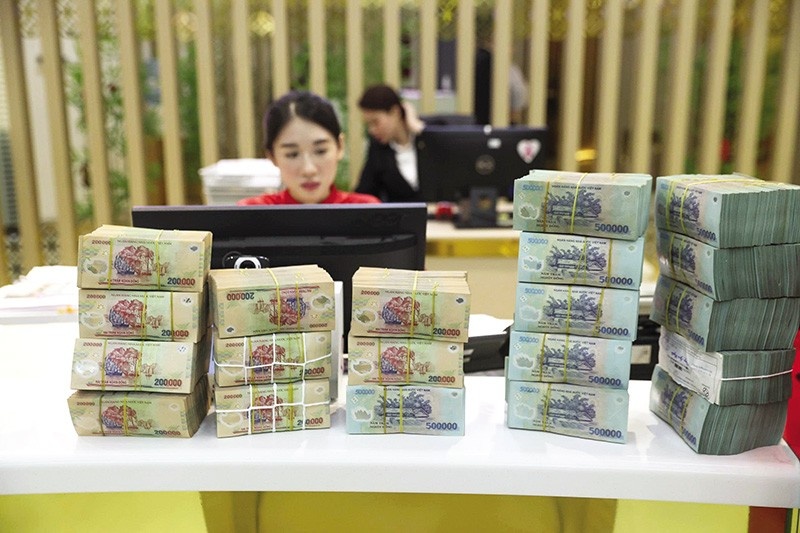 |
| Credit will continue to be prioritised for production and business activities, growth drivers and key projects |
Credit will continue to be prioritised for production and business activities, growth drivers and key projects, while capital flows into high-risk and speculative sectors will remain under strict control.
The message clearly reflects one reality: banks remain the dominant funding channel, but they can no longer continue bearing the entire burden of economic growth.
Meanwhile, the real estate sector continues to maintain enormous capital demand as multiple large-scale projects are implemented simultaneously.
According to Dr Luc, this will remain a major source of pressure on the banking system’s capital balance.
While credit demand remains high, funding sources for the banking system are no longer as abundant as before. Liquidity pressure is expected to persist throughout 2026, extending from the tight conditions seen in 2025.
One of the reasons behind liquidity pressure, according to Luc, is the relatively slow growth of capital mobilisation.
“The cash holding ratio increased in 2025, partly because household businesses expanded cash transactions during the initial phase of implementing new mechanisms related to invoices, documentation and VAT. This caused cash flows to return to the banking system more slowly,” he said.
In addition, foreign investors have also tended to withdraw capital from Asian stock markets, including Vietnam. In 2025, foreign investors posted net sales of $5.2 billion on Vietnam’s stock market and continued net selling of another $1.2 billion in the first quarter of 2026.
“Moreover, credit institutions proactively repurchased bonds ahead of maturity and reduced new issuance amid a rising interest rate environment. Meanwhile, other investment channels such as gold, silver, foreign currencies, stocks, real estate and digital assets have become more attractive than deposit interest rates, drawing money away from the banking system,” Luc said.
Speaking to VIR, senior economist Le Xuan Nghia said preliminary analysis showed that in just the first two months of 2026, the number of deposits withdrawn by residents from the banking system was equivalent to the total figure for the whole of 2025.
“Low interest rates may help businesses breathe more easily in the short term, but if the banking system’s funding base becomes increasingly strained, maintaining ‘cheap money’ for a prolonged period will place enormous pressure on financial stability and system safety. In other words, monetary policy can support growth, but it cannot replace more fundamental solutions,” he said.
According to Nguyen Ba Hung, senior country economist at ADB in Vietnam, the economy currently relies on two major credit supply channels: banks and bonds.
“However, each channel has very different advantages and if their functions are not allocated appropriately, excessive pressure will be placed on the banking system,” Hung said.
In principle, Hung explained, short- and medium-term credit should flow through banks, while long-term credit should be mobilised through the bond market. In reality, however, Vietnam has deviated from this principle.
“Long-term capital still mainly flows through the banking system, while the bond channel accounts for only a small proportion. More notably, more than half of the bonds currently on the market are issued by banks themselves. This means direct capital flows from bond investors into production and business enterprises remain very limited,” Hung said.
Dinh Duc Quang, head of Global Markets at UOB Vietnam, said that besides traditional channels such as foreign direct investment and portfolio investment, there is another highly important but often overlooked source of capital: cross-border funding through international financial institutions operating in Vietnam.
“Similarly, the corporate bond market also represents a potential space for connecting domestic enterprises with international capital flows,” Quang said. However, according to Quang, what foreign investors are currently most concerned about is the market’s credit risk assessment infrastructure, pricing mechanisms and benchmark yield curve system.
In his view, that is precisely the foundation for foreign investors to build risk assessment models, price assets and establish confidence when participating in Vietnam’s corporate bond market.
“If regulators such as the Ministry of Finance and the State Bank of Vietnam coordinate with market participants to improve pricing infrastructure and develop benchmark yield curves for both the short-term money market and long-term capital market, the ability to draw in new capital inflows will improve significantly,” he said.
 | Crafting successful M&A deals: strategies for long-term growth and resilience At the second panel of the 2024 Vietnam M&A Forum, themed "A Blossoming Market" and hosted by VIR on November 27 in Ho Chi Minh City, industry insiders emphasised that due diligence, adaptability, and robust partnerships are essential for achieving long-term M&A success. |
 | Nation’s long-term growth stability can begin now Along with the prospect of market upgrade, Vietnam’s stock market is expected to bring many opportunities for investors. Trinh Ha, a financial market analyst from Exness Investment Bank, outlined to VIR’s Thu Trang the likely scenarios ahead. |
 | Vietnam should harness AI to boost long-term growth Vietnam should better prepare for AI adoption to sustain strong growth and achieve high-income status by 2045. |
What the stars mean:
★ Poor ★ ★ Promising ★★★ Good ★★★★ Very good ★★★★★ Exceptional
 Tag:
Tag:
Related Contents









Latest News





More News
- From loans to women’s economic empowerment (October 06, 2026 | 17:58)
- VIB named Outstanding Retail Bank 2026, targets transaction banking (October 06, 2026 | 10:52)
- FTSE upgrade paves way for stronger stock market development (October 05, 2026 | 18:44)
- coLoan to empower women through inclusive green finance (October 05, 2026 | 18:42)
- Techcombank CEO: AI no longer a tool but a new operating foundation (October 05, 2026 | 18:11)
- Banks sustain profit growth as funding costs squeeze margins (October 02, 2026 | 22:22)
- Nam A Bank delivers strong breakthrough in 2026 (October 02, 2026 | 19:00)
- Policy credit builds sustainable livelihoods from the grassroots (September 29, 2026 | 07:48)
- VIB deploys Front Arena treasury and foreign exchange trading system on AWS (September 28, 2026 | 16:46)
- Nam A Bank receives $60 million loan from FMO (September 28, 2026 | 12:37)


Latest News






 Mobile Version