
Vietnam’s green transition demands collective financial action

Speaking at a conference on green finance and sustainable growth hosted by VIR on December 15, Nguyen Ngoc Canh, Deputy Governor of the State Bank of Vietnam (SBV), stressed that green transition is no longer a policy option, but an inevitable requirement as the world faces profound challenges related to climate change, environmental degradation, and socioeconomic development.
“Green transition has now become a defining trend of our time. Countries around the world, including Vietnam, are being compelled to recalibrate their development strategies towards greater sustainability, striking a balance between economic growth objectives and strong commitments to global climate goals, moving towards a low-carbon and highly resilient economy,” said Canh.
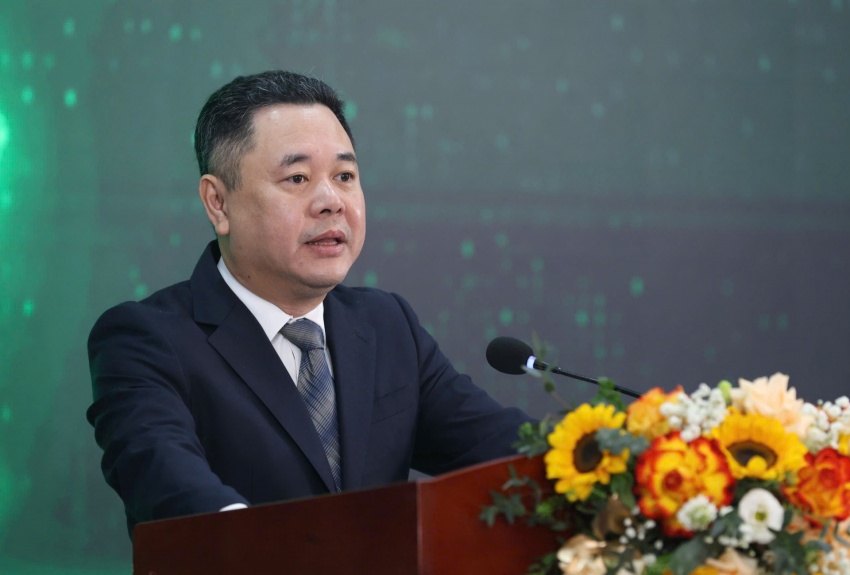 |
| Nguyen Ngoc Canh, deputy governor of the SBV. Photo: Dung Minh |
According to Canh, Vietnam has issued and is implementing a wide range of strategies and development plans aligned with green growth and sustainable development objectives, particularly as the country enters a new era of national advancement, with an eye towards the 100th anniversary of the nation’s founding in 2045. This phase places growing emphasis on the quality of growth, inclusiveness, and long-term sustainability.
Citing a report by the Ministry of Finance, the SBV’s deputy governor noted that the financial resources required to realise Vietnam’s green growth targets and its net-zero emissions commitment by 2050 are substantial.
“Under the carbon neutrality scenario, Vietnam’s total long-term investment demand for green and sustainable development is estimated at $670–700 billion by 2050, with climate change adaptation alone accounting for around $368 billion, or nearly 6.8 per cent of GDP per year,” he added.
The sheer scale of capital demand, according to Canh, underscores the need for Vietnam to mobilise all available financial resources for its national green growth agenda. Beyond state budget funding, the roles of the capital market, green bonds, green credit, the carbon market, and international financing sources are becoming increasingly critical.
Within the national policy framework, the banking sector has been clearly identified as one of the key capital mobilisation channels for sustainable development.
“Recognising the vital role of green credit and sustainable finance, the SBV has continuously improved the legal framework and policy mechanisms, while rolling out comprehensive measures to boost green lending and strengthen the management of environmental and social risks in credit activities,” said Canh.
At the implementation level, the deputy governor observed that credit institutions have proactively researched and developed a range of green funding and green credit products to finance projects delivering environmental benefits, supporting climate change adaptation, promoting circular economy models, and fostering sustainable production.
As a result, green credit in Vietnam’s banking system has expanded rapidly in both scale and growth momentum. According to data released by the SBV at the event, as of November 30, outstanding green credit reached approximately $30 billion, with average annual growth exceeding 21 per cent from 2017 through September this year, significantly higher than overall credit growth across the economy.
“This clearly demonstrates that banks and credit institutions are increasingly prioritising the development of dedicated capital channels for green growth and sustainable development,” noted Canh.
Nevertheless, the SBV’s deputy governor candidly acknowledged that the efforts of the banking sector alone are insufficient to meet the economy’s growing green transition needs.
“We must continue to diversify financial resources, with stronger participation from both domestic and international capital channels, particularly the private sector and the capital market, to share the burden with the banking system,” he added.
 |
| Photo: Dung Minh |
According to Canh, while expanding green finance channels helps alleviate pressure on banks, it can, more importantly, enable the mobilisation of medium- and long-term capital in a more flexible, secure, and efficient manner, in line with global green finance trends and international best practices.
“The conference provides a space for stakeholders to exchange views, share experiences, and discuss the role of various capital sources in advancing sustainable development, thereby identifying practical and concrete solutions to mobilise and deploy financial resources effectively for Vietnam’s national green transition,” stated Canh.
Commending VIR for organising the event, the SBV’s deputy governor expressed confidence that, with active participation and a strong spirit of collaboration among stakeholders, the conference would deliver tangible outcomes and help shape the next steps in Vietnam’s strategy to mobilise capital for green growth and sustainable development.
 | Green finance tapped into via carbon arena The formation of a domestic carbon market and international connectivity opportunities have opened up a sustainable green finance channel to support Vietnam in achieving its green growth goals. |
 | Green finance framework vital for reshaping industrial future Vietnam is in critical need for a clearer framework for green finance to develop its carbon trading and renewables ecosystem and reshape its industrial future. |
 | Green finance offers 'passport' for Vietnamese construction, building materials firms Sustainability is no longer a trend but the new operating system of the global economy. With stricter green standards sweeping across markets, Vietnamese construction companies must accelerate their transition or fall behind. |
What the stars mean:
★ Poor ★ ★ Promising ★★★ Good ★★★★ Very good ★★★★★ Exceptional
 Tag:
Tag:Related Contents



Latest News





More News
- Government proposes relaxing IPO conditions (October 19, 2026 | 08:00)
- Citi warns of intensifying competition for capital amid higher rates (October 16, 2026 | 16:54)
- Banks poised for Q3 profit growth amid margin pressure (October 16, 2026 | 16:51)
- Eximbank to strengthen corporate governance structure (October 16, 2026 | 11:32)
- Citi honours 13 banks with 2025 STP Awards (October 15, 2026 | 16:01)
- Green transition requires realistic roadmap (October 14, 2026 | 17:31)
- VIR workshop explores credit policy and carbon market development (October 14, 2026 | 11:22)
- Stronger carbon market needed to unlock climate finance (October 14, 2026 | 11:00)
- Carbon market opens new avenues for green finance (October 14, 2026 | 10:00)
- VPBank and Western Union enhance digital remittance experience (October 13, 2026 | 15:44)









 Mobile Version