
Vietnam shifts national brand focus from visibility to value

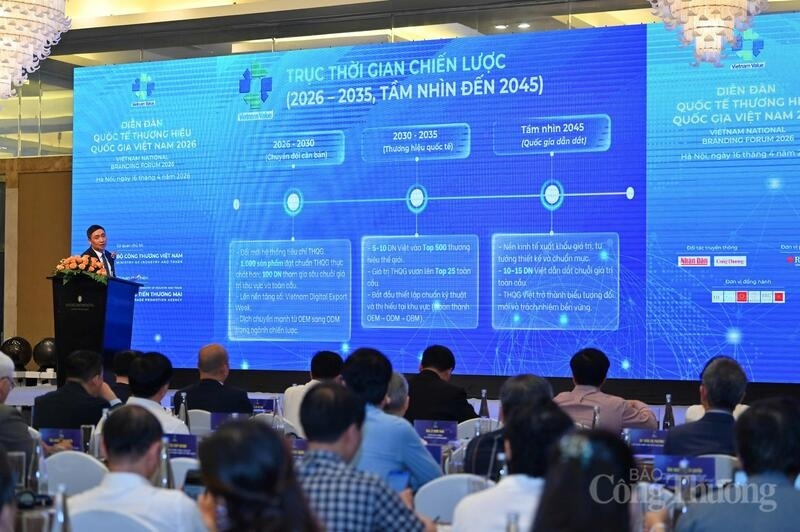 |
The 2026 Vietnam National Branding Forum, held in Hanoi on April 16, offered a comprehensive overview of the country's branding journey while identifying key impediments and strategic directions towards 2035, with a vision to 2045.
Speaking at the forum, Hoang Minh Chien, deputy director general of the Trade Promotion Agency under the Ministry of Industry and Trade, noted that after more than two decades of implementation, the Vietnam National Brand Programme has achieved significant progress in both scale and standing.
“In 2003, there were only 30 participating firms, but that number has now risen to 190. This is a remarkable leap, reflecting the growing maturity of Vietnam’s business community,” he said.
According to Chien, the value of Vietnam’s national brand has also seen strong growth. Numerous Vietnamese companies have begun to establish a presence on the global brand map. Banks such as Vietcombank, BIDV and VietinBank have entered the world’s top 500 most valuable banking brands; Vinamilk ranks among the top 50 global dairy brands; and Viettel has emerged as a top telecommunications group in Southeast Asia.
However, he also pointed to a notable paradox – while the number of recognised national brand products has increased rapidly, their overall quality and value have yet to keep pace. The combined value of Vietnam’s top 100 corporate brands stood at approximately $38.4 billion in 2025, even declining by 14 per cent on-year.
This reflects a broader structural issue, with Vietnam still largely positioned in lower-value segments of global supply chains, focusing on original equipment manufacturing, while capabilities in original design manufacturing and own brand manufacturing remain limited.
Entering a new phase of development, Chien stressed that the national brand can no longer serve merely as an external 'showcase', but must become a substantive driver of national competitiveness. "This shift is particularly urgent as Vietnam targets developed, high-income status by 2045," he said.
"A strong brand cannot rely indefinitely on natural resources or low-cost labour. It must be built on knowledge, technology, and cultural identity," Chien added.
A key policy development is the launch of the 'Go Global' initiative for 2026-2030 under Decision 626/QD-TTg, marking a fundamental shift from providing support to actively accompanying businesses and sharing risks.
The programme sets concrete targets, including training 10,000 enterprises, supporting 1,000 companies in developing internationalisation strategies, and assisting 100 firms in overseas investment and deeper participation in global value chains.
"Our goal is that every Vietnamese product entering international markets carries a story – one that reflects quality, identity, and value," Chien added.
To achieve this, the implementation roadmap will be divided into phases. Starting in 2026, efforts will focus on strengthening inter-agency coordination, reforming programme delivery, and refining the national brand identity system.
Between 2027 and 2030, priorities will include supporting sector-based brand development, promoting high-value-added products, and accelerating the digitalisation of trade promotion activities. Beyond 2030, the focus will shift towards elevating and firmly establishing Vietnam’s brand position globally.
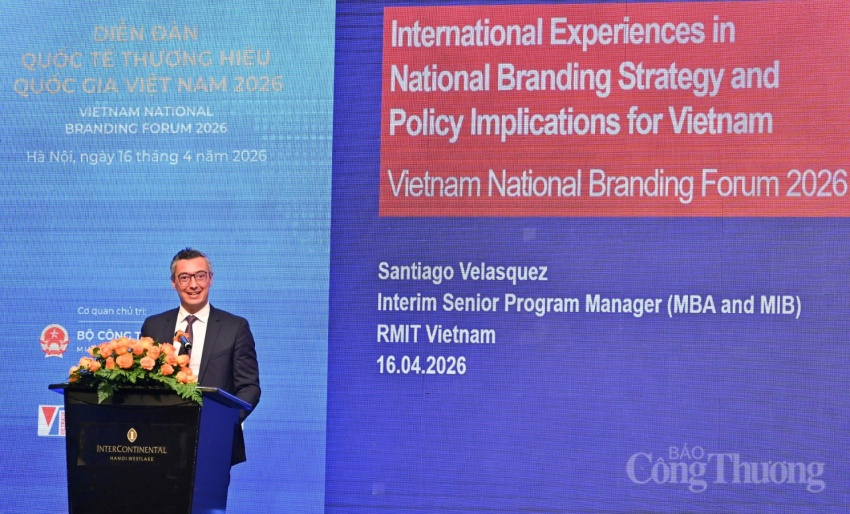 |
| Santiago Velasquez |
From an international academic perspective, Santiago Velasquez, interim senior programme manager at RMIT University Vietnam, observed that global awareness of Vietnam has improved significantly in recent years. “Where Vietnam was once relatively unknown, its products and culture are now increasingly visible in everyday consumption across many countries. This indicates that the national brand is becoming more recognisable,” he said.
However, he cautioned that moving from recognition to trust remains a major challenge, requiring a more systematic and consistent approach to national brand building.
Velasquez referred to the 'nation brand hexagon' model, which identifies six pillars shaping a country’s reputation: exports, governance, tourism, investment, people and culture. These elements are closely interconnected, and weaknesses in one can undermine the others.
The challenge, he argued, is not to excel simultaneously across all pillars, but to identify and prioritise key strengths. “A country cannot focus on everything at once. It must choose core pillars to invest in. Once one pillar becomes strong enough, it creates a spillover effect, enhancing the others and shaping overall perception,” he explained.
In practice, successful countries tend to adopt clear positioning strategies: Germany is associated with manufacturing quality, Singapore with governance excellence, and Estonia with digital innovation. A focused approach helps build a consistent and recognisable identity.
Among these pillars, culture plays a particularly important role in amplifying national brand strength, especially in building trust. “When a country is recognised through its culture, consumers develop familiarity and emotional connection. This becomes the foundation for trust in its products, services and business environment,” Velasquez noted.
He cited South Korea’s transformation following the 1997 Asian financial crisis as a case in point. By integrating culture into its development strategy, the country generated powerful spillover effects across exports, tourism and investment. As the national brand strengthened, scepticism towards product origin declined, enabling businesses to access global markets more effectively.
“The story of a national brand is not about how a country is perceived at a given moment, but about the standards it consistently upholds over time,” he said.
In an era of deeper integration, where competition extends beyond price to include quality, reputation, and value-addition, the national brand cannot be separated from enterprise capability and overall economic performance. “This is both a challenge and an opportunity for Vietnam to reshape its branding approach towards greater substance and sustainability,” he added.
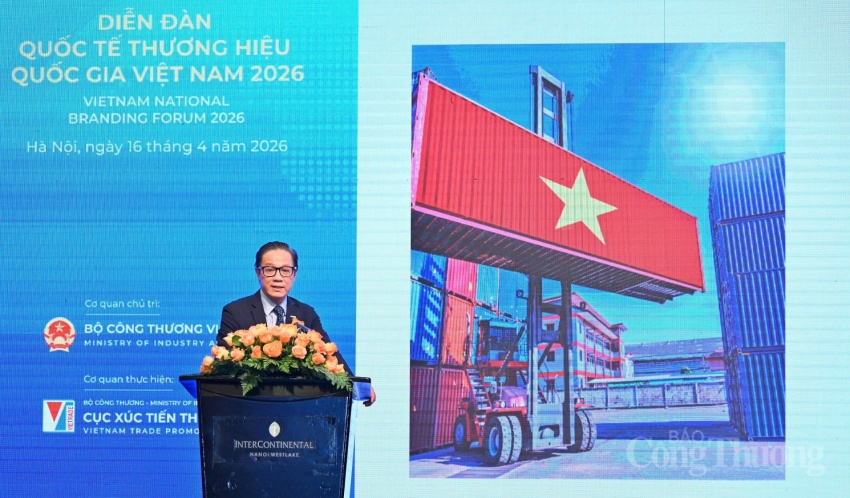 |
| Dinh Hong Ky |
Dinh Hong Ky, chairman of Secoin, shared practical insights drawn from 37 years of operation and 12 consecutive years of achieving National Brand recognition. “Branding is not just about the product itself, but how it is understood, perceived and remembered,” he said.
He argued that Vietnamese companies do not lack quality products, but rather the ability to tell compelling and meaningful brand stories. As a result, the national brand does not yet fully reflect the country’s true production capabilities.
Businesses are also facing multiple challenges, including institutional barriers, high compliance costs, and difficulties in accessing land and investment opportunities. At the same time, increasingly stringent international standards, particularly “green barriers” such as environmental, social, and governance requirements, carbon footprint measurement, and traceability, are placing growing pressure on firms.
“Sustainability and supply chain transparency are no longer optional; they have become mandatory. What was once compliance is now a competitive advantage,” Ky noted.
In this context, green transformation is no longer a matter of awareness, but a matter of survival for companies participating in global supply chains. Vietnam’s commitment to net-zero emissions by 2050 is accelerating the need for deeper and faster change.
At the same time, building brands in overseas markets remains a weak point. Many Vietnamese companies still rely heavily on intermediaries, lack structured branding strategies, and operate without a strong support ecosystem.
Drawing from Secoin’s journey, Ky highlighted a core philosophy: Vietnamese firms do not need to become 'giants' to compete globally, but must instead identify and leverage their unique identity. “We are not a billion-dollar company, we compete through identity,” he said.
A strong international brand is built on five key elements: product quality, uniqueness, authenticity, design and environmental responsibility. Among these, authenticity goes beyond origin to encompass cultural, historical and traditional narratives conveyed in a compelling way.
Ky suggested that government support should extend beyond production to include design and branding. Industry associations should play a stronger role in connecting stakeholders and standardising sectoral benchmarks, while a more integrated ecosystem linking designers, businesses and markets is needed.
“The combination of cultural identity, business appeal and a commitment to innovation is driving Vietnam’s growing influence in international markets,” he concluded.
What the stars mean:
★ Poor ★ ★ Promising ★★★ Good ★★★★ Very good ★★★★★ Exceptional
 Tag:
Tag:Related Contents








Latest News




More News
- Petronas, Petrovietnam to expand energy cooperation (October 21, 2026 | 12:13)
- AI in customer experience: Finding the right level of automation (October 21, 2026 | 09:03)
- Fresh graduates fall short on soft skills, employers say (October 19, 2026 | 13:14)
- Ford innovations continue towards sustainable growth (October 19, 2026 | 09:40)
- Preparing professionals for a new business environment (October 19, 2026 | 09:13)
- KN Holdings honoured for ESG efforts in Vietnam (October 18, 2026 | 11:00)
- APEA 2026 Vietnam honours 65 outstanding leaders and enterprises (October 17, 2026 | 10:00)
- MEXC highlights AI-driven trading and broader market access at TOKEN2049 (October 17, 2026 | 09:00)
- EuroCham confidence index holds at 78.3 despite operational hurdles (October 16, 2026 | 17:27)
- Shrimp and rice firms face rising standards in export markets (October 16, 2026 | 09:00)






 Mobile Version