
Vietnam moves towards data-driven tax administration

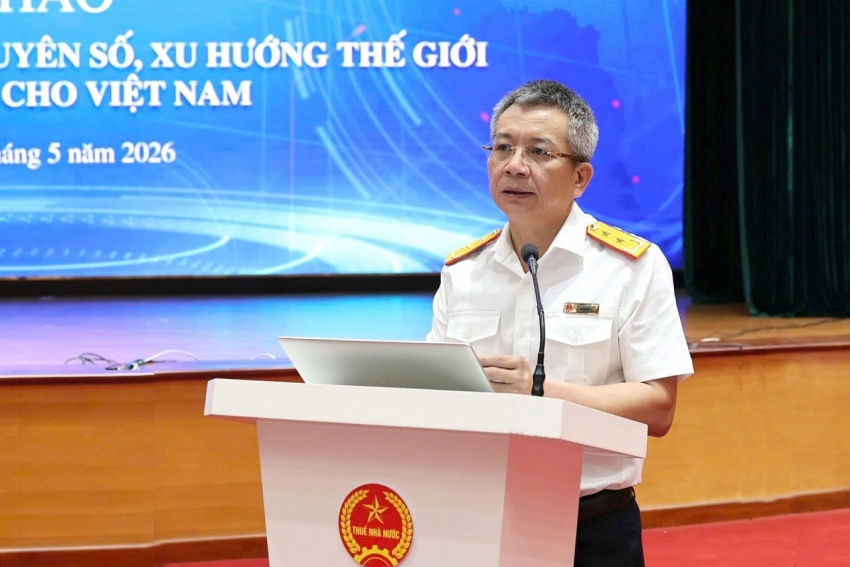 |
| Director general of Taxation Mai Xuan Thanh |
On May 21, the Department of Taxation held a conference, “Tax Reform in the Digital Era: From Global Trends to Vietnam’s Action Strategy.” The event aimed to identify challenges, assess existing gaps and explore opportunities for innovation in building a modern, transparent and internationally compatible tax system.
Director general of Taxation Mai Xuan Thanh said the successful rollout of the nationwide e-invoice system and the operation of the eTax Mobile platform marked important milestones in the digitalisation of Vietnam’s tax administration. However, he warned that stopping at the current level of reform could leave the tax sector lagging behind the rapid transformation of global tax governance models.
Citing studies by the OECD, Deloitte and EY, Thanh noted that by 2025, around 86 per cent of countries worldwide were transitioning towards a “Tax Administration 3.0” model, where tax calculation and management are conducted almost in real time through digital data systems.
Meanwhile, more than 82 per cent of large global corporations are restructuring operations to meet growing requirements for data transparency and ESG-driven development standards. At the same time, many countries are accelerating the implementation of the global minimum tax (GMT), carbon taxes and integrated tax models designed for the digital economy.
“Although the tax sector is managing an enormous volume of e-invoice data, there remains a situation where raw data is abundant while analytical intelligence is still lacking,” Thanh said. “Management thinking that relies heavily on manual post-audit methods will no longer be suitable when businesses and the broader economy are operating on digital and real-time data platforms.”
Against this backdrop, the tax chief called on departments and units across the sector to engage in substantive and action-oriented discussions.
First, he stressed the need to confront reality and accurately assess the existing gaps. Vietnam’s tax administration model, he said, must be directly benchmarked against international practices and global tax development trends.
Second, he urged frank and practical debate focused on core issues, avoiding superficial consensus. “We must be willing to identify loopholes and weaknesses in current processes to find effective solutions,” he said.
Third, all discussions must ultimately lead to concrete action. Whether it concerns the GMT, Carbon Border Adjustment Mechanisms or Embedded Tax models, a central question remains over how Vietnam’s tax authority should proceed.
During the conference, tax officials and experts presented a range of topics, including the roadmap for adjusting tax incentive policies and carbon taxes; practical experiences on the GMT; reforming international tax dispute resolution; integrated tax ecosystems; data-driven tax audits; transfer pricing risk management; and oversight of digital platforms.
Discussions also focused heavily on tax data governance, the application of AI in monitoring related-party transactions and cross-border financial flows, transparency for multinational corporations’ tax reporting, as well as challenges in attracting and developing high-quality IT talent.
The director general reiterated that digital transformation should not be viewed merely as a technological upgrade, but as a comprehensive restructuring of tax governance itself.
He pointed out that every modern tax governance trend emerging globally must ultimately be translated into solutions suited to Vietnam’s practical conditions, ensuring not only effective state management, but also greater convenience for taxpayers and a more transparent business environment.
Thanh called on tax authorities to continue studying international tax governance trends, while proposing innovative solutions and expanding the use of big data, AI and digital technologies throughout the entire tax process.
 | Tax sector eyes 20 per cent GDP revenue mobilisation in 2026-2030 The Finance Ministry has tasked the tax sector with boosting budget revenue mobilisation, expanding taxation in the digital economy and accelerating smart tax administration reforms for 2026-2030. |
 | Tax circular amendments aim to ease import-export procedures The Ministry of Finance is accelerating reforms to modernise import-export tax administration, expand digitalisation, and create a more transparent regulatory framework. |
 | Ministry of Finance finalises land use tax report after delegate request The Ministry of Finance has accelerated a study into a unified property tax framework to curb market speculation and align the nation’s fiscal policy with international standards. |
What the stars mean:
★ Poor ★ ★ Promising ★★★ Good ★★★★ Very good ★★★★★ Exceptional
 Tag:
Tag:Related Contents









Latest News




More News
- Sojitz in Vietnam: 40 years from individual projects to a business cluster 'KATAMARI' (October 08, 2026 | 09:00)
- Coteccons targets 'Quality Growth' with 25 per cent dividend plan (October 07, 2026 | 13:00)
- Vietnam Education Forum opens UK Education Mission's Hanoi visit (October 07, 2026 | 12:27)
- Tax authorities deactivate TINs of nearly 180,000 businesses (October 07, 2026 | 12:08)
- World Bank raises Vietnam's 2026 GDP growth forecast to 7.4 per cent (October 07, 2026 | 11:41)
- Vietstock 2026 to spotlight livestock innovation and green transition (October 07, 2026 | 09:00)
- Vietnam’s GDP grows over 9 per cent in first nine months (October 05, 2026 | 18:45)
- Vietnam earns $56.3 billion from agro-forestry-fishery exports (October 05, 2026 | 18:32)
- DSV balances resilience and decarbonisation in supply chains (October 05, 2026 | 18:20)
- Electronics exports reach $175.4 billion in the first nine months (October 05, 2026 | 18:12)



Latest News





 Mobile Version