
Vietnam and France seek to deepen economic and financial cooperation

 |
| Minister of Finance Ngo Van Tuan. Photo: Nguyen Yen |
Minister Tuan highlighted the long-standing traditional friendship between Vietnam and France, noting that bilateral ties have developed across various fields since the two countries established diplomatic relations in 1973.
"The elevation of bilateral relations to a Strategic Partnership in 2013 and a Comprehensive Strategic Partnership in 2024 has provided a solid foundation for increasingly substantive and in-depth cooperation," he said.
Minister Tuan said cooperation between the two countries had progressed across three key pillars: trade, investment and development finance. In the first eight months of 2026, two-way trade exceeded $5 billion, with Vietnam's exports to France reaching $3.1 billion and imports from France totalling $1.9 billion.
France currently has 749 valid investment projects in Vietnam with the total registered capital of $4.01 billion, ranking 16th among 154 countries and territories investing in the country. Meanwhile, Vietnamese investors have 20 projects in France with the total registered investment of $39.18 million.
France has also maintained its position as Vietnam's leading European bilateral ODA provider through the French Treasury Directorate General (DGT) and the French Development Agency (AFD), with average annual funding of more than €100 million ($116 million).
On tax cooperation, Minister Tuan shared Vietnam's efforts to improve its legal framework and implement international standards on information transparency. He asked France to recognise and support these reforms during international assessments.
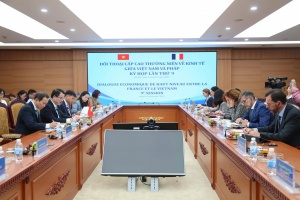
Tuan proposed that the two sides continue to make effective use of the Vietnam-France High-Level Economic Dialogue mechanism, co-chaired by the two finance ministries, in preparation for its 10th session, scheduled for early December 2026.
Given Vietnam's growing demand for strategic infrastructure development, he expressed hope that France would provide highly concessional loans, technical assistance and technology transfer.
In trade and investment, the Vietnamese minister called on France to complete ratification of the EU-Vietnam Investment Protection Agreement at an early date. He also encouraged French corporations to invest in infrastructure, aerospace and renewable energy, as well as form joint ventures with Vietnamese companies to capitalise on ongoing supply chain shifts.
 |
| MoU between the Tax Department Vietnam and France's Directorate General of Public Finances. Photo: Nguyen Yen |
Minister Roland Lescure, for his part, discussed several key cooperation projects, including Hanoi's Nhon-Hanoi Station Urban Railway Line 3, the VNREDSat-2 satellite project and regional railway connectivity projects.
"France is ready to support Vietnam in discussions with the European Union on the list of countries cooperating on tax matters, while pledging close coordination to resolve difficulties and accelerate the implementation of joint projects," he said.
Minister Lescure also proposed exploring bilateral cooperation on regional railway connectivity projects.
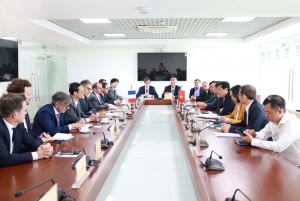
During the meeting, Ministers Tuan and Lescure witnessed the signing of an MoU between the Tax Department of Vietnam and France's Directorate General of Public Finances.
The MoU aims to establish a framework for bilateral cooperation and support the Vietnamese tax authority in reviewing its organisational structure and improving working procedures towards greater alignment with OECD standards. It will also seek to strengthen the professional capacity of tax officials and gradually establish a network of experts between the two agencies.
 |
| Photo: Nguyen Yen |
The two sides identified several priority areas for cooperation, including exchange of information upon request and automatic exchange of information; IT infrastructure, data platforms and the application of AI in tax administration; tax inspection; and international assistance in tax debt recovery.
In addition to technical cooperation, the two agencies will work together through a range of activities, including high-level visits and working sessions, training programmes, conferences and thematic seminars, expert exchanges, and joint development of annual action plans.


What the stars mean:
★ Poor ★ ★ Promising ★★★ Good ★★★★ Very good ★★★★★ Exceptional
 Tag:
Tag:Related Contents




Latest News



More News
- Vietnam and Liechtenstein sign double taxation avoidance agreement (October 19, 2026 | 18:08)
- Creative Young Entrepreneur 2026 showcases five young businesses (October 19, 2026 | 17:59)
- IEAE Hanoi 2026 to spotlight smart electronics trends (October 19, 2026 | 17:44)
- Vietnam and EFTA member states sign free trade agreement (October 19, 2026 | 13:10)
- TC-HICT handles over 8.2 million TEUs since 2018 launch (October 17, 2026 | 16:56)
- Vietnam transforming AI ambitions into business impact (October 16, 2026 | 18:01)
- A broader platform for France-Vietnam cooperation (October 16, 2026 | 17:51)
- AEON to open 13th general merchandise store in Vietnam (October 14, 2026 | 17:56)
- Three international exhibitions open to boost industrial supply chain links (October 14, 2026 | 17:37)
- Garment and textile industry transitions towards high-value production (October 14, 2026 | 17:30)









 Mobile Version