
Milk cartons and the circular economy: when schools become agents of change

 |
As Vietnam enters a new phase of mandatory household waste separation, an education-environment initiative is being piloted across 16 primary schools in Ho Chi Minh City. What is unfolding there offers a compelling lesson: real change can begin with something as small as a milk carton.
Great potential, significant challenges
According to Education & Times newspaper, Vietnam generates billions of paper cartons annually, representing a considerable reservoir of recyclable resources. Yet, the recycling rate remains far below its potential, leaving this valuable material stream largely untapped in the country's push towards a circular economy.
In Ho Chi Minh City – one of Vietnam's most densely populated urban centres and among its highest generators of household waste – beverage cartons present a growing challenge in the daily waste stream. Despite being highly recyclable, they are among the categories least consistently sorted at source. The root cause is not a lack of public awareness, but rather the absence of well-established sorting habits and a sufficiently integrated collection infrastructure to close the loop effectively.
The recycling potential of this material, however, is both real and promising. Through modern processing techniques, the composite layers of a paper carton can be separated and given new life: high-quality wood pulp fibres are recovered for reuse, while the remaining mixed materials are transformed into practical products such as eco-roofing sheets, compression boards, and stationery. A sustainable circular economy cycle is ready to function – the critical missing link is establishing proper sorting habits at the very first step.
School-based solution
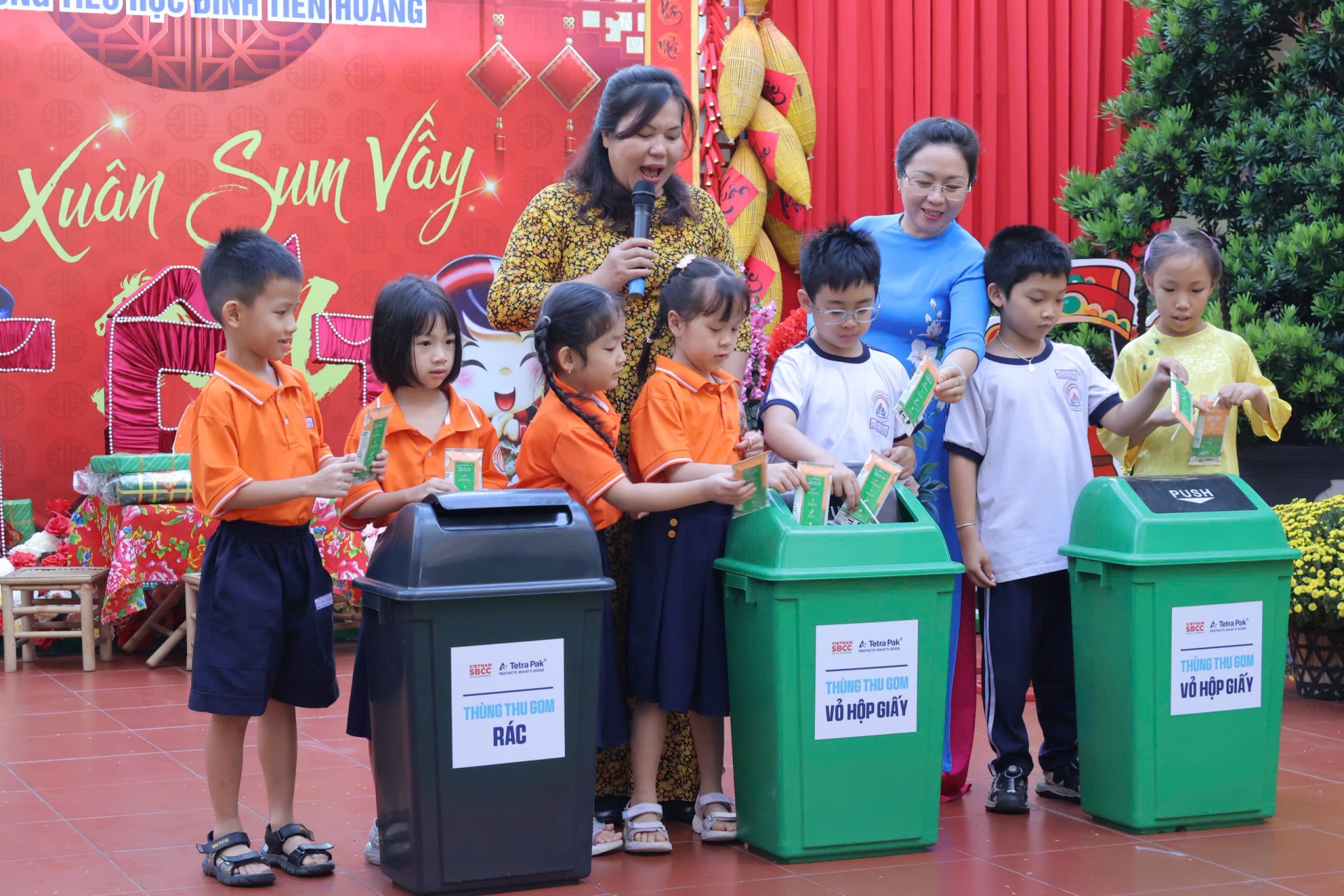
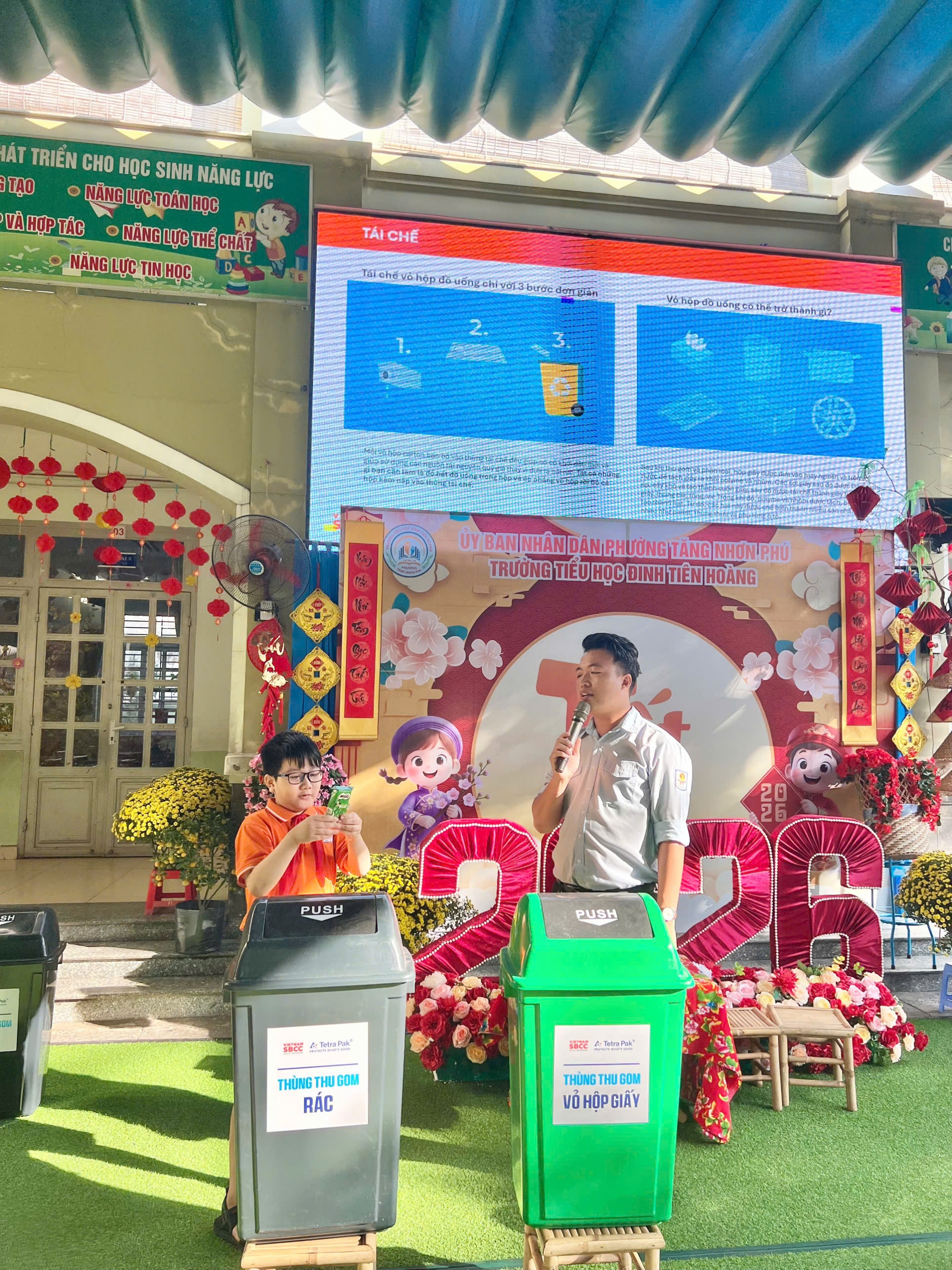
The "Carton for Communities" programme, initiated by Tetra Pak, is currently being piloted at 16 schools across Ho Chi Minh City. Alongside broader community awareness efforts, the initiative places particular focus on students – a group uniquely positioned to build recycling and sorting habits from an early age.
Educational psychologists describe children as "reverse change agents" – individuals capable of spreading positive behaviours to parents and the wider community far more effectively than the reverse. This is not mere theory. Field studies conducted across Asia and Latin America have consistently documented the effect: when children change their behaviour, families follow.
The process students are taught takes just four steps: Drink it clean – Tuck in the straw – Close the lid – Flatten it. Each action takes only seconds, yet makes a meaningful difference: properly handled cartons save storage space and become valuable feedstock for the recycling chain.
What sets this programme apart is its design as a complete loop – connecting schools, collection teams, and recycling partners into a continuous chain in which cartons travel from students' hands to the processing facility and back into the community in the form of new products.
Building awareness, not imposing it
Nguyen Do Thu Minh, sustainability manager at Tetra Pak Vietnam – the company spearheading carton collection and recycling infrastructure development in the country – identified the core bottleneck facing the sector.
"Tetra Pak paper cartons can be recycled where appropriate collection, sorting, and processing systems exist. In practice, one of the main challenges lies at the source-separation stage. Through the “Carton for Communities” programme, we hope to share our experience and foster collaboration between schools, families, and businesses to gradually build a stable collection system – thereby contributing to reduced carbon emissions and more efficient use of natural resources," Minh said.
Before this initiative, Tetra Pak had already rolled out its School Recycling Programme across Bac Ninh and Binh Duong provinces, reaching nearly 1,200 schools. The programme continues to expand with the goal of narrowing the gap between recycling potential and reality.
Bui Duyen, director of SBCC Vietnam – a social enterprise specialising in Social and Behaviour Change Communication for Sustainable Development, and a key implementing partner of the programme – offered a behavioural perspective.
"Through the 'Carton for Communities' programme, we are not simply teaching students how to sort waste – we are nurturing their identity as protectors of their city. Using tangible tools such as dedicated collection bins, posters, and interactive games, the act of correctly handling a milk carton becomes an inspiring experience rather than a dry obligation," said Duyen. "Real change begins when children bring these habits home and teach their parents how to handle cartons properly. The small actions of each family gradually ripple outward – through alleyways, neighbourhoods, and communities – building a society that lives with responsibility and environmental care."
From the classroom, Phuoc Quyen, head pioneer teacher at Dinh Tien Hoang Primary School in Ho Chi Minh City, reflected on the programme's impact, "Since the programme launched, our Monday morning assemblies have become far more lively and meaningful. Seeing students remind one another to handle their cartons correctly – something that takes only a few seconds – yet contributes to building a sense of environmental and social responsibility from an early age, is truly encouraging."
Small classrooms to large-scale change
The pilot across 16 schools is not simply about measuring outcomes – it is laying the practical groundwork for refining and scaling the model further. What students practise each day represents the most tangible realisation of the environmental goals that Vietnamese society is working towards.
Regulation can shape behaviour, but only education and a genuine love of nature can produce lasting change in values and mindsets. When a green consciousness is cultivated in the early years of life, it no longer requires reminding – it becomes a natural part of how a person lives.
Tens of thousands of tonnes of cartons each year are waiting to be given a second life. Those numbers are not distant abstractions. They begin with the milk carton in a child's hands on a school morning – and with the small habit that child carries home to the family dinner table.
 |
 | Tetra Pak’s Direct UHT technology a boon for coconut industry Tetra Pak's cutting-edge technology of Direct Ultra-High Temperature (UHT) and integrated solutions for processing coconuts maintains the flavour, taste, and nutritional value of the extracted products, increasing value for the coconut industry. |
 | Tetra Pak-Doveco launches Vietnam’s first Tetra Recart® packaging line Tetra Pak, a global leader in food processing and packaging solutions, announced on June 30 the inauguration of Vietnam’s first Tetra Recart® packaging line with Dong Giao Foodstuff Export JSC (Doveco). |
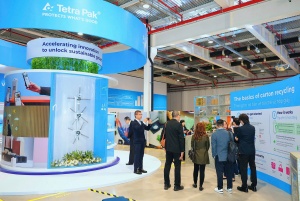 | Tetra Pak expands in Vietnam with new line in Binh Duong Tetra Pak, a world-leading food processing and packaging solutions company, on July 3 launched its second aseptic carton packaging material production line at its Binh Duong facility in Vietnam. |
What the stars mean:
★ Poor ★ ★ Promising ★★★ Good ★★★★ Very good ★★★★★ Exceptional
 Tag:
Tag:Related Contents

Latest News




More News
- Government launches child protection programme for 2026–2030 (August 06, 2026 | 11:33)
- TMIV, Tohe host autism art event in Hanoi (July 13, 2026 | 17:06)
- TUI Academy Hanoi opens to bridge tourism skills gap (July 10, 2026 | 15:05)
- Panasonic to donate 1,000 flashlights to residents in Nghe An and Ha Tinh ahead of storm season (July 02, 2026 | 09:00)
- Viatris collaborates with medical community to enhance management of non-communicable diseases in Vietnam (June 29, 2026 | 17:20)
- Save Turtles Run returns to Con Dao for fifth anniversary (June 18, 2026 | 15:58)
- Citi Vietnam hosts annual blood donation as part of Global Community Day (June 09, 2026 | 08:53)
- Nghi Son Green scheme expands in Thanh Hoa to protect marine environment (June 02, 2026 | 09:55)
- IOM supports community disaster resilience in Gia Lai (June 01, 2026 | 08:00)
- Conference highlights animal welfare ambitions stemming from dog and cat meat trade (May 20, 2026 | 12:04)


Latest News




 Mobile Version