
Pushing for clearer housing rules

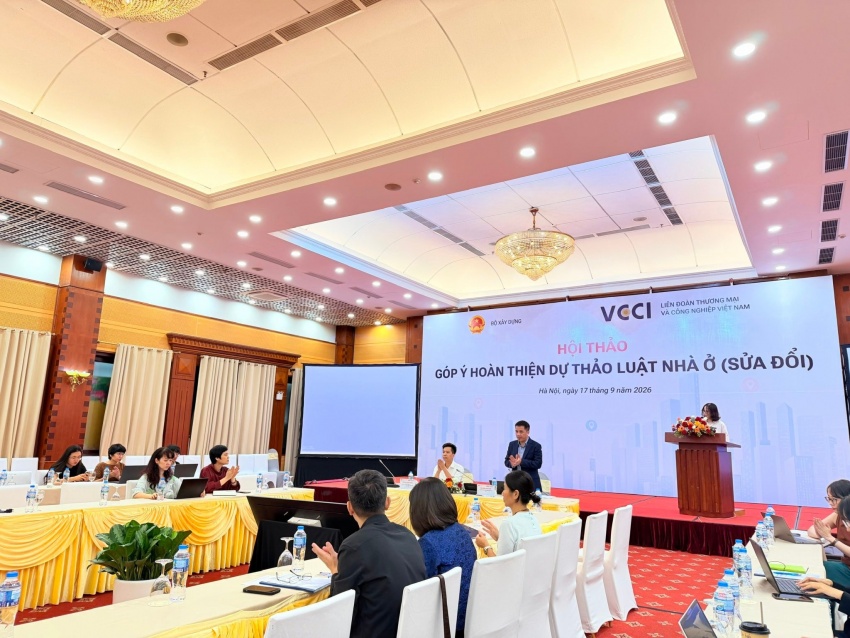
At a seminar jointly organised by the Vietnam Chamber of Commerce and Industry (VCCI) and the Ministry of Construction (MoC) in late September, business representatives, experts, and legal professionals called for the draft law to reduce regulatory uncertainty and create stronger incentives for private capital to enter the housing market.
Ha Quang Hung, deputy director of the Housing and Real Estate Market Management Agency under the MoC, said, “The revision is in line with current orientations for amending the Land Law and related laws, as well as the socioeconomic development in the upcoming time. It aims to reform administrative procedures and solve market barriers.”
 |
| Photo: Thanh Son |
Hung elaborated that for the first time, the draft dedicates a specific chapter to rental housing, covering eligible tenants and investment models (both public and private capital) to pricing mechanisms and incentives. The draft also introduces a model for accommodation catering to experts and workers located outside industrial zones.
Regarding foreign homeownership, to ensure consistency with the Land Law, the draft repeals the provision allowing foreign organisations and individuals to own detached houses, focusing instead only on appropriate housing types.
In terms of social housing and old apartment buildings, the draft also legalise pilot policies. The renovation of old apartment buildings will be linked to urban redevelopment and will, for the first time, employ the public-private partnership investment model.
Businesses and investors suggested changes in private capital, public policy, and administrative intervention.
Dau Anh Tuan, VCCI deputy secretary general and head of its Legal Department, said, “For businesses and investors, the key issue is whether the new rules provide enough certainty for long-term decisions. Incentives involving land, taxation, and credit need to be accompanied by an operating mechanism that gives businesses a reason to participate in developing the rental housing market.”
Under the draft, projects financed by private capital could face requirements concerning eligible tenants and priority groups similar to those applied to projects using state capital.
The VCCI warned that applying rigid requirements to privately financed projects could affect investors' ability to recover capital and maintain commercial efficiency. He called for a clearer distinction between social housing policies supported by public resources and market-based housing activity financed by private capital.
Drawing on the condition in practice of the real estate market, the Ho Chi Minh City Real Estate Association proposed adding a policy to develop commercial housing at price points affordable for middle- and low-income earners.
Developing this segment could help meet genuine housing demand, rectify the real estate product mix's skew towards the high-end segment, and provide additional options for those who do not qualify for social housing policies, according to association chairman Le Hoang Chau.
“Establishing a legal framework that enables enterprises to voluntarily participate in developing reasonably priced commercial housing, based on business viability and market demand," Chau said. "It also should set maximum prices for outright sales, instalment sales, and rentals using an appropriate mechanism, while researching into preferential credit policies for developers.”
Investors also sought for an exit from legal uncertainty. The draft's provisions on apartment renovation and reconstruction show another area where legal clarity will matter.
Realty lawyer Pham Thanh Tuan said the draft needs greater consistency among provisions covering demolition, compensation, resettlement, relocation, and compulsory relocation.
For dangerous apartment buildings requiring urgent evacuation, he proposed a mechanism allowing temporary accommodation and relocation first, followed by completion of plans for renovation or reconstruction.
“It should have clearer rules where an approved planning scheme does not provide for rebuilding the apartment building, including the owner's right to choose between monetary compensation and resettlement housing,” he said.
Vietnam’s housing market is expected to move into a new phase as legal reforms begin to unlock projects and developers gradually rebuild supply.
According to the MoC, the development of social housing has achieved positive results: by 2025, more than 103,000 units had been completed, reaching 103 per cent of the yearly target. In the first five months of 2026, 40 additional projects were kicked off, comprising nearly 34,400 units.
To date, the whole country is implementing approximately 720,000 units, reaching 72 per cent of the target of one million units, of which more than 180,000 have been completed, helping hundreds of thousands of families improve their housing.
Foreign investors continue to maintain a substantial presence in Vietnam’s property market. The broader foreign funding picture has also strengthened significantly in 2026. Total registered foreign investment inflows reached $40.63 billion in the first eight months of 2026, up 55.4 per cent on-year, while foreign inflow disbursement reached an estimated $17.25 billion, up 12 per cent.
Real estate accounted for an estimated $1.29 billion, or 7.5 per cent, of disbursed foreign investment during the January-August period, placing it behind manufacturing and processing, which received $14.24 billion.
What the stars mean:
★ Poor ★ ★ Promising ★★★ Good ★★★★ Very good ★★★★★ Exceptional
 Tag:
Tag:Related Contents




Latest News



More News
- Enterprises honoured as Outstanding Provider of Green Industrial Solutions (October 06, 2026 | 18:03)
- MIK Group launches House of MIK in Ho Chi Minh City (October 03, 2026 | 17:00)
- Vietnam hospitality shifts towards integrated mixed-use developments (October 03, 2026 | 10:00)
- Stavian IP accelerates its modern expansion (October 02, 2026 | 14:00)
- ESG for future-ready industrial success (October 02, 2026 | 09:00)
- Green Future Awards honour five leading industrial park developers (October 01, 2026 | 22:20)
- Green transition leaders honoured at Green Future Awards 2026 (October 01, 2026 | 22:10)
- Six developers honoured as Emerging Green Industrial Property Developers (October 01, 2026 | 22:00)
- Why logistics will define the next phase of growth (October 01, 2026 | 09:00)
- Urban Development Law takes effect on October 1 (September 30, 2026 | 17:49)







 Mobile Version