
Digital banking enters season of transformation

In the days leading up to Lunar New Year, spending and transfers surge. Amid this acceleration, banks are everywhere yet almost invisible.
There are no queues or paperwork; with a smartphone, most personal financial transactions can be completed within minutes. Transfers, bill payments, savings, and even consumer loans are embedded seamlessly in familiar applications.
Banking has become a natural layer of digital life, particularly for younger users. And when convenience becomes routine, few stop to ask what enables it.
A quiet paradox lies beneath this simplicity: the smoother digital banking feels on the surface, the more complex and sophisticated the systems behind it must be.
What users experience as effortless convenience is the outcome of years of sustained digital transformation across Vietnam’s banking sector.
As the outer layer of digitised services reaches maturity, the focus is no longer merely on placing banks inside mobile apps. The transformation has moved inward, towards reshaping operating models through digital core banking platforms.
In the early phase of digitalisation, banks concentrated on customer-facing channels such as internet banking, mobile apps, QR payments, and e-wallets.
These initiatives expanded access, reduced reliance on physical branches, and aligned banking with evolving digital lifestyles. But as customers grew accustomed to these services, expectations shifted towards faster speeds, simpler journeys, and uninterrupted availability.
At that point, structural constraints became visible. Launching new products could take months, policy adjustments were cumbersome, and integrating with technology partners proved complex. The bottleneck did not lie in the interface, but in legacy core systems.
Traditional core banking can be compared to an old but solid building: stable and reliable, yet difficult to renovate or expand.
By contrast, digital core banking resembles a structure designed from modular blocks, allowing components to be assembled, modified, or replaced without disrupting the entire system. The distinction is not merely technical; it determines how agile and adaptive a bank can be.
A modular digital core enables faster product rollouts, smoother integration with fintech partners and digital commerce platforms, and flexible scaling as demand grows.
Crucially, it allows incremental innovation without dismantling critical infrastructure, a vital consideration in a sector where stability and security are paramount.
As banking products are now expected to launch in weeks rather than months, traditional architectures are increasingly stretched.
From a digital core foundation, a new operating landscape is emerging, where data becomes a strategic asset, AI supports decision-making, and banks integrate deeply into broader digital ecosystems instead of operating in isolation.
From the early 2020s, Vietnam’s market began to witness new digital banking models. Some adopted branchless strategies centred entirely on mobile experiences.
Others targeted specific segments such as young customers, small merchants, or underserved regions. Certain models embedded financial services directly into consumer ecosystems, making banking part of daily shopping and lifestyle journeys.
Despite differing strategies, these models share common operational demands: speed, flexibility, and scalability.
Many therefore moved away from legacy systems and adopted composable digital core architectures from inception, often running alongside traditional cores at their parent banks. This dual approach balances innovation with risk management.
Vietnam has also seen the entry of international digital core banking platforms, bringing global expertise and accelerating time-to-market.
Among them, Mambu is recognised as a leading provider, serving over 265 customers in more than 65 countries and processing more than 500 million API calls daily on its cloud-native platform. Although not a bank itself, its aggregated operational scale across clients rivals that of major global institutions.
In Vietnam, digital pioneers such as TNEX, VPBank Cake, and Timo have partnered with Mambu since the early 2020s. While each pursues a distinct strategy, their early adoption of digital core platforms reflects a shared recognition that operational flexibility is as critical as user experience.
In practice, digital core banking is no longer experimental. Since 2020-2021, Vietnamese banks have deployed digital cores in live environments to support specific products and customer segments.
Today, parallel digital cores are increasingly used to diversify offerings while legacy systems continue to ensure stability. This phased transformation allows banks to innovate without jeopardising operational resilience.
Regulatory guidance has also played a defining role. The State Bank of Vietnam has consistently promoted cashless payments and comprehensive digital transformation.
Although fully digital bank licences have yet to be issued, a controlled innovation framework has provided space for new models to operate and mature safely.
Rather than pursuing rapid disruption, the system has emphasised gradual, adaptive progress, ensuring technology advances in tandem with macroeconomic stability and prudential oversight.
Ultimately, financial digital transformation differs from other sectors: innovation must be anchored in rigorous risk management.
Many observers believe future banking will become even more embedded in daily life. Consumers may no longer consciously perceive themselves as using banking services, yet will continue to borrow, save, pay, and invest through integrated platforms across e-commerce, mobility, and digital ecosystems.
Behind that apparent invisibility lies not simplicity, but a profound structural reinvention at the core.
 |
As finance becomes a natural part of consumption and business activities, the boundary between banking services and digital services continues to blur.
To achieve this, back-end infrastructure must be flexible, open, and integration-ready. According to Bui Tri Hung, country manager of Mambu Vietnam, for banks to embed themselves deeply into everyday life, user-friendly applications are not enough.
“What matters more is a core platform capable of rapidly adapting to changes in markets, data, and customer behaviour. In this context, digital core banking is no longer just a technology solution-it is becoming the foundation that enables banks to participate more deeply in emerging digital ecosystems,” he said.
In practice, as banks connect more seamlessly with external partners and leverage data and new technologies, financial products are shifting from mass offerings to personalised experiences, from reactive responses to proactive, companion-based services.
This transformation may be quiet, but its long-term implications for how banks serve the economy and society are profound.
Looking back, banking digital transformation is not an overnight story, but a long journey requiring patience, investment, and mindset change.
The steps taken since the early 2020s show that Vietnam’s banking sector is moving into deeper transformation. And within this invisible flow, digital core banking, unassuming yet powerful is steadily laying the groundwork for a new, sustainable phase of growth for Vietnam’s banking industry.
 | AI giving Standard Chartered the edge in digital banking Nguyen Ngoc Lan Anh, Chief Technology and Operations Officer at Standard Chartered Bank Vietnam, shares key insights on the benefits of AI in financial services, highlighting how Standard Chartered applies AI to drive innovation, boost efficiency, and enhance customer and employee experiences. |
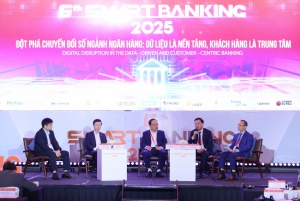 | Vietnam’s banking sector enters data-driven era AI and data are fast becoming the lifeblood of the digital economy, where they are no longer just technological tools but strategic imperatives, well-defined priorities, and robust long-term planning from financial institutions. |
 | Cake and Visa collaborate to pioneer bank-led cross-border receivables solution Cake by VPBank is preparing to introduce Cake GlobalX, a bank-led cross-border receivables solution designed to support Vietnam’s growing community of online entrepreneurs earning income from overseas markets, currently under development in partnership with global payments leader Visa. |
What the stars mean:
★ Poor ★ ★ Promising ★★★ Good ★★★★ Very good ★★★★★ Exceptional
 Tag:
Tag:
Latest News




More News
- VIB deploys Front Arena treasury and foreign exchange trading system on AWS (September 28, 2026 | 16:46)
- Nam A Bank receives $60 million loan from FMO (September 28, 2026 | 12:37)
- Vietnam’s finance sector moves to build an AI-driven digital ecosystem (September 25, 2026 | 10:58)
- Vietnam pushes digital finance into tangible gains (September 25, 2026 | 08:17)
- Citi and HDBank sign MoU to expand banking cooperation (September 24, 2026 | 09:50)
- Asia Securities Forum AGM brings regional market leaders to Hanoi (September 24, 2026 | 09:48)
- New credit push aims to widen SME access to capital (September 23, 2026 | 18:46)
- VIFC-Danang forum focuses on green finance and regulatory certainty (September 23, 2026 | 17:48)
- VIFC steps up focus on talent and green finance (September 23, 2026 | 17:34)
- Fundiin and TNEX forge strategic partnership for personalised digital finance (September 23, 2026 | 17:32)






 Mobile Version