
Middle East war weighs heavily on accountant confidence

The outbreak of war in the Middle East overshadowed the results from the Association of Chartered Certified Accountants (ACCA) and Institute of Management Accountants (IMA) Q1 2026 Global Economic Conditions Survey (GECS) published on April 14.
The survey fieldwork, conducted between March 3-19, coincided with the outbreak of the conflict in the region, which will have been a major factor weighing on respondents’ sentiment.
“As an export-oriented economy deeply integrated into global supply chains, Vietnam faces particular vulnerabilities from the forces identified in this survey. Brent crude prices rose by nearly 70 per cent following the outbreak of hostilities, threatening to drive up the costs of production and transportation of goods, directly affecting the competitiveness of Vietnamese exports,” the report said.
“The surge in fertiliser prices, driven by disrupted supply from the Middle East, further heightens pressure on Vietnam’s vital agricultural sector. Currency depreciation pressures on emerging economies add another layer of challenge for Vietnamese businesses and financial planners.”
Across Asia-Pacific, 33 per cent of respondents ranked geopolitical instability as their top risk priority in Q1, well above the global average of 25 per cent. Cybersecurity ranked second globally at 17 per cent, a growing concern as Vietnam’s digital economy expands.
Globally, 74 per cent of surveyed finance professionals now expect inflation to rise over the next three months, and 35 per cent expect interest rates to increase. Encouragingly, the Global New Orders Index registered a solid recovery and the Global Employment Index also improved, reflecting the underlying resilience of the global economy before the conflict escalated.
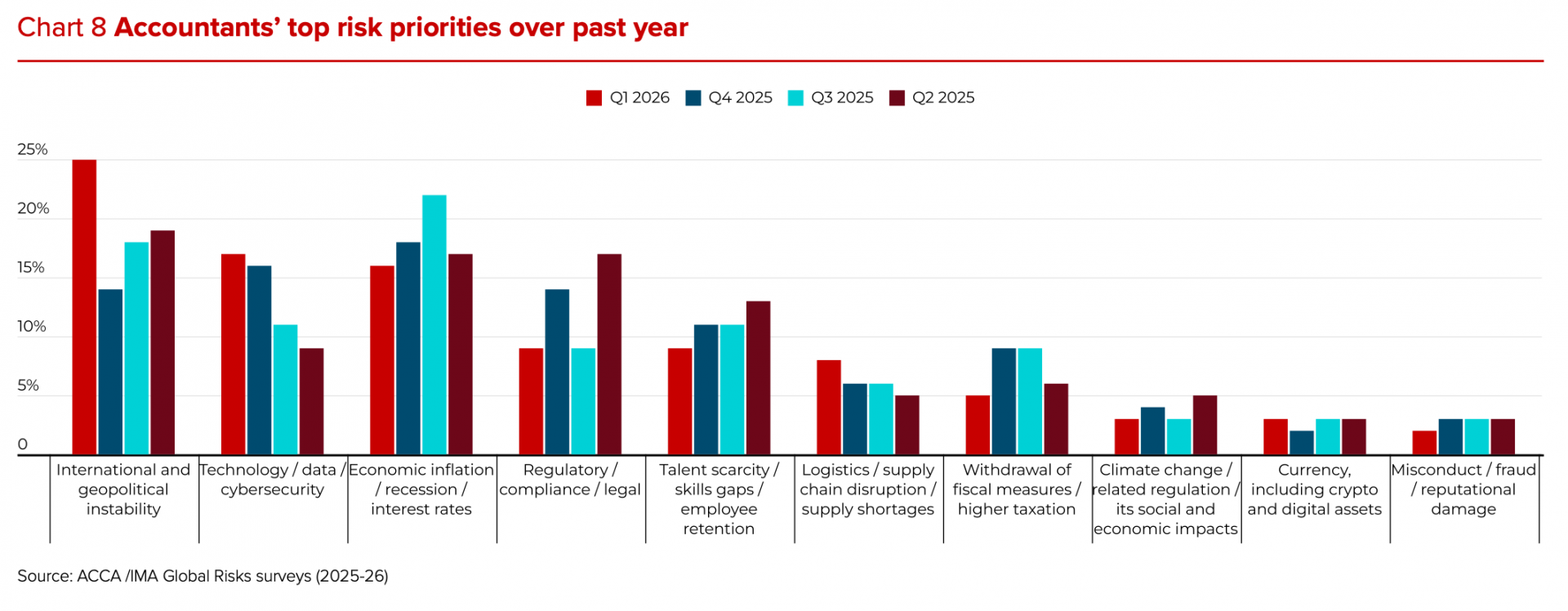 |
| Accountatnts' top risk priorities over past year |
Ren Varma, head of Mainland Southeast Asia at ACCA asserted that the Q1 GECS findings were a powerful reminder that global geopolitical instability was not a distant concern, but had direct and immediate implications for businesses and finance professionals in Vietnam.
“Rising operating costs, mounting inflationary pressures and the convergence of geopolitical, technological and economic risks demand faster adaptation than ever before. This is precisely when the integrity, professional expertise and strategic thinking of accountants matter most. The ACCA is committed to ensuring our members and future members in Vietnam are equipped to lead through this uncertainty,” Varma said.
The survey showed a sharp decline in confidence among accountants and finance professionals in the early months of this year. Sentiment is close to the series lows recorded at the beginning of the pandemic in 2020, as firms grapple with the fourth major shock to hit the global economy already this decade. Confidence also fell very sharply among chief financial officers taking part in the survey.
“While the April two-week ceasefire brought hope to markets of some recovery from the biggest global oil shock since at least the 1970s, the enormous uncertainty clouding the global economy remains. Even if a more durable resolution is found energy and other commodity prices look set to remain elevated,” the report said.
While geopolitical instability unsurprisingly ranked as the top risk priority for accountants in Q1, it is only the second time since the global risks survey was added to the GECS in Q2 2023 that economic risks have not been the top concern. They were in third place after cyber risks, which were second.
Rachael Johnson, head of Risk Management and Corporate Governance at ACCA said that this shift did not suggest a reduction in economic worries, but a growing recognition of how converging forces shape the macro landscape.
“Respondents point to AI and cyber threats amplifying other risks, and emphasise how eroding trust in institutions, information and leadership, is becoming a defining feature of operating in today’s world,” she said.
Rising cost pressures were evident at businesses in Q1, with the percentage of respondents reporting increased operating costs at its highest rate since Q3 2022 in the aftermath of Russia’s invasion of Ukraine. Given the recent spike in the price of energy and other important commodities and increasing stresses in supply chains, the risk is that cost pressures facing firms will mount over coming months.
Some of the survey results were a bit more encouraging, likely owing to the resilience of the global economy ahead of the onset of the conflict in the Middle East. The Global New Orders Index registered a solid increase and is now at its historical average level. The Global Employment Index, which captures the hiring and firing decisions of firms, also improved somewhat, while remaining below its historical average.
“The global economy entered 2026 in decent shape, but enormous uncertainty currently clouds the outlook. Inflation is already beginning to rise sharply, and downside risks to growth will mount the longer energy and other commodity prices remain elevated,” said Alain Mulder, senior director, Europe Operations & Global Special Projects at IMA.
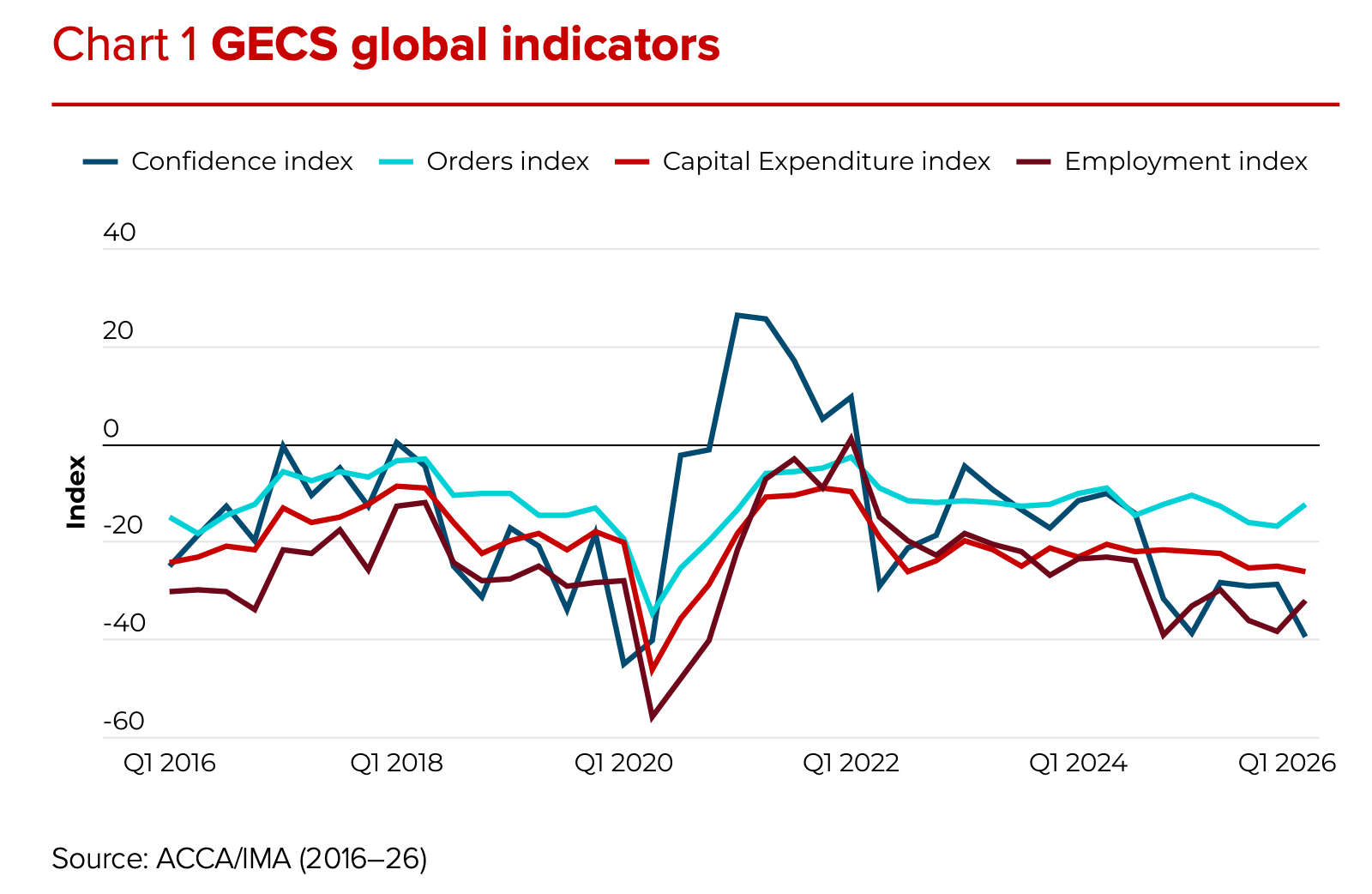 |
| GECS global indicators |
Jonathan Ashworth, chief economist at ACCA noted that major supply shocks created very tricky situations for policymakers.
“After years of above target inflation, central bankers need to tread cautiously so as to not let the inflation genie out of the bottle. Very high government debt levels also constrain the room for major fiscal support in many countries, even in advanced economies,” said Ashworth. “Developments in the Middle East over coming weeks and months will be absolutely key for global economic prospects over the remainder of this year.”
 | Global business confidence remains fragile despite Q2 uptick Global business confidence among professional accountants is showing tentative signs of a recovery, according to new data from an international survey. |
 | ACCA builds new generation of financial leaders in Vietnam The Association of Chartered Certified Accountants (ACCA) celebrated its New Member Ceremony on October 13 and 14 in Hanoi and Ho Chi Minh City, highlighting the theme “Legacy of Leadership”. |
 | ACCA urges firms not to delay sustainability reporting over data gaps As sustainability reporting requirements continue to evolve, new guidance from the Association of Chartered Certified Accountants stresses that organisations should not be deterred by a lack of hard data, as reasonable estimates can still generate useful information. |
What the stars mean:
★ Poor ★ ★ Promising ★★★ Good ★★★★ Very good ★★★★★ Exceptional
 Tag:
Tag:
Related Contents




Latest News






More News
- Samsung Vietnam to deepen cooperation with local manufacturers (October 08, 2026 | 12:00)
- Sojitz in Vietnam: 40 years from individual projects to a business cluster 'KATAMARI' (October 08, 2026 | 09:00)
- Coteccons targets 'Quality Growth' with 25 per cent dividend plan (October 07, 2026 | 13:00)
- Vietnam Education Forum opens UK Education Mission's Hanoi visit (October 07, 2026 | 12:27)
- Tax authorities deactivate TINs of nearly 180,000 businesses (October 07, 2026 | 12:08)
- World Bank raises Vietnam's 2026 GDP growth forecast to 7.4 per cent (October 07, 2026 | 11:41)
- Vietstock 2026 to spotlight livestock innovation and green transition (October 07, 2026 | 09:00)
- Vietnam’s GDP grows over 9 per cent in first nine months (October 05, 2026 | 18:45)
- Vietnam earns $56.3 billion from agro-forestry-fishery exports (October 05, 2026 | 18:32)
- DSV balances resilience and decarbonisation in supply chains (October 05, 2026 | 18:20)










 Mobile Version