
From carbon value to greener capital

Carbon pricing is increasingly being used to put an economic value on emissions. Rather than remaining primarily a policy instrument, carbon pricing is becoming more closely connected with investment decisions, project economics, and corporate costs.
The scale of this shift is reflected in the World Bank’s State and Trends of Carbon Pricing 2026 report, which recorded 87 direct carbon pricing policies worldwide, covering more than 29 per cent of global greenhouse gas (GHG) emissions. These mechanisms generated more than $107 billion in government revenue in 2025, with an average direct carbon price of nearly $21 per tonne of CO2 equivalent.
 |
| Nguyen Thi Thu Ha, deputy head for the Steering Committee for Environmental, Social, and Governance at Agribank |
For Agribank, the implications are particularly relevant given its customer base and operating areas. Agriculture, farmers, and rural communities face high exposure to climate change, but also offer substantial potential for emissions reductions through rice production, livestock, forestry, biomass energy, waste treatment, and the circular economy.
This gives banks a broader financing role beyond carbon credit trading. The focus is on supporting activities that can deliver measurable emissions reductions and assessing when the resulting carbon value is sufficiently certain to be recognised in lending decisions.
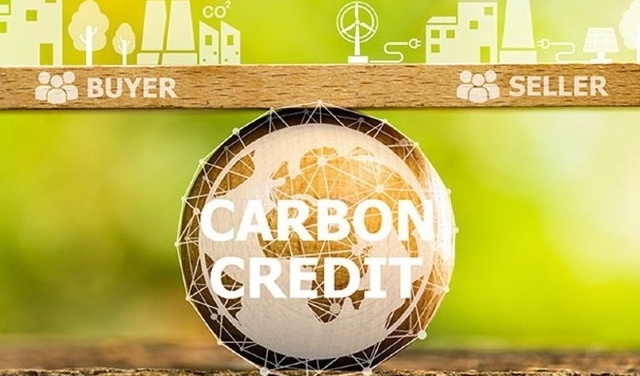
An emission allowance represents the amount of emissions permitted under a compliance scheme, while a carbon credit represents a verified emissions reduction or removal that meets applicable methodologies, standards, and registration requirements. One credit generally represents one tonne of CO2 equivalent, but the two instruments carry different rights, obligations, and levels of financial certainty.
Turning emissions reduction potential into a tradable asset requires an appropriate methodology and baseline, reliable data, issuance, and measurement, reporting, and verification (MRV) framework. A forest area, rice field, or waste treatment facility does not automatically generate credits that can be sold.
For lenders, the important distinction is where a project stands in this process. There is a significant difference between estimated emissions reduction potential, a registered project, verified results, issued credits, a signed purchase agreement, and actual payment.
Each stage carries a different level of certainty and affects credit assessment differently. Projects may need capital during preparation and investment, while carbon value can only be measured and potentially monetised after emissions reductions have been monitored and verified. Even then, revenue depends on finding a buyer and completing the transaction and payment.
Funding before revenue
Vietnam’s carbon market framework is moving towards pilot operation. Its legal foundation was established under the 2020 Law on Environmental Protection and further developed through legislation covering the domestic carbon exchange, and international exchange of GHG mitigation outcomes and carbon credits.
Since 2022, establishments required to conduct GHG inventories have increased from just over 1,900 to 2,441, up nearly 28 per cent. Recent directives on environmental criteria and the Green Taxonomy, together with officially identifying green projects, provides a further basis for identifying eligible activities.
However, inclusion in the Green Taxonomy does not mean a project will generate carbon credits, while a project generating carbon credits does not automatically qualify for green credit.
According to Hanoi Stock Exchange data, the VN2025 allowance code for the 2025-2026 compliance period has a total volume of 511.47 million tonnes of CO2 equivalent allocated to 110 establishments. Trading began in June and is scheduled to end in December 2027. Trading volume and value have remained at zero on recent trading days, providing limited evidence of a stable reference price or sufficient liquidity for lending assumptions.
Vietnam has also gained experience in commercialising emissions reduction outcomes. In early 2024, the country received $51.5 million from the World Bank for 10.3 million tonnes of verified emissions reductions under the North Central Region Emissions Reduction Programme.
Financing requirements vary across the project cycle. Preparation may involve surveys, feasibility studies, documentation, methodologies, data collection, and consultants. Implementation requires capital for equipment, infrastructure, technology, and working capital. Once operations begin, projects may still need financing for MRV and independent verification, as well as bridge funding while awaiting credit issuance or payment.
The main risks are project readiness, data and MRV, revenue certainty, and the allocation of rights and benefits. An emissions reduction target does not necessarily translate into a commercially viable project. In agriculture and forestry, dispersed activities can make individual measurement costly, while cooperative or raw material area models require effective governance and data management.
Emissions may be reduced without credits being issued, credits may be issued without a buyer, or contracted payments may be delayed or disputed. Where farmers change production practices but rights over credits and related revenues are unclear, incentives to maintain those practices may weaken.
Carbon value can affect project economics through three channels: lower operating costs, reduced compliance costs, and revenue from emissions reduction outcomes or carbon credits. These channels should be assessed separately to avoid double counting.
Core production and business income should remain the primary basis for debt repayment. Carbon revenue should be treated as an additional source, with its contribution determined by its level of certainty.
 |
Developing roles
At an early stage, estimated emissions reduction potential should not form part of the base repayment assumption. Once methodology, reliable data, registration, and a credible market outlet are established, part of the expected value could be considered, subject to a risk adjustment. Where credits have been issued or receivables under a firm purchase agreement established, banks have stronger grounds to consider related value while assessing transfer rights, payment conditions, buyer capacity, and legal risks.
This approach is particularly relevant to sectors where Agribank has an established presence. By mid-2026, its total assets exceeded $108 billion, deposits exceeded $100 billion, and outstanding loans surpassed $80 billion.
By the end of August, lending to agriculture, farmers, and rural areas had exceeded $53.6 billion, accounting for 64.7 per cent of total outstanding loans. As of July 31, the bank had more than 58,000 lending groups with over 910,000 members and loans exceeding $8.64 billion.
Agribank’s green credit portfolio stood at nearly $1.2 billion at the end of March. The bank continued to implement a $120 million green credit programme for individual customers and a $2 billion financing programme for clean and high-tech agriculture in 2026. Under the scheme to develop one million hectares of high-quality, low-emission rice in the Mekong Delta, Agribank is implementing a lending programme for linked production, processing, and consumption chains with a minimum scale of $1.2 billion.
Agribank could develop its role in carbon finance in five areas: financing emissions reduction activities, connecting customers with technical and financial partners, providing payments and cash flow management, mobilising climate finance through concessional and blended finance, and supporting customers through the wider green transition.
A low emission rice chain provides one potential model. Farmers could be linked through a cooperative with a purchasing company, with cultivation practices, water management, and data recording agreed among the parties. A technical unit could establish the monitoring methodology, support MRV, and prepare documentation. The bank could assess seasonal capital for farmers, equipment financing for cooperatives, and procurement and processing capital for the lead company.
Greater clarity is needed over ownership, transfer, and benefit-sharing arrangements for emissions reduction outcomes and carbon credits. Rules on receivables, secured transactions, accounting, taxation, and foreign exchange will also need to keep pace with market development.
Reliable data and MRV are equally important. Lowering the cost of measurement and verification for cooperatives and small businesses, alongside group-based methodologies and shared data platforms, could make participation more practical and improve the quality of project information from the outset. Blended finance, guarantees, technical assistance, and concessional capital can help address financing gaps during project preparation, pilot implementation, MRV, and technology investment, while complementing conventional credit assessment.
For producers and communities, contracts should clearly set out costs, data ownership, revenue sharing, obligations, and mechanisms for resolving disputes. Ultimately, carbon value can influence financing decisions only when emissions reductions are measurable, economic rights are clear, and future revenue can be assessed with reasonable confidence.
What the stars mean:
★ Poor ★ ★ Promising ★★★ Good ★★★★ Very good ★★★★★ Exceptional
 Tag:
Tag:Related Contents



Latest News
More News
- From cost advantage to ecosystem strength (October 12, 2026 | 09:00)
- Corporate treasury on the cusp of AI transformation (October 12, 2026 | 08:00)
- Vietnam strengthens global credit standing with R&I upgrade to BBB (October 09, 2026 | 16:56)
- From risk to reputation: Jason Ho on what makes a bank worthy of trust (October 08, 2026 | 14:00)
- Building Vietnam’s next chapter of FDI growth (October 08, 2026 | 12:15)
- Policy loans open new paths for people rebuilding their lives (October 07, 2026 | 17:24)
- FTSE upgrade opens door to $2 billion in passive fund inflows (October 07, 2026 | 12:12)
- VIB raises $1 billion from international markets in record funding plan (October 07, 2026 | 10:28)
- From loans to women’s economic empowerment (October 06, 2026 | 17:58)
- VIB named Outstanding Retail Bank 2026, targets transaction banking (October 06, 2026 | 10:52)







 Mobile Version