
Carbon pricing becomes business reality as ETS pilot launched

 |
| Photo: PwC |
According to PwC, carbon pricing is no longer a distant regulatory concept with the launch of the ETS (Emissions Trading System) on June 29. It is becoming a business issue with potential implications for compliance, cost management, investment planning, supply chains, and competitiveness.
For many organisations, the 2026–2028 pilot phase should be viewed as a window to prepare rather than a period to wait. Experience from more mature carbon markets shows that businesses which build emissions data, governance and decarbonisation capabilities early are often better positioned as market rules become more demanding.
The ETS pilot phase is currently expected to run until the end of 2028, after which the system is planned to be fully implemented from 2029 onwards.
PwC noted that Vietnam is in a pilot and market-readiness phase, with the framework focused on Monitoring, Reporting and Verification, Greenhouse gas inventory discipline, registry processes, allowance allocation, and compliance readiness in selected high-emitting sectors. The pilot initially covers 110 facilities across thermal power, iron and steel, and cement: sectors with material emissions exposure and comparatively stronger readiness for monitoring and reporting.
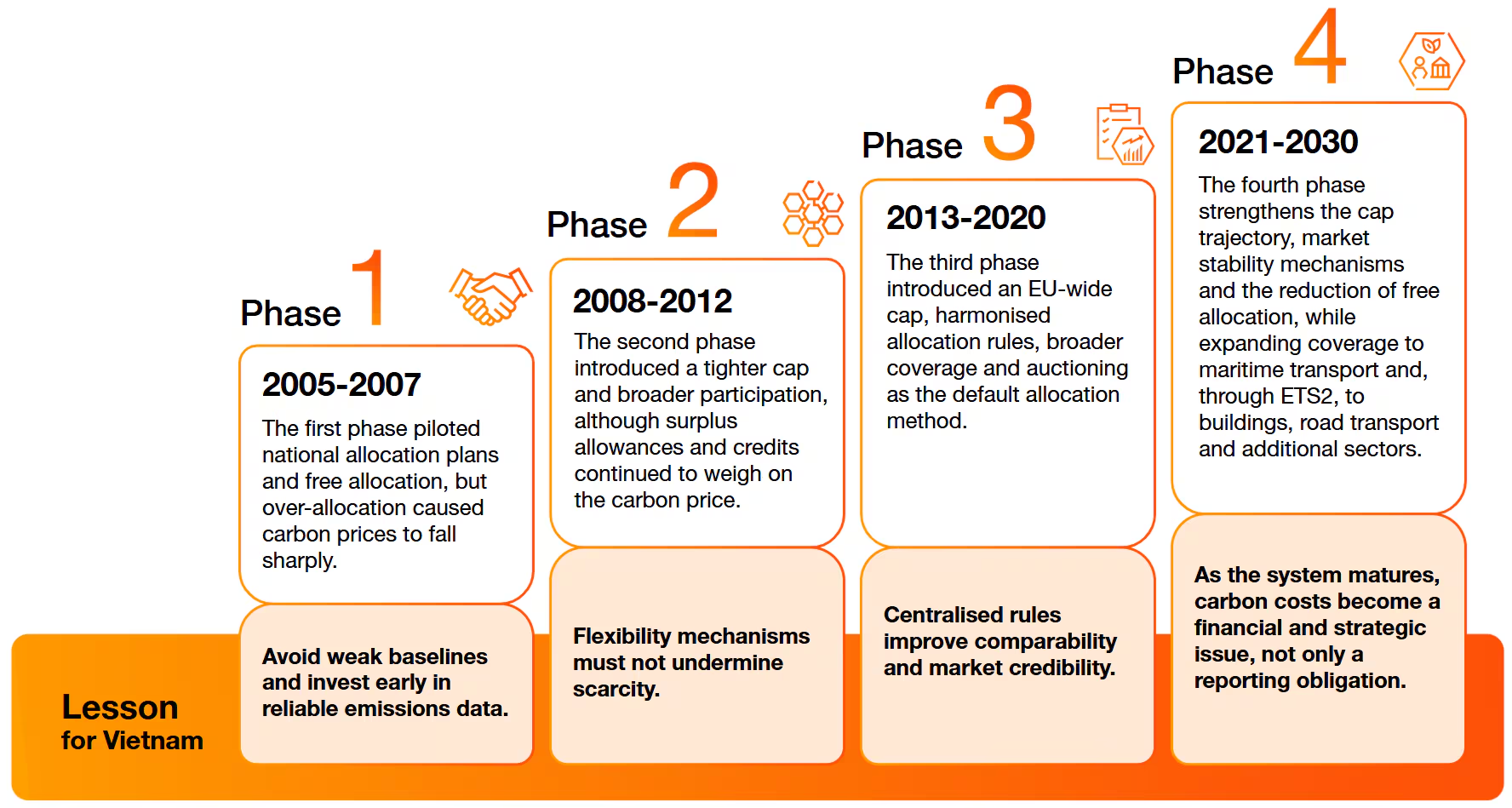
Vietnam’s pilot differs from the EU ETS in one critical respect. The EU ETS operates under a declining absolute cap, while Vietnam’s pilot uses an intensity- and output-based allocation approach with free allocation in the initial phase. This means that Vietnam’s total covered emissions may still increase if production output grows, unless benchmarks and allocation rules tighten over time.
Vietnam has also introduced flexibility mechanisms, including eligible carbon credits and certain banking and borrowing arrangements. These features support transition, but will need to preserve environmental integrity and maintain a credible future price signal.
As Vietnam moves through this early stage, the EU ETS provides a useful benchmark for how emissions trading systems can mature from initial market set-up into a driver of compliance, investment and strategy.
 |
| Photo: PwC |
For Vietnamese businesses, the pilot phase is a timely opportunity to build capabilities before obligations become broader or more complex. Early action can strengthen compliance readiness, clarify carbon-related implications and position businesses for future market developments.
All businesses should start by building the foundations needed to participate in a maturing carbon market. They should monitor updates to allowance rules, ETS implementation and carbon market mechanisms to anticipate new requirements. It is also necessary to improve data quality, monitoring, reporting and verification processes to support credible ETS participation.
Another way is to build shared ownership across sustainability, operations, finance and compliance teams so carbon readiness is embedded in decision-making. Define responsibilities, oversight and links to risk management and strategy, so carbon governance is embedded in the organisation.
 | Vietnam shapes next-generation carbon market As carbon markets evolve rapidly, Vietnam is stepping up its institutional and technical groundwork for market operation. |
 | Vietnam launches pilot carbon trading exchange Vietnam launched its long-awaited carbon trading exchange on June 29, marking a key milestone in the country’s transition towards a low-carbon economy and creating a market-based mechanism to help businesses reduce greenhouse gas emissions. |
 | Businesses urged to join carbon market Deputy Prime Minister Nguyen Van Thang has urged businesses to be transparent with environmental data and participate in the carbon market after the exchange begins its pilot operation. |
What the stars mean:
★ Poor ★ ★ Promising ★★★ Good ★★★★ Very good ★★★★★ Exceptional
 Tag:
Tag:Related Contents





Latest News

More News
- New challenges for workforce data and HR policy management with PIT changes (August 17, 2026 | 10:32)
- Leading in AI: from pilot initiatives to enterprise value (August 10, 2026 | 07:00)
- Programme launched to develop new Vietnamese business leaders (July 28, 2026 | 13:50)
- Family businesses face succession hurdles (June 30, 2026 | 17:05)
- Global shocks and tightening cash for Vietnamese business (June 22, 2026 | 06:00)
- Data and governance key hurdles to AI scaling for Vietnamese firms (June 17, 2026 | 16:55)
- Vietnam second fastest growing automotive market in ASEAN‑6 (April 20, 2026 | 20:34)
- Vietnam’s green push requires further hurdles to clear (March 30, 2026 | 08:00)
- The use of artificial intelligence to advance ESG goals for businesses (March 06, 2026 | 11:50)
- Vietnam a strategic growth engine for Asia-Pacific: CEO survey (March 05, 2026 | 17:12)







 Mobile Version