
Experts explore tourism real estate's sustainable capital potential

The discussion took place at VIR's conference 'Tourism Real Estate 2026: Where Hospitality Meets Cash Flow' in Hanoi on June 23. It was the second session of the event, focusing on making tourism real estate a sustainable channel for capital flows.
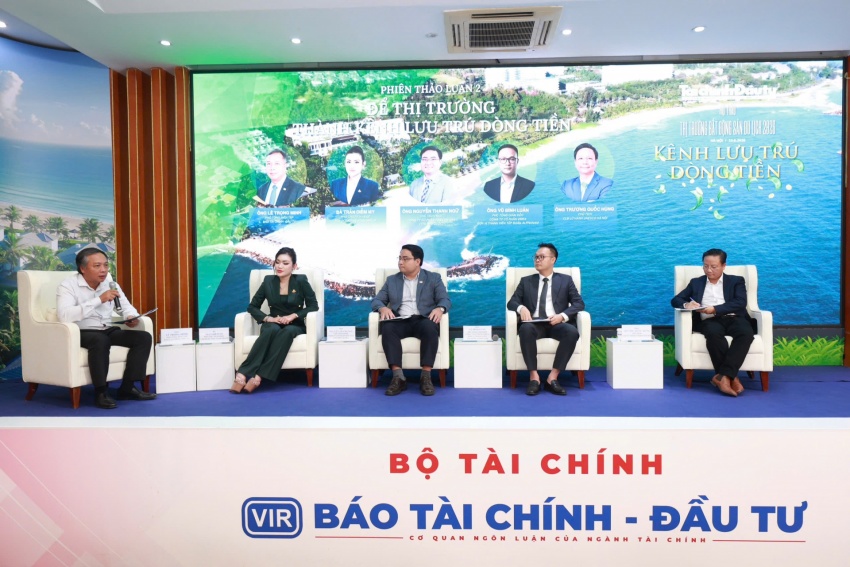 |
Moderating the discussion, Le Trong Minh, deputy editor-in-chief of VIR, said that for tourism real estate to become a true destination for capital, the market must first restore confidence among both developers and individual investors.
“Building that confidence is not an easy task. However, with the participation of leading developers and industry stakeholders, we can identify the key factors needed to support the sustainable development of Vietnam’s tourism real estate market,” Minh said.
One of the central themes of the discussion was how to create iconic projects capable of maintaining their competitiveness and attractiveness over the long term.
According to Tran Diem My, vice chairwoman of Five Star Group, most developers entering the tourism real estate sector aspire to create projects that become local landmarks. However, being iconic does not necessarily mean being the largest or requiring the highest level of investment.
“An iconic project can be modest in scale yet rich in cultural value, allowing visitors to experience the unique identity of a destination and the vision of its developer. The success of a project should not be measured solely by revenue, but also by its contribution to the local economy, cultural preservation, and the legacy it leaves for future generations,” My said.
She also introduced the company’s 'vertical city' concept, which is being implemented at the Five Star Odyssey & Poseidon development. The project is designed as a fully integrated ecosystem, combining luxury residences, 5-star hospitality services, wellness and healthcare facilities, and even pet-friendly amenities within a single destination.
According to My, while pursuing innovative development models, the company places strong emphasis on legal transparency and regulatory compliance. Significant efforts have been devoted to working closely with relevant authorities to complete procedures related to the project's integrated mixed-use facilities.
She added that transparency, professional operations, and the ability to deliver tangible value to both investors and visitors will be critical factors in strengthening confidence in Vietnam’s tourism real estate market and supporting its long-term growth.
Nguyen Thanh Ngu, chairman of Toan Hai Van JSC, said that tourism real estate can only achieve sustainable growth when it is built around the creation of destinations with a unique identity.
“Phu Quoc possesses all the necessary conditions to enter a new growth cycle. As Vietnam’s largest island, with a favourable climate and a rapidly rising profile on the global tourism map, Phu Quoc is well positioned to attract high-end travellers and international investment,” Ngu said.
In particular, the island’s role as a host destination for APEC 2027 is expected to provide a significant boost, encouraging further government investment in critical infrastructure, including energy, freshwater supply, and transport connectivity.
“We are developing a 290-hectare project in southern Phu Quoc based on the concept of a ‘Vietnamese Identity City’, with the goal of creating a destination deeply rooted in Vietnamese culture, from architecture to cuisine. Our ambition is not simply to sell real estate products, but to build a place that visitors will want to return to again,” Ngu said.
He added that in an increasingly competitive tourism market, projects that successfully combine cultural authenticity, high-quality experiences, and professional operations will be better positioned to generate sustainable cash flows and long-term value for both investors and local communities.
Ngu noted that the company has clearly separated building management from commercial operations management. While international brands help elevate service standards and attract global customers, local operators bring a deeper understanding of local culture and consumer preferences.
“A professionally managed property with strong occupancy rates will ensure stable cash flow and liquidity for investors,” he added.
Meanwhile, Vu Dinh Luan, deputy CEO of Virex JSC, a member of Alphanam Group, shared his perspective on the potential of mountain tourism, a segment that he believes still has significant room for growth in Vietnam.
According to Luan, unlike coastal tourism, mountain tourism requires exceptionally high standards in planning, construction engineering, and integration with the natural environment. However, it is precisely these challenges that create the uniqueness of each project.
“Sapa is a year-round destination offering very different experiences, from snow hunting in winter to golden rice terraces in autumn. We believe Vietnam’s mountain tourism segment still has enormous and untapped potential,” he said.
At the Alphora Muong Hoa development, billed as one of Asia’s largest multi-branded international resort complexes, Alphanam has adopted a sustainable development approach. The project’s structures are designed to follow the natural contours of the mountainside, minimising disruption to the terrain while preserving the valley’s original landscape and ecological character.
“Muong Hoa Valley in Sapa is a truly unique destination. It possesses some of Vietnam’s most pristine natural scenery and a rich cultural heritage shaped by the H’Mong, Red Dao, Tay, Giay, and Xa Pho ethnic communities. The greatest challenge for Alphanam when we came here was how to bring world-class luxury standards to the destination without compromising the soul and identity of the valley,” Luan said.
According to him, the company’s development philosophy goes beyond creating a high-end tourism product. Instead, the objective is to integrate international hospitality standards with local cultural values, ensuring that economic development contributes to preserving the unique character that makes the destination attractive in the first place.
He added that maintaining this balance between luxury, sustainability, and cultural authenticity will be essential for unlocking the long-term potential of Vietnam’s mountain tourism sector.
Truong Quoc Hung, chairman of the Hanoi UNESCO Travel Club, noted that Vietnam’s tourism industry is recovering strongly and remains the most important source of visitor demand for the tourism real estate sector.
However, according to Hung, traveller expectations have changed significantly in recent years. Tourists are no longer looking solely for accommodation; they increasingly seek high-quality, authentic experiences, which depend heavily on the operational capabilities of project developers and managers.
He also pointed out that setbacks experienced by some tourism real estate projects in previous years have made individual investors more cautious and selective.
“From 2026 onwards, investors will become more rational in their decision-making. They will look for products capable of generating real returns of 5–10 per cent, managed by developers with a long-term destination-building vision, rather than relying solely on expectations of property price appreciation,” Hung said.
According to Hung, as the market enters a more mature phase, the success of tourism real estate projects will increasingly be measured by their ability to generate sustainable cash flows, deliver consistent visitor experiences, and create long-term value for both investors and local destinations.
 | Tourism and infrastructure fuel Vietnam's real estate growth Tourism real estate has become a key component of the national strategy for developing coastal cities, the marine economy, and tourism through to 2045. |
 | Tourism real estate must create real cash flow To generate sustainable values, tourism real estate must operate as a destination ecosystem to generate real cash flow and long-term trust. |
 | New policy drivers to boost tourism real estate Experts at the first panel of VIR’s seminar discussed the key policy drivers expected to unlock the next phase of growth for Vietnam’s tourism real estate sector. |
What the stars mean:
★ Poor ★ ★ Promising ★★★ Good ★★★★ Very good ★★★★★ Exceptional
 Tag:
Tag:Related Contents




Latest News
More News
- HoREA proposes new framework for affordable commercial housing (October 08, 2026 | 17:01)
- Hong Hac City event to explore Bac Ninh's urban transformation (October 08, 2026 | 15:27)
- Onsen in the heart of the city: a new experience at the shopping mall (October 08, 2026 | 08:00)
- Enterprises honoured as Outstanding Provider of Green Industrial Solutions (October 06, 2026 | 18:03)
- MIK Group launches House of MIK in Ho Chi Minh City (October 03, 2026 | 17:00)
- Vietnam hospitality shifts towards integrated mixed-use developments (October 03, 2026 | 10:00)
- Stavian IP accelerates its modern expansion (October 02, 2026 | 14:00)
- ESG for future-ready industrial success (October 02, 2026 | 09:00)
- Green Future Awards honour five leading industrial park developers (October 01, 2026 | 22:20)
- Green transition leaders honoured at Green Future Awards 2026 (October 01, 2026 | 22:10)



Latest News





 Mobile Version