
Vietnam to increase IoT application in transport

The Ministry of Construction (MoC) issued Decision No. 673/QD-BXD dated May 8, promulgating the plan for implementing the project on application of the Internet of Things (IoT) in the field of smart transport.
The purpose of the plan is to organise the synchronised and effective implementation of the tasks assigned in Decision No.2692/QD-TTg dated December 11, 2025, of the prime minister approving the application of IoT in smart transportation. It also specifies the work content, deadlines, and responsibilities of relevant agencies and units in implementation of the initiative.
 |
| Photo: The MoC |
The specific goals for the 2026-2028 are to complete the national institutional framework and technical standards for IoT applications in smart transportation. Accordingly, at least two cities will be selected to pilot the implementation of a smart operation centre integrating IoT transportation data; all the East cluster of the North-South Expressway will have a complete electronic toll collection system and all the electronic toll collection data will be integrated into a common smart transportation data sharing system.
Also, 90 per cent of national legal documents, standards, and technical regulations on IoT in transportation will be developed, promulgated, or submitted for promulgation.
In the 2029-2035 period, the country will see the expansion of IoT applications in smart transportation. Accordingly, at least five cities and 10 provinces will deploy and operate smart operation centres integrating IoT transportation data; 100 per cent of IoT transportation data will be standardised and ready for interconnection and sharing between the MoC, the Ministry of Public Security, and local authorities; and at least 50 per cent of major transportation routes (expressways, ring roads) will have IoT sensor infrastructure installed for the management, monitoring, and maintenance of road infrastructure.
The plan also outlines the tasks and solutions for implementation, including research, propose, and refine the legal framework (system of legal documents, system of technical standards) for applying IoT in the field of smart transportation; build IoT infrastructure in smart transportation; deploy IoT applications in smart transportation.
Funding for the plan will come from the state budget, public-private partnerships, official development assistance, and other legitimate sources. Funding from domestic and foreign businesses, organisations, and individuals is encouraged; integrated funding from other approved programmes and projects, as well as other legitimate sources, will be used to carry out the tasks.
Domestic technology enterprises are being encouraged to develop IoT equipment and platforms, with a view towards gradually mastering core technologies and cutting reliance on imported components.
There are incentives and support mechanisms for research and development for businesses, research institutes, and universities in the fields of IoT, AI, big data, and cybersecurity.
 | Thai Nguyen looks to develop smart transport, opportunities for businesses Digital transformation and smart transport development will be key tasks for the northern province of Thai Nguyen in the next decade, creating new opportunities for business. |
 | Singapore, France ink deal on smart transport, digital and green issues Singapore and France have signed a digital and green partnership (DGP) which aims to strengthen cooperation in these fast-growing sectors. |
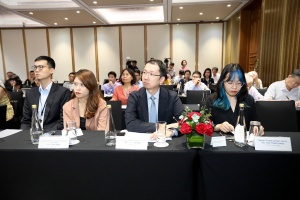 | Opening up opportunities for cooperation and investment in smart mobility The Smart Mobility Industry Networking Seminar took place in Hanoi on November 1, bringing the industry together to discuss solutions and technologies related to the smart mobility sector in Vietnam. |
What the stars mean:
★ Poor ★ ★ Promising ★★★ Good ★★★★ Very good ★★★★★ Exceptional
 Tag:
Tag:Related Contents







Latest News



More News
- IEAE Hanoi 2026 to spotlight smart electronics trends (October 19, 2026 | 17:44)
- Vietnam and EFTA member states sign free trade agreement (October 19, 2026 | 13:10)
- TC-HICT handles over 8.2 million TEUs since 2018 launch (October 17, 2026 | 16:56)
- Vietnam transforming AI ambitions into business impact (October 16, 2026 | 18:01)
- A broader platform for France-Vietnam cooperation (October 16, 2026 | 17:51)
- AEON to open 13th general merchandise store in Vietnam (October 14, 2026 | 17:56)
- Three international exhibitions open to boost industrial supply chain links (October 14, 2026 | 17:37)
- Garment and textile industry transitions towards high-value production (October 14, 2026 | 17:30)
- French business delegation meets MoF to discuss investment cooperation (October 14, 2026 | 11:37)
- Friso promotes global scientific collaboration on children’s gut health in Vietnam (October 13, 2026 | 16:18)










 Mobile Version