
Vietnam approves PPP study for $1 billion expressway for Central Vietnam

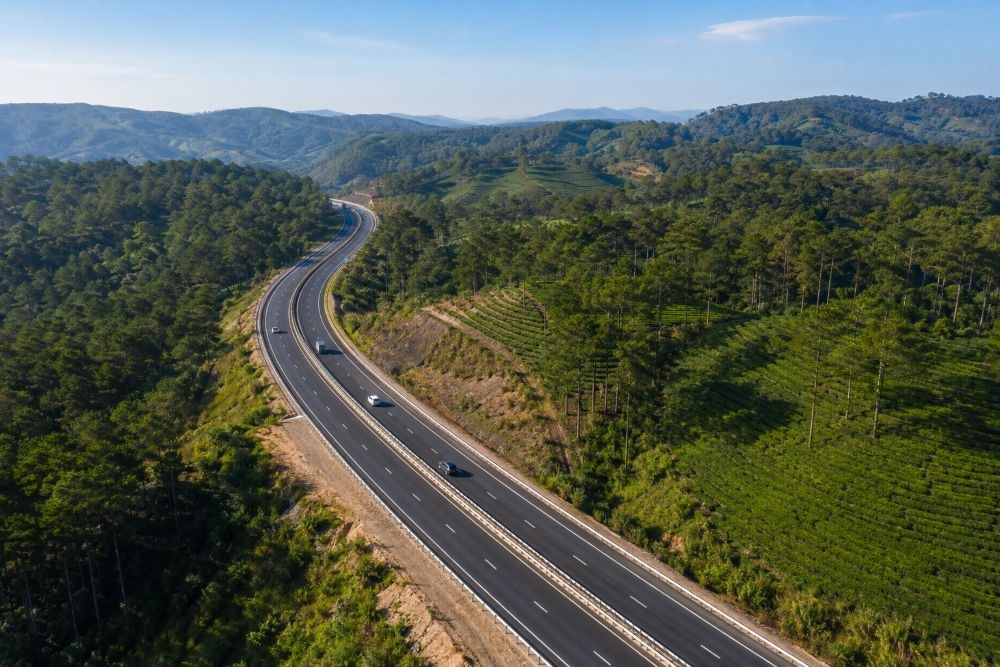
The expressway, to be executed under the public-private partnership (PPP) model, will be approximately 99km long, beginning at the intersection with the eastern North–South expressway system in Dien Tho commune, Khanh Hoa province, and ending beneath Prenn Pass in Lam Dong province.
Accordingly, on June 29, the Ministry of Construction (MoC) issued a document with approval on assigning Khanh Hoa People's Committee to conduct the project's investment study under the PPP model. The provincial authority will be responsible for carrying out the study in line with the project's characteristics and conditions, while reporting the findings and proposing solutions for any issues beyond its authority.
The MoC also instructed Khanh Hoa People's Committee to implement the next procedural steps in accordance with the Law on Public-Private Partnership Investment, the Road Law, the Construction Law, and other relevant legal regulations, ensuring full compliance with applicable legislation.
 |
Earlier, on June 24, Khanh Hoa People's Committee submitted a proposal to the MoC seeking approval to serve as the competent authority for implementing the Nha Trang–Lien Khuong expressway construction project under a PPP framework using a build-operate-transfer (BOT) contract mechanism.
At the same time, the province requested the MoC's support in proposing central government budget funding under the 2026-2030 medium-term public investment plan to participate in the project.
It also sought approval to adjust the implementation schedule for the Nha Trang–Lien Khuong expressway so that construction could begin before 2030.
Under the national master planning, the Nha Trang–Lien Khuong expressway consists of two sections: the 80.8km Nha Trang–Dalat section and the 18.2km Da Lat–Lien Khuong section.
During the period before 2030, Khanh Hoa People's Committee proposes prioritising investment for the 80.8 km Nha Trang–Dalat section under a PPP BOT contract.
The route will feature four traffic lanes, a roadbed width of 22–24.75 metres, and a design speed of 80–100 km/h, with a preliminary total investment of approximately $1 billion.
According to preliminary calculations, site clearance costs are estimated at $46.8 million, construction and equipment costs at $755 million, other expenses and loan interest at $17.08 million, and contingency costs at $122 million.
Regarding the financing structure, the province proposes that the state contribute approximately $651.4 million, equivalent to 65 per cent of the total investment, while the remaining $350.8 million, or 35 per cent, would be mobilised by private investors.
According to Khanh Hoa People's Committee, adopting the PPP model is necessary given that transport infrastructure investment demand during the 2026-2030 period is estimated at nearly $120 billion, exceeding the capacity of the state budget.
For large-scale expressway projects with long capital recovery periods, such as the Nha Trang–Dalat section, mobilising private-sector investment would help reduce pressure on public investment while accelerating project implementation.
The provincial authority believes that a state contribution of 65 per cent of the total investment is appropriate because the project traverses complex mountainous terrain requiring numerous bridges and tunnels, while traffic volumes during the initial years are expected to remain relatively low.
If the state's funding ratio were reduced, the investment payback period would be extended, weakening the project's financial viability and reducing its appeal to both investors and lending institutions.
Beyond its significance for relevant localities, the Nha Trang–Dalat expressway is expected to play a strategic role for the broader South Central Coast and Central Highlands regions.
The expressway will establish an east–west transport corridor linking the Central Highlands with the South Central Coast's deep-water seaport network, particularly Van Phong Economic Zone and Khanh Hoa's seaport system.
The project is then expected to reduce logistics costs, strengthen regional competitiveness, expand opportunities for industrial, commercial, service and tourism development, and enhance national defence and security.
The expressway is also regarded as one of the region's key interprovincial infrastructure projects, contributing to execute development objectives for the Central Highlands and the South Central Coast under resolutions issued by the Politburo and the National Master Planning.
 | Vinh–Thanh Thuy expressway moves forward with investment approval Construction of the Vinh–Thanh Thuy expressway is being prepared as part of efforts to improve regional transport infrastructure. |
 | Coordinated push keeps Ho Chi Minh City-Long Thanh expressway expansion on track The expansion to Ho Chi Minh City-Long Thanh expressway is advancing at pace, driven by the developer's intensive coordination and contractors’ round-the-clock efforts to secure the 18-month deadline. |
 | Vietnam, Laos increase key transport infrastructure connectivity Vietnam and Laos are working to boost key strategic infrastructure projects to increase connectivity between the two countries. |
What the stars mean:
★ Poor ★ ★ Promising ★★★ Good ★★★★ Very good ★★★★★ Exceptional
 Tag:
Tag:
Related Contents




Latest News

More News
- Quang Tri province to tighten delayed power projects (October 13, 2026 | 10:34)
- $600 million Ho Chi Minh City - Long Thanh expressway expansion under pressure (October 09, 2026 | 16:00)
- Hung Yen’s regional GDP beats expectations (October 09, 2026 | 15:25)
- VIR seminar focuses on taking domestic suppliers into global supply chains (October 08, 2026 | 14:50)
- Building Vietnam’s next chapter of FDI growth (October 08, 2026 | 12:15)
- Vietnam to foster links between foreign and domestic sector (October 08, 2026 | 11:00)
- Vietnam shifting focus to building high-quality FDI ecosystem (October 08, 2026 | 10:45)
- VIR seminar to explore innovative global supply chains in Hanoi (October 07, 2026 | 12:04)
- Vietnam’s registered FDI surpasses $50 billion in nine months (October 07, 2026 | 10:30)
- Samsung Electro-Mechanics to add $1.85 billion semiconductor investment in Thai Nguyen (October 06, 2026 | 18:23)








 Mobile Version