
VIFC investment conference focuses on unlocking capital flows

The conference took place in Ho Chi Minh City on August 11, focusing on investment opportunities, regional capital flows, and recommendations for translating commitments into actual capital flowing into the economy.
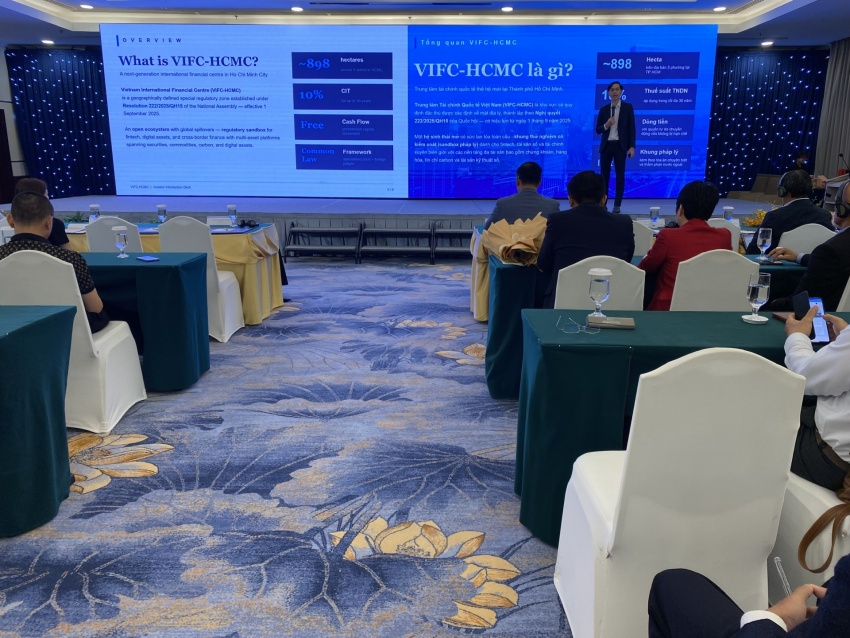 |
| Prof. Dr Nguyen Huu Huan, vice chairman of the VIFC, discusses investor opportunities. Photo: Bich Ngoc |
Prof. Dr Nguyen Huu Huan, vice chairman of the Vietnam International Financial Centre in Ho Chi Minh City said that Vietnam is entering a new phase of development, with substantial demand for long-term capital for infrastructure, urban development, energy, green transition, and digital transformation. In the first half of 2026, Vietnam’s GDP grew by 8.18 per cent, while Ho Chi Minh City’s economy expanded by 8.55 per cent.
“Against this backdrop, the VIFC faces a very specific challenge – how to make it easier and more cost-competitive for international capital to flow into Vietnam, through a wider range of financial products and within an environment that international investors can genuinely trust and use,” Huan said.
This is also an important condition for supporting the target of achieving double-digit economic growth in Ho Chi Minh City and Vietnam as a whole.
"We are not seeking to build a second Singapore or Hong Kong. The VIFC needs to establish its own position within the regional financial network, based on Vietnam's unique advantages," he said.
"Our advantage lies in becoming a financial gateway to an economy of more than 100 million people, characterised by strong growth, substantial investment demand, and increasingly deep integration into global value chains – particularly financial value chains," added Huan.
Pham Quang Nhat, director of the Investment and Trade Promotion Centre of Ho Chi Minh City, said that the city’s appeal to international investors has been reflected in concrete figures.
As of July, total foreign direct investment (FDI) in the city had reached more than $9.8 billion, up 144.5 per cent on-year. Notably, the city recorded 1,119 cases of capital contribution, share purchases, and purchases of contributed capital, with total registered capital of nearly $2.74 billion.
“These figures clearly demonstrate international investors’ confidence in and interest in the city’s development prospects. However, while attracting large volumes of capital is important, it is not enough. The key issue is not only the scale of registered capital, but also the quality of capital flows, the economy’s capacity to absorb them, and their spillover effects on production capacity, technological capabilities, human resources, and the competitiveness of domestic enterprises,” Nhat said.
“Going forward, investment promotion for VIFC will focus on identifying clear investment, business, and translating opportunities into concrete propositions, and creating the conditions needed to turn investor interest into action,” Nhat said.
Talking about the demand of office for VIFC, Le Trong Hieu, senior director of Office and Industrial Services at CBRE Vietnam, said that Ho Chi Minh City’s office market has undergone a significant qualitative shift in supply over the past decade.
“Total office space has increased from around one million square metres of net leasable area in 2015 to more than 1.7 million sq.m so far, accompanied by a notable increase in Grade A buildings meeting international standards. At the same time, Ho Chi Minh City has continued to cement its position as the country’s largest economic hub, attracting FDI inflows and an expanding presence of multinational corporations,” Hieu said.
The establishment of VIFC in Ho Chi Minh City is expected to become a new growth driver for the city’s office market over the medium to long term.
“The attraction of international financial institutions, investment funds, fintech companies, and professional services firms will create a new wave of corporate and high-quality talent migration to Ho Chi Minh City, driving growing demand for internationally standardised office space, particularly within the VIFC area,” he said.
During 2026-2028, approximately 76 per cent of future office supply is expected to be located close to the VIFC, all of which will be in the Grade A segment, reflecting market expectations for the emergence of a modern financial ecosystem in Ho Chi Minh City.
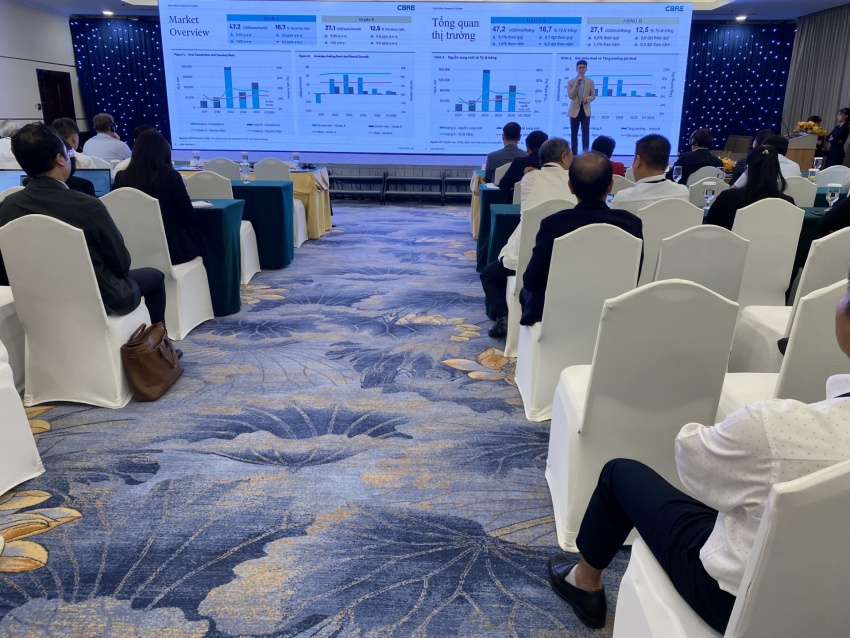 |
| CBRE Vietnam's Le Trong Hieu discusses a decade of Ho Chi Minh City's office market. Photo: Bich Ngoc |
 | VIFC shouldn't try to be Dubai, says VinaCapital chief economist Michael Kokalari, chief economist at VinaCapital and one of the seven founding members of Vietnam International Financial Center (VIFC), analyses what needs to be done to establish the centre. |
 | Vietnam invites Swiss investors to join international financial centre Deputy Prime Minister Nguyen Van Thang has chaired a business dialogue in Zurich to promote Vietnam's investment opportunities in finance and high technology. |
 | Dutch businesses upbeat about Vietnam's reforms and IFC ambitions Dutch businesses have expressed confidence in Vietnam's economic prospects, institutional reform agenda, and plans to develop an international financial centre, while signalling interest in expanding cooperation in finance, logistics, high technology, and the green transition. |
What the stars mean:
★ Poor ★ ★ Promising ★★★ Good ★★★★ Very good ★★★★★ Exceptional
 Tag:
Tag:Related Contents


Latest News

More News
- Vietnam’s registered FDI surpasses $50 billion in nine months (October 07, 2026 | 10:30)
- Samsung Electro-Mechanics to add $1.85 billion semiconductor investment in Thai Nguyen (October 06, 2026 | 18:23)
- Electronics funding will be won via a capable ecosystem: SGS (October 06, 2026 | 09:00)
- LNG power plant projects risk falling behind schedule (October 03, 2026 | 09:00)
- Pandora opens world’s largest fine jewellery crafting facility (October 02, 2026 | 22:21)
- An Phat 5 Industrial Park positions for new wave of investment in northern Vietnam (October 02, 2026 | 09:00)
- Hanoi to launch portal to ease hurdles for tech businesses (October 01, 2026 | 09:00)
- Foreign investors to be widened for market access (September 30, 2026 | 17:54)
- Phu Quoc Airport planning adjusted to serve APEC 2027 (September 30, 2026 | 17:35)
- Nearly 200 foreign-invested enterprises in Vietnam to pay global minimum tax (September 30, 2026 | 17:26)


Latest News




 Mobile Version