
Sustainability standards drive shift in Vietnam's green economy

As climate risks intensify and sustainability standards tighten, businesses are being forced to rethink production models and value chains to stay competitive, particularly in agriculture. Despite Vietnam's position as a global agricultural powerhouse, farmers and agribusinesses remain among the most vulnerable to climate shocks, natural disasters, and market disruptions.
A notable feature of the current green transition narrative is that the pressure does not come from regulations or net-zero commitments, but from the market itself. Bui Khanh Dung, director of Musa Pacta Company, said green production is no longer an option but an inevitable path of development.
“If in the past competition was mainly about cost, productivity, or market expansion, today requirements on traceability, carbon emissions, environmental responsibility, and environmental, social, and governance (ESG) standards have become new conditions for participating in supply chains,” he said. “These requirements are emerging in developed markets and are spreading across the entire production and trade ecosystem. In other words, businesses are not transitioning because they want to stay ahead of the trend. They are doing so because without change, they will gradually be excluded from the game.”
However, as transition pressures intensify, another question arises: is the market truly ready to support businesses in this process?
According to Dr. Mac Quoc Anh, vice chairman and secretary general of the Hanoi Association of Small- and Medium-sized Enterprises (SMEs), Vietnam has more than 1.1 million enterprises, of which about 98.5 per cent are SMEs. This is the sector facing the greatest transition pressure while also having the most limited resources.
“Businesses’ demand today is not simply for loans. What they need is medium- and long-term capital that is stable enough to invest in technology, innovate production processes, meet environmental standards, and gradually upgrade their position in the value chain. In numerous instances, the issue is not interest rates, but access to capital, unsecured lending capacity, and the ability to correctly assess growth potential,” he said.
This is also why he proposed accelerating value chain-based credit models, increasing the share of unsecured lending, and developing mechanisms tailored to SMEs’ characteristics.
“More broadly, green credit demand actually reflects a much larger requirement: the need to upgrade the competitiveness of Vietnamese enterprises in a rapidly changing business environment,” he said.
 |
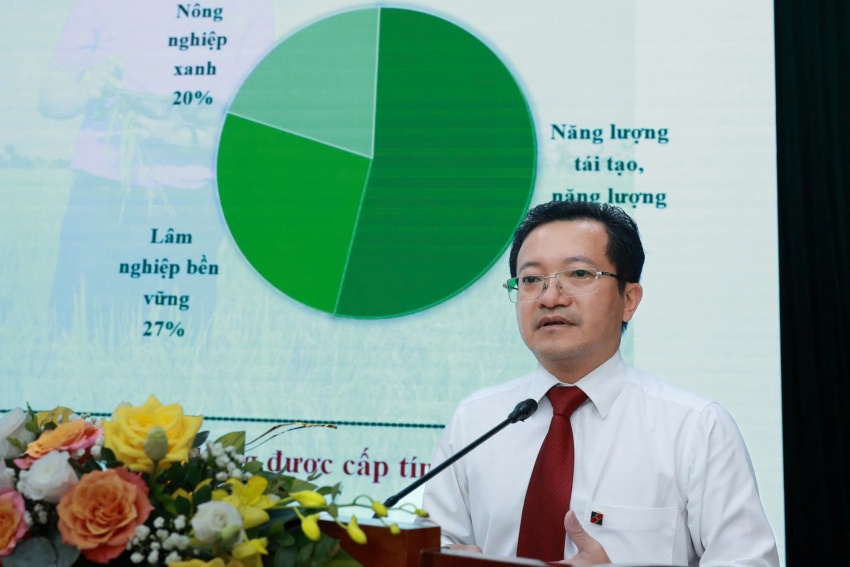
Associate Professor Dr. Pham Manh Hung of the Banking Academy of Vietnam (BAV) said the key lesson from China does not lie in the scale of its green credit, which reached $6.6 trillion by the end of 2025, accounting for around 16.2 per cent of total outstanding loans, but in the fact that the country has built a unified green taxonomy for its entire financial system.
Hung noted that before green capital flows expanded, China spent many years developing a unified green classification system for the entire economy.
“When there is no unified standard, each institution may interpret green differently. This increases due diligence costs, widens information asymmetry, and creates risks of greenwashing projects to access preferential funding,” he explained. “Conversely, when a clear taxonomy exists, banks can assess projects more quickly, investors have a better basis for comparison, and regulators can more effectively monitor policy outcomes.”
He added that China does not treat green taxonomy as a technical appendix to green finance policy.
“Instead, it is linked to statistical systems, disclosure mechanisms, bank performance evaluation, refinancing tools, and green industrial policy strategy. This linkage has turned taxonomy from a set of standards into part of the market infrastructure,” said Hung.
However, while businesses are pressured to 'go green' faster, the market’s ability to support this transition has not developed at a comparable pace.
Ngo Anh Nguyet, lecturer at the Banking Research Institute under BAV, noted that although Vietnam has issued a decision on environmental criteria and the certification of green taxonomy projects, several key components are still being completed.
“Quantitative technical thresholds for each project type are still missing, the ‘do no significant harm’ principle has not been fully specified, while environmental databases and independent verification mechanisms are still under development,” she said. “These gaps make it difficult to determine whether a project truly delivers environmental value. When criteria are unclear and data is not standardised, due diligence costs tend to rise, making credit institutions more cautious when approaching new transition sectors.”
Hoang Thi Dieu Thuy
|

| Dr. Bui Thanh Minh
Deputy director of the Private Economic Development Research Board Green transition demand is present across all three sides. Businesses are under pressure to change to maintain market access and supply chain positions. Banks seek to expand green credit. Regulators are also promoting green growth and sustainable development goals. However, green capital flows have not yet been fully unlocked. One key reason is that the cost of evaluating and certifying green projects remains high, while supporting data for appraisal is incomplete and fragmented. This creates difficulties for both enterprises and financial institutions in accessing and disbursing capital. Vietnam should take an ecosystem approach rather than focusing on isolated policies. A centralised data platform integrating environmental, emissions, energy, resource, and production data could serve as a bridge between businesses and financial institutions. When data is digitised, standardised, and effectively shared, appraisal costs will decline, access to capital will improve, and green credit development will become more transparent. |

| Nguyen Quang Ngoc
Deputy head of Credit Policy Department of Agribank Green credit is also seen as an important factor in attracting new-generation investment flows. Many multinational corporations are increasingly concerned about clean energy supply capacity, emission levels, and sustainability commitments of host countries. However, to broaden green capital flows, existing barriers still need to be removed, from improving the green taxonomy system and standardising data and ESG criteria to enhancing the capacity of enterprises and financial institutions. More broadly, green credit is no longer simply a banking product. It is becoming one of the key tools supporting economic restructuring and enhancing long-term competitiveness of the economy. |
What the stars mean:
★ Poor ★ ★ Promising ★★★ Good ★★★★ Very good ★★★★★ Exceptional
 Tag:
Tag:
Related Contents



Latest News


More News
- JBIC considers new financing options for Vietnam’s energy projects (October 03, 2026 | 08:00)
- Vestas to supply 16 turbines for two new Vietnam wind farms (October 01, 2026 | 07:00)
- Inter-sectoral cooperation on Montreal protocol (September 30, 2026 | 17:20)
- EV battery recycling rate proposed at 8 per cent from 2029 (September 29, 2026 | 16:00)
- Bankability remains hurdle for Vietnam's JETP projects (September 29, 2026 | 12:08)
- Binh Minh Plastics extends clean water project to border communities (September 29, 2026 | 10:57)
- Coca-Cola Vietnam expands packaging collection programme (September 25, 2026 | 08:15)
- Pacifico Energy secures sea survey licence for offshore wind project in Lam Dong (September 24, 2026 | 18:02)
- Vietnam secures $221 million in UN development programmes for 2027-2031 (September 23, 2026 | 17:39)
- Carlsberg Vietnam shows how resource efficiency can shape green industrial growth (September 18, 2026 | 09:03)


Latest News





 Mobile Version