
Seminar marks 40 years of doi moi with call for private sector reform

 |
On April 13, more than 100 representatives from central ministries, business associations, economists, financial and legal experts, commercial banks, and major corporations gathered for the event in Hanoi.
Opening the discussion, Nguyen Duc Hien, Deputy Head of the Party Central Committee's Commission for Policy and Strategy, revealed that a comprehensive proposal to reform Vietnam's development model – anchored in sci-tech and digital transformation – will be submitted to the Politburo at the upcoming Third Plenum of the Central Committee, scheduled for late June to early July.
He underscored the central role of the private sector in this transition. "The private economic sector is one of the most important growth drivers, contributing around half of GDP and generating a large share of employment," he noted. However, the sector remains fragmented, with more than one million registered enterprises – mostly small and medium-sized – alongside approximately five million household businesses.
Despite a clear policy ambition to build strong private conglomerates, progress has been slower than expected. "We have spent nearly three years trying to realise this goal, but tangible results remain limited," Hien added. A key mechanism – where the state commissions private enterprises to undertake major national strategic tasks – has been introduced but is being implemented slowly.
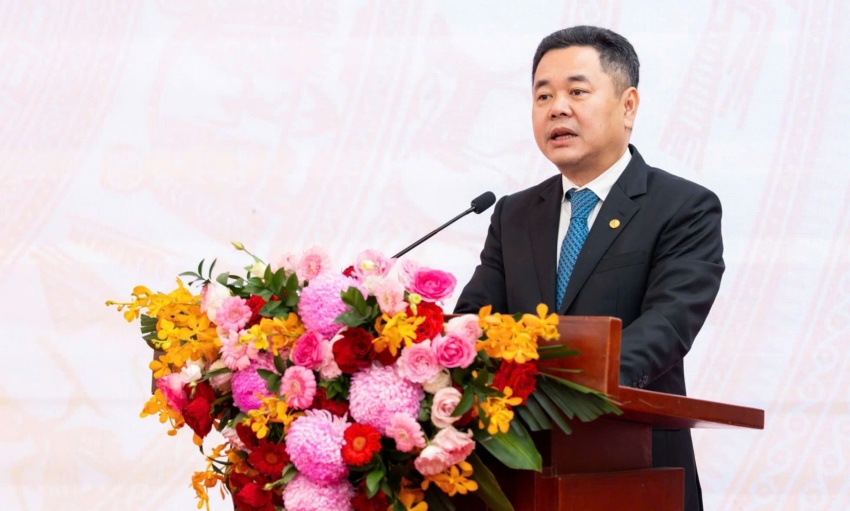 |
| Nguyen Ngoc Canh, Deputy Governor of the State Bank of Vietnam |
From the banking sector’s perspective, Nguyen Ngoc Canh, Deputy Governor of the State Bank of Vietnam, reflected on the transformative journey of the past four decades. “It is impossible to speak of doi moi without recognising the locomotive role of economic groups,” he said. Whether state-owned enterprises or private corporations, these entities have consistently formed the backbone of the economy.
They have contributed significantly to GDP and state budget revenues, while creating millions of jobs and delivering key national infrastructure and industrial projects. At the same time, they have helped elevate Vietnamese brands in manufacturing, services, and trade to the international stage, strengthening the country’s economic self-reliance.
The banking system, Canh explained, has evolved in tandem with this growth. “The continuous improvement of the legal framework governing monetary policy, credit, and banking operations has enabled credit institutions to channel substantial capital into the economy,” he said, highlighting the sector’s role in supporting production, business expansion, and overall economic growth.
By the end of 2025, total outstanding credit reached approximately VND18.6 quadrillion ($740 billion), up over 19 per cent on-year, equivalent to 144 per cent of GDP. Domestic enterprises accounted for roughly 48 per cent of total credit, while large corporations and state-owned groups comprised about 7 per cent. Banks have also accelerated the adoption of digital technologies, developing modern payment services that improve access to finance.
These achievements, he argued, demonstrate that the rapid development of Vietnam’s banking system is not just a source of financial resources for businesses but also a key driver of enterprise growth in its own right.
Providing a broader business perspective, Dau Anh Tuan, deputy secretary general of the Vietnam Chamber of Commerce and Industry, highlighted both the progress and the paradoxes of the private sector.
Vietnam now has over one million formally operating enterprises and around five million household businesses. The private sector contributes approximately half of GDP and generates the majority of jobs. Several private conglomerates have secured strong positions domestically and begun expanding regionally and globally. Resolution No.68-NQ/TW of the Politburo in 2025 identifies the private sector as “one of the most important drivers” and a “pioneering force” in the country’s industrialisation and modernisation.
Notable achievements are evident across sectors. In manufacturing, THACO has built a large automotive and mechanical production ecosystem, while VinFast has emerged as Vietnam’s first electric vehicle producer, listed on Nasdaq and expanding into international markets. Hoa Phat has grown into one of Southeast Asia’s leading steelmakers.
In technology, FPT has become a regional leader, investing heavily in digital transformation, AI, and semiconductors. In consumer goods, Vinamilk and Masan have built competitive regional brands. Meanwhile, Vingroup, Sun Group, and BRG Group have made large-scale investments in infrastructure and real estate, reshaping the economic landscape of multiple regions.
However, Tuan pointed to persistent structural challenges. "The private sector is large but not yet strong; dynamic but not yet deep; significant in contribution but still modest in global value chains," he observed. Nearly 97 per cent of private enterprises are small and medium-sized, many employing fewer than 10 workers – a limited scale that constrains investment in technology and innovation.
The sector also faces imbalances, with a large share of revenue concentrated in finance and real estate, while manufacturing remains underdeveloped. Linkages to global value chains have weakened, labour productivity lags that of state-owned and foreign-invested enterprises, and investment in research and development remains modest. Many firms continue to operate under family-based models with limited transparency and professional governance.
 |
Le Khac Hiep, vice chairman of Vingroup, shared insights into the development of Vietnam’s automotive industry, a sector often seen as a litmus test for industrial capability.
According to Hiep, Vietnam’s auto industry was largely confined to assembly for many years, characterised by low localisation rates and heavy dependence on external supply chains. Domestic firms struggled to participate deeply due to constraints in technology, capital, and market scale. The industry remained structurally incomplete, with consumption demand but limited supporting industries to generate sustainable value.
The emergence of VinFast marked a significant turning point. Rather than following the traditional assembly path, the company invested from the outset in a highly automated manufacturing complex, encompassing research and development, stamping, welding, painting, engine production, and the gradual mastery of core technologies. This approach laid the foundation for a shift from “dependent manufacturing” to “self-reliant production.”
"More importantly, VinFast positioned itself not as a standalone entity but as a central node within a broader production network, connecting and leading a system of suppliers," said Hiep. "This strategy has begun to restructure Vietnam’s automotive industry towards a more integrated domestic value chain."
By 2025, the localisation rate for electric vehicles had reached approximately 60 per cent, with a target of 80 per cent once battery cell production is established domestically in 2026. Mastery of core technologies allows firms to better control value chains, reduce external dependence, and create opportunities for domestic enterprises to participate more deeply.
VinFast’s impact on supporting industries is particularly evident in improving market certainty. Through long-term, large-scale partnerships, VinFast has provided that assurance. With predictable orders, suppliers can confidently invest in machinery, upgrade technology, and expand production, conditions essential for building genuine industrial capacity.
At the same time, participation in VinFast’s global-oriented supply chain requires suppliers to upgrade technical standards, quality management, and sustainability practices. This process helps them meet VinFast’s requirements while enhancing their competitiveness in other international value chains.
Production hubs such as those in Haiphong and Ha Tinh have become new growth poles, attracting labour, capital, and infrastructure investment. On a broader scale, VinFast’s entry into global markets is bringing international standards into domestic supply chains, creating positive pressure for Vietnamese enterprises to upgrade and integrate more deeply into the global economy.
With an expanding market, a clear localisation strategy, and a leading role within its ecosystem, VinFast is contributing to the formation of deeper economic linkages, helping lay the groundwork for Vietnam to gradually position itself more firmly within global value chains.
What the stars mean:
★ Poor ★ ★ Promising ★★★ Good ★★★★ Very good ★★★★★ Exceptional
 Tag:
Tag:Related Contents






Latest News




More News
- Sojitz in Vietnam: 40 years from individual projects to a business cluster 'KATAMARI' (October 08, 2026 | 09:00)
- Coteccons targets 'Quality Growth' with 25 per cent dividend plan (October 07, 2026 | 13:00)
- Vietnam Education Forum opens UK Education Mission's Hanoi visit (October 07, 2026 | 12:27)
- Tax authorities deactivate TINs of nearly 180,000 businesses (October 07, 2026 | 12:08)
- World Bank raises Vietnam's 2026 GDP growth forecast to 7.4 per cent (October 07, 2026 | 11:41)
- Vietstock 2026 to spotlight livestock innovation and green transition (October 07, 2026 | 09:00)
- Vietnam’s GDP grows over 9 per cent in first nine months (October 05, 2026 | 18:45)
- Vietnam earns $56.3 billion from agro-forestry-fishery exports (October 05, 2026 | 18:32)
- DSV balances resilience and decarbonisation in supply chains (October 05, 2026 | 18:20)
- Electronics exports reach $175.4 billion in the first nine months (October 05, 2026 | 18:12)



Latest News




 Mobile Version