
SABECO’s major growth lever boost

In Vietnam, green transition is no longer optional. Rising costs, tighter regulations and capital flows linked to environmental, social, and governance (ESG) are turning sustainability into a core business variable for companies seeking long-term competitiveness.
In Vietnam, green transition has moved from recommendation to business imperative. The change is driven not only by environmental risks, but by structural forces in the market: volatile energy prices, tightening international trade standards, and capital allocation increasingly tied to ESG performance.
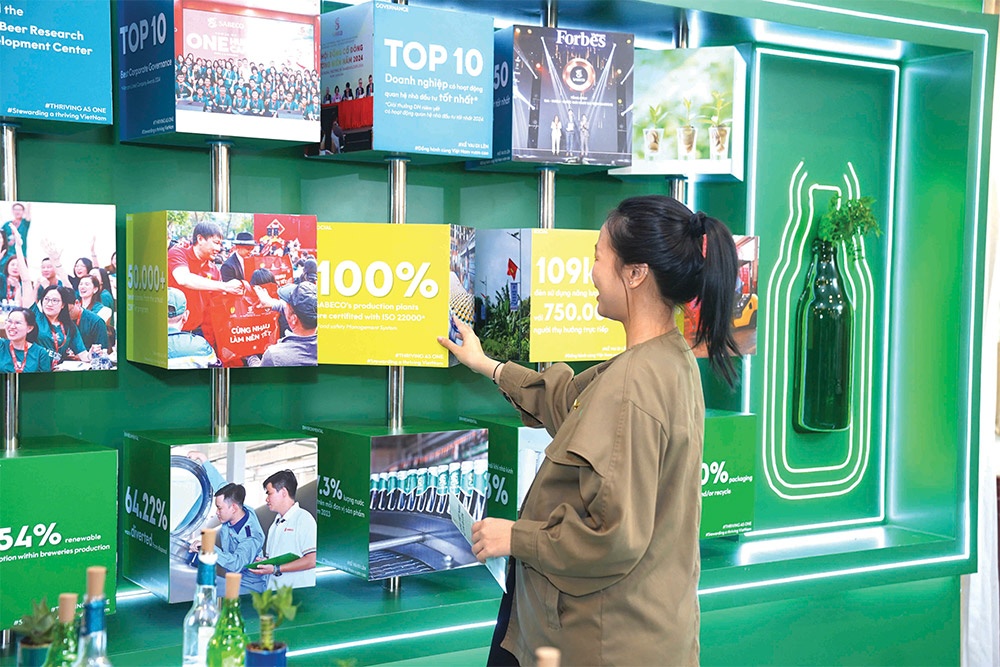 |
| Sustainability is both an environmental concern and an economic question for firms |
Fast-moving consumer goods (FMCG) illustrate this transformation most clearly. The sector is built on rapid inventory cycles and high sales volumes, but operates with relatively thin margins. It is also heavily exposed to fluctuations in aluminium prices, fuel costs, and international logistics. When freight rates surge or energy becomes more expensive, cost pressure is transmitted directly to manufacturers.
Sustainability, therefore, is both an environmental concern and an economic question focused on cost control, supply-chain security and profit stability.
Measurable gains
Saigon Beer-Alcohol-Beverage Corporation, known as SABECO, is pursuing transformation across multiple fronts: renewable energy adoption, water resource discipline, circular packaging systems, governance reform and community engagement. These measures are intended to support the long-term operating model rather than generate short-term publicity.
In terms of energy, renewables now account for more than 40 per cent of the company’s usage. This figure, however, comes at a cost. Rooftop solar arrays, biomass systems and energy-efficient machinery require substantial initial investment. In exchange, the company becomes less vulnerable to electricity tariff changes and fossil fuel volatility.
At factory level, green investments are assessed through financial metrics: payback periods, annual savings and impact on unit cost. Sustainability initiatives are not implemented unless they demonstrate measurable efficiency gains. Nor are projects maintained without evidence of economic return.
Water is treated as a business risk as well as an environmental issue. Process optimisation, reuse systems and wastewater treatment have reduced dependence on external supply. In parts of Vietnam where industrial water shortages are emerging, water has effectively become a production constraint.
Meanwhile, packaging is another major lever at SABECO. Returnable bottles, lightweight designs and recycling standards reduce reliance on virgin materials. With aluminium and paper affected by global supply disruptions, controlling packaging volume increasingly means controlling costs.
Governance has also evolved. ESG oversight has moved to board level, becoming part of compliance management and risk assessment. This enhances transparency, strengthens credibility with investors and reinforces accountability across operations.
An often underappreciated dimension is workforce stability. Businesses with credible sustainability strategies attract stronger talent, reduce turnover and improve internal engagement. In competitive labour markets, this directly affects operational efficiency and long-term productivity.
None of this comes without difficulty. Green transition is capital-intensive and requires organisational change. Payback cycles are long and benefits are not always immediate. However, the greater threat lies in inaction.
Companies that delay face rising compliance costs and shrinking market access. In financial markets, weaker ESG profiles result in higher perceived risk and greater funding constraints. In export markets, environmental credentials are increasingly becoming non-negotiable requirements for market entry.
In practice, FMCG businesses in Vietnam are facing persistent pressure from rising input costs while competition is intensifying across most categories. The beer market, in particular, has moved beyond its high-growth stage and entered a more mature cycle marked by brand differentiation and operational efficiency.
Environmental regulation, including extended producer responsibility (EPR), has also raised the cost of compliance as companies are now required to fund packaging collection, recycling systems and waste treatment. At the same time, younger consumers are increasingly prioritising sustainability ahead of price alone.
From a financial standpoint, international investors are embedding ESG scores into risk assessments and portfolio selection. This means sustainability performance now influences how companies are valued and how easily they can secure capital. Businesses that score poorly on ESG increasingly face higher financing costs, stricter lending conditions and reduced access to long-term funding.
Sustainable priorities
The policy environment is reinforcing this shift. EPR regulation is forcing manufacturers to take responsibility beyond production and into post-consumer waste. Trade agreements are embedding climate-related disclosure requirements. Vietnam’s net-zero commitments are also filtering through to new investment requirements and planning standards. Collectively, these factors are moving environmental performance into the centre of corporate strategy.
Companies that postpone adaptation may deal with rising compliance costs later, when regulatory requirements are more demanding and deadlines tighter. Early movers, by contrast, have greater freedom to structure investments gradually and shape regulation rather than simply comply with it.
International research suggests that early investment in energy efficiency can reduce operating costs by 5–14 per cent. However, the benefits are neither immediate nor automatic. Green infrastructure requires high upfront capital and long payback periods. Yet, large-scale enterprises are less concerned with short-term financial returns than with stabilising their cost base over a longer horizon.
Consumer behaviour in Vietnam is also changing. Sustainability now influences purchasing decisions across product packaging, sourcing ethics and corporate reputation. Environmental responsibility is becoming a factor in brand loyalty rather than a supplementary marketing message.
Over the long term, sustainability strengthens supply-chain resilience. Energy-efficient plants are less exposed to fuel price fluctuations. Businesses that invest in recycling depend less on aluminium and paper market cycles. As risks linked to inputs are gradually “locked in”, cost predictability improves and margins become more reliable.
For many multinational corporations, the rationale is already clear. Acting early reduces cost exposure. Acting ahead establishes market positioning. Acting first enables leadership among sustainability-conscious consumers – the fastest-growing demographic segment this decade.
Larry Lee Chio Lim, deputy general director of SABECO, said, “We see sustainability as a competitive advantage. Investment in energy efficiency does not only cut emissions, but also improves operating costs and strengthens long-term access to capital.”
The remark reflects how ESG has shifted from a reporting requirement to a strategic function. Sustainability is no longer confined to annual disclosures, but now shapes corporate decision-making across procurement, production and capital expenditure.
Globally, the shift towards net-zero targets is rewriting commercial rules. Those who move late pay more. Early movers effectively purchase competitive advantage while the transition remains financially manageable.
Viewed more broadly, SABECO’s transformation mirrors the direction Vietnam’s economy is taking. Growth cannot rely solely on natural resources and low-cost labour. The new drivers are efficiency, transparency and sustainability.
As green transition becomes the new rulebook, competitive advantage will belong not to the largest companies, but to the most adaptable. In this environment, today’s investment, however costly, may define tomorrow’s market position.
 | Green manufacturing insights and transformations: SABECO’s path to industry leadership In an era when global market forces, consumer expectations, and national emphasis converge towards sustainability, green manufacturing has shifted from a corporate aspiration to an economic imperative. For Vietnam, this shift is especially urgent, and highly strategic. |
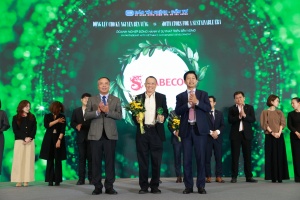 | SABECO honoured for sustainable development SABECO was recognised for its commitment to sustainable business and green-growth initiatives at the 2025 Sustainable Development Conference. |
What the stars mean:
★ Poor ★ ★ Promising ★★★ Good ★★★★ Very good ★★★★★ Exceptional
 Tag:
Tag:Related Contents


Latest News




More News
- Sojitz in Vietnam: 40 years from individual projects to a business cluster 'KATAMARI' (October 08, 2026 | 09:00)
- Coteccons targets 'Quality Growth' with 25 per cent dividend plan (October 07, 2026 | 13:00)
- Vietnam Education Forum opens UK Education Mission's Hanoi visit (October 07, 2026 | 12:27)
- Tax authorities deactivate TINs of nearly 180,000 businesses (October 07, 2026 | 12:08)
- World Bank raises Vietnam's 2026 GDP growth forecast to 7.4 per cent (October 07, 2026 | 11:41)
- Vietstock 2026 to spotlight livestock innovation and green transition (October 07, 2026 | 09:00)
- Vietnam’s GDP grows over 9 per cent in first nine months (October 05, 2026 | 18:45)
- Vietnam earns $56.3 billion from agro-forestry-fishery exports (October 05, 2026 | 18:32)
- DSV balances resilience and decarbonisation in supply chains (October 05, 2026 | 18:20)
- Electronics exports reach $175.4 billion in the first nine months (October 05, 2026 | 18:12)



Latest News




 Mobile Version