
UOB sees Vietnam growth easing in fourth quarter

 |
| Source: UOB |
In a report released on December 22, UOB projected fourth-quarter growth at 7.2 per cent on-year, following a strong 8.23 per cent rise in the third quarter – the highest since the post-Covid rebound – after 8.19 per cent in the second quarter. The bank noted that resilient exports and production helped sustain growth despite headwinds from US tariffs.
In the first 10 months of the year, Vietnam’s exports surged 16.8 per cent on-year, despite a high base a year ago at 14.2 per cent on-year. One key driver was shipments to the US, which jumped by 28.1 per cent on-year during the same period (24.3 per cent last year), as orders accelerated (like front-loading) after US reciprocal tariff rates were dialled back to a base rate of 10 per cent globally. Cumulative trade surplus in October came in at $18.7 billion, smaller compared to the $22.4 billion in 2024, due to sharply higher input requirements in response to export demand.
Manufacturing saw a broad-based increase in tandem, increasing 10.8 per cent on-year in the first nine months, a faster pace compared to the 9.4 per cent rise in the same period in 2024. With four consecutive months of above-50 readings, Vietnam’s Purchasing Managers’ Index suggests that the outlook for the manufacturing sector remains positive.
UOB report noted that despite volatility in US trade and tariff policies since early 2025, foreign investment into Vietnam has continued to gain traction, supported by investor confidence in the outlook for the country and ASEAN. As supply chain realignments persist, realised foreign investment recorded $21.3 billion in the first 10 months, well above our expectations of $20 billion for the full year and $19.6 billion in the same period in 2024. The pipeline remains strong, as indicated by registered overseas funding which jumped 15 per cent on-year to $31.5 billion, from $27.3 billion in the same period last year.
Domestic sentiment is similarly upbeat, with retail sales expanding at an average 9.8 per cent on-year in the first 10 months, ahead of the 8.6 per cent pace in 2024. This comes on the back of rising inbound visitors. In the first 10 months, visitor arrivals surged by more than 21 per cent on-year to 17.2 million, from more than 14.1 million in the same period last year. Based on the current momentum, 2025 is on track to exceed the record 18 million visitors in 2019 and will be an added catalyst for domestic spending.
"With real GDP expanding by a robust 7.85 per cent on-year in the first three quarters, Vietnam’s outlook remains positive for 2026," UOB reported. "However, one downside risk to watch is the implementation of the final reciprocal tariff rates since August, which saw the rate for Vietnam staying at 20 per cent, which could potentially dampen global trade activity going into 2026 as US consumers and producers are burdened with higher import costs."
Due to a high base in the fourth quarter last year, UOB anticipates the final quarter would be a challenge, given a backdrop of tariffs and trade frictions. As such, UOB anticipates Vietnam’s fourth-quarter growth to slow to 7.2 per cent on-year, for a full-year expansion of 7.7 per cent. It would be even more daunting to achieve the official 8.3-8.5 per cent projection, which would require the fourth quarter expansion in the range of 9.7-10.5 per cent on-year.
"For 2026, Vietnam’s growth pace could moderate slightly to 7 per cent due to base effects and dissipation of front-loading," UOB anticipated.
Vietnam’s inflation rate has yet to show a meaningful slowdown. Inflation rate in the first 10 months hit 3.3 per cent, compared to the average of 3.6 per cent in 2024 and 3.26 per cent in 2023. Main drivers continue to be costs of housing and construction materials (6.2 per cent on-year average, 18.8 per cent weight) and healthcare (17 per cent on-year average, 5.4 per cent weight).
"Combined with the potential for decent growth prospects going into 2026 and persistent VND weakness, these factors would constrain the State Bank of Vietnam’s (SBV) ability to ease policy," UOB reported. "As such, we expect the SBV to keep its refinancing rate steady at 4.5 per cent."
The VND is on track to finish weaker against the USD for the fourth consecutive year. While tariff-related uncertainties weighed on sentiment, stronger-than-expected GDP growth helped limit losses, keeping the year-to-date depreciation at a modest 3.5 per cent, broadly in line with prior years. Volatility remained contained, supported by the SBV holding its benchmark rate steady at 4.5 per cent throughout the year and deploying foreign currency interventions to smooth market fluctuations.
Looking ahead to 2026, UOB expects the VND to continue underperforming regional peers despite a broadly softer USD backdrop. UOB maintains a cautious stance on the VND, and updated USD/VND forecasts are at 26,300 in the first quarter next year, 26,100 in the second quarter, 26,000 in the third quarter, and 25,900 in the fourth quarter.
 | UOB Vietnam elevates retail banking experience with enhanced credit card suite UOB Vietnam has unveiled a refreshed credit card portfolio, offering enhanced lifestyle benefits and exclusive privileges through partnerships with renowned brands. |
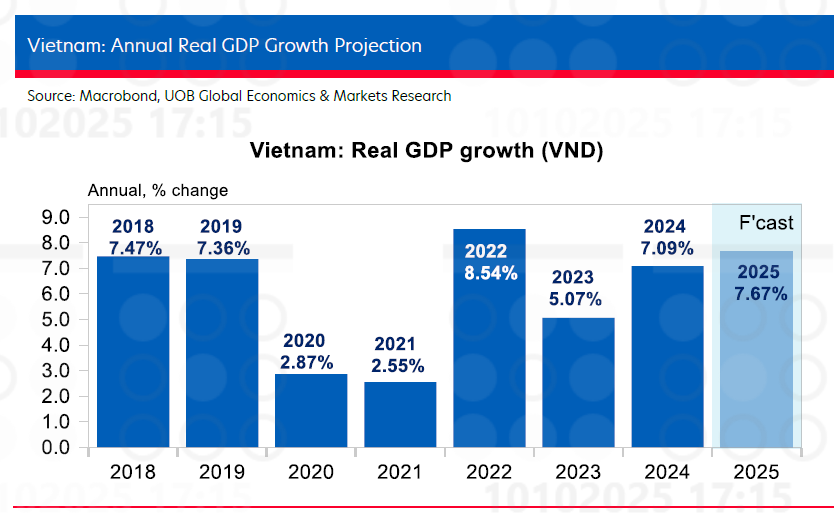 | Vietnam's Q3 growth surged on export strength: UOB Vietnam’s economic performance so far in 2025 has been deemed stronger than expected, and with an expansion of 7.85 per cent on-year achieved in the first three quarters, the outlook remains positive for 2025, according to UOB (United Overseas Bank). |
 | Vietnam leads ASEAN in consumer optimism Vietnam continues to lead the region in consumer optimism, according to the sixth edition of the ASEAN Consumer Sentiment Study (ACSS) released by UOB on November 20. |
What the stars mean:
★ Poor ★ ★ Promising ★★★ Good ★★★★ Very good ★★★★★ Exceptional
 Tag:
Tag:
Related Contents





Latest News






More News
- MEXC highlights AI-driven trading and broader market access at TOKEN2049 (October 17, 2026 | 09:00)
- EuroCham confidence index holds at 78.3 despite operational hurdles (October 16, 2026 | 17:27)
- Shrimp and rice firms face rising standards in export markets (October 16, 2026 | 09:00)
- SCG and Prime Group add value to the ecosystem (October 15, 2026 | 15:55)
- Project readiness key to unlocking green finance (October 15, 2026 | 12:35)
- Sovereign AI and human oversight key to secure digital government (October 15, 2026 | 12:32)
- MEXC Ventures partners with Corelia Academy: Bringing digital asset education closer to Vietnamese students (October 15, 2026 | 09:00)
- Global design expertise meets a more sophisticated Vietnam market (October 15, 2026 | 09:00)
- Vietnam growth nears double digits, UOB raises forecast (October 14, 2026 | 17:39)
- Smart factories need skills, finance and trust to scale (October 14, 2026 | 17:33)










 Mobile Version