
New market models infiltrate stricken localities


 |
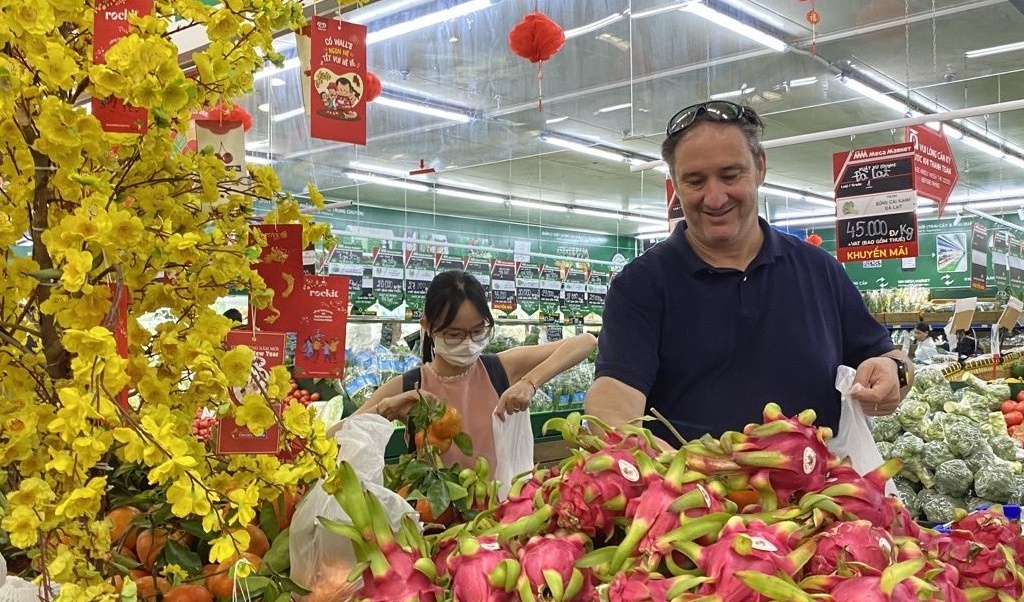
| Prepared fruits and vegetables for quarantine areas. Photo: Le Toan |
The past month has been an extremely busy time for Nguyen Thi Huu Hue, fashion designer and owner of the Hualala brand and Phori’s House homestay chain. In addition to maintaining online sales, Huu Hue and her associates also carry out charity programmes such as giving necessities to people in difficult circumstances and providing places to stay for doctors performing community vaccinations in Ho Chi Minh City as free quarantine places.
In addition to food donation that has been carried out regularly, Hue also cleaned up an empty 6-storey house in the centre of District 1 to make a resting place for doctors.
“Many doctors at field hospitals need somewhere to self-isolate, and doctors who vaccinate people in the city do not dare to return home because they may infect their relatives. Currently, my house in District 1 is full, so I want to seek more support from benefactors who have vacant houses in Binh Thanh, Phu Nhuan, and districts 1-3,” Hue shared on Facebook.
Hue’s story is just one of the thousands of touching stories that are taking place every day in cities forced to implement social distancing to prevent the pandemic, especially Hanoi and Ho Chi Minh City along with 19 southern provinces.
Nguyen Phuong Bao Ngoc, a 32-year-old charity worker in Hanoi, said that she has never seen the life of poor workers as difficult as it is now.
Ngoc bought about 3 tons of rice, divided into 1,500 gifts, but in only two days all of them were distributed, while the number of people coming to receive gifts was increasing.
Fearing that social distancing could not be guaranteed, Ngoc decided to cooperate with the local government to distribute necessities. Every day, Hang Trong ward authorities drive to her house to receive rice and noodles to hand to people in need.
“My joy is that people with difficulties in life will overcome the pandemic. Giving without demanding, I just want them to know that there are still people willing to reach out to help them,” said Ngoc.
Among the current charity models, the zero-VND supermarket is becoming a solution chosen by organisations and businesses to be able to support more people.
At the end of July, the first two such supermarket buses organised by the Hanoi Federation of Labour in association with BRG Retail brought essentials to nearly 1,800 workers in Hanoi’s industrial zones.
In the first 10 days of August, the buses brought gifts worth over VND4 billion ($173,000) to about 20,000 workers who have stopped working or lost their jobs in industrial zones such as North Thang Long, Quang Minh, and more.
In addition to that, 20 other zero-VND mini supermarkets operated by Hanoi Youth Union, Red Star Entrepreneurs Club, and enterprises including PNJ, Alphanam, Phu Thai, Hung Thinh, and Deloitte Cen Group were established to serve disadvantaged groups. Households are given a voucher worth VND400,000 ($17.50) and can visit the supermarket on the specified date and time to ensure distancing.
Last year, the model of a zero-VND supermarket, rice ATM, and community refrigerator were also popular forms of charity in Ho Chi Minh City. In addition, campaigns to help people go to the market and bring price-stabilised goods to residential areas are also carried out regularly as a way for people in pandemic areas to be supported.
What the stars mean:
★ Poor ★ ★ Promising ★★★ Good ★★★★ Very good ★★★★★ Exceptional
 Tag:
Tag:Related Contents



Latest News
More News
- Congratulations from VFF Central Committee's int’l partners to 14th National Party Congress (January 25, 2026 | 09:46)
- List of newly-elected members of 14th Political Bureau announced (January 23, 2026 | 16:27)
- 14th Party Central Committee unanimously elects To Lam as General Secretary (January 23, 2026 | 16:22)
- List of members of 14th Party Central Committee announced (January 23, 2026 | 09:12)
- Highlights of fourth working day of 14th National Party Congress (January 23, 2026 | 09:06)
- Press provides timely, accurate coverage of 14th National Party Congress (January 22, 2026 | 09:49)
- Press release on second working day of 14th National Party Congress (January 22, 2026 | 09:19)
- Minister sets out key directions to promote intrinsic strength of Vietnamese culture (January 22, 2026 | 09:16)
- 14th National Party Congress: Renewed momentum for OVs to contribute to homeland (January 21, 2026 | 09:49)
- Party Congress building momentum for a new era of national growth (January 20, 2026 | 15:00)






 Mobile Version