
Japan takes lead in Atlantic bluefin tuna battle


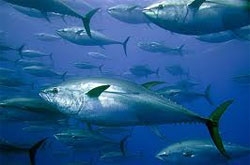 |
Facing declining stocks and over-exploitation of a fish prized in Japan as gourmet sashimi and sushi, Tokyo issued a sharp warning to bluefin-trawling nations on the Mediterranean rim.
Countries that fail to show they will honour catch limits "should not engage in fishing in 2011," chief delegate Masanori Miyahara told the International Commission for the Conservation of Atlantic Tunas (ICCAT) in a closed-door session.
In an opening statement obtained by AFP, Miyahara was to propose a new rule whereby each party' "ability and plan" to monitor and police their catches of bluefin be first submitted to ICCAT's compliance committee.
The 48-member ICCAT, meeting in Paris until November 27, is charged with setting the rules and quotas for Atlantic fishing of bluefin.
It is also tasked with monitoring compliance, for which it has only a spotty record.
Until this year, the organisation has routinely ignored the catch limit recommendations of its own scientists. Even then, the more generous quotas set were often surpassed by a wide margin.
Industrial-scale fishing using huge trap nets during spawning season have helped drive down stocks by about 85 percent, marine biologists say.
Miyahara reminded delegates that Japan recently refused, for the first time, more than 3,000 tonnes in Atlantic bluefin shipments due to irregularities in documentation.
Tokyo would call for suspending fishing entirely if necessary, he told journalists before the plenary began.
"According to our reading, the science does not require that level of severe measure this year. But in future, if it is necessary, we are ready to take those measures," he said.
The bluefin debate pits dug-in economic interests against mounting concern that the gleaming, fatty fish is close to being wiped out as commercially viable species.
Japan consumes nearly 80 percent of all bluefin caught in the Atlantic and Mediterranean, and thus wield enormous influence in the talks here.
"Japan has the key, and the means to convince fishing countries to accept the necessary conservation measures," said Sergi Tudela, a fisheries expert at WWF Spain.
"The decision on bluefin will be an agreement between Japan and the European Union."
The head of the US National Oceanic and Atmospheric Administration (NOAA), Jane Lubchenco, also underscored Japan's influence.
"Japan has an absolutely critical role to play," she told AFP. "It has a serious responsibility, and I think they take these issues very seriously."
Still, conservationists remain guarded in assessing Japan's new surge of vigilance in safeguarding the species.
"On tuna and sharks, what Japan is saying and putting in writing is great, now they have to deliver," said Sue Lieberman, policy director for the Pew Environment Group. "Much more needs to be done."
They also point out that Japanese companies -- notably industrial giant Mitsubishi -- have huge stockpiles of frozen bluefin, providing at least a two-year cushion if supplies are ruptured.
On Thursday, during a closed-door meeting in which compliance of ICCAT members was reviewed, a Japanese delegate criticized the poor performance of some nations, according to someone present.
"Countries that want to sell tuna to Japan had better start to work properly," said the source, who asked not to be named.
The meeting in Paris will set catch Atlantic bluefin catch limits for 2011. The 2010 quota was 13,500 tonnes.
The EU and the United States favour a "reduction" for next year, but have not specificied by how much.
Conservationists say only a temporary ban on bluefin fishing can ensure a long-term recovery of the species.
What the stars mean:
★ Poor ★ ★ Promising ★★★ Good ★★★★ Very good ★★★★★ Exceptional
 Tag:
Tag:Related Contents





Latest News





More News
- Russian President congratulates Vietnamese Party leader during phone talks (January 25, 2026 | 09:58)
- Worldwide congratulations underscore confidence in Vietnam’s 14th Party Congress (January 23, 2026 | 09:02)
- Political parties, organisations, int’l friends send congratulations to 14th National Party Congress (January 22, 2026 | 09:33)
- 14th National Party Congress: Japanese media highlight Vietnam’s growth targets (January 21, 2026 | 09:46)
- 14th National Party Congress: Driving force for Vietnam to continue renewal, innovation, breakthroughs (January 21, 2026 | 09:42)
- Vietnam remains spiritual support for progressive forces: Colombian party leader (January 21, 2026 | 08:00)
- Int'l media provides large coverage of 14th National Party Congress's first working day (January 20, 2026 | 09:09)
- Vietnamese firms win top honours at ASEAN Digital Awards (January 16, 2026 | 16:45)
- ASEAN Digital Ministers' Meeting opens in Hanoi (January 15, 2026 | 15:33)
- ASEAN economies move up the global chip value chain (December 09, 2025 | 13:32)








 Mobile Version