

According to Mitsutoshi Okabe, chief representative of the Japan External Trade Organization (JETRO) Ho Chi Minh City Office, findings from the 2025 Survey on the Business Conditions of Japanese Companies Investing Overseas show that 67.5 per cent of Japanese companies operating in Vietnam expect to be profitable in 2025. This marks an increase of 3.4 percentage points from the previous year and the highest level recorded since 2009, even as issues related to institutions, administrative procedures, and human resources persist.
Japanese business outlook in Vietnam turns more optimistic
Japanese businesses in Vietnam remain cautiously optimistic, with profitability expectations reaching their highest level in more than a decade, despite ongoing structural challenges.
“This also marks the first time in five years that Vietnam’s profit forecast ratio has exceeded the ASEAN average of 65.3 per cent. Conversely, the proportion of firms expecting losses declined to 17.6 per cent, down 1.7 percentage points on-year. The profit ratio has increased for two consecutive years,” Okabe said in the announcement of the survey held in Ho Chi Minh City on January 26.
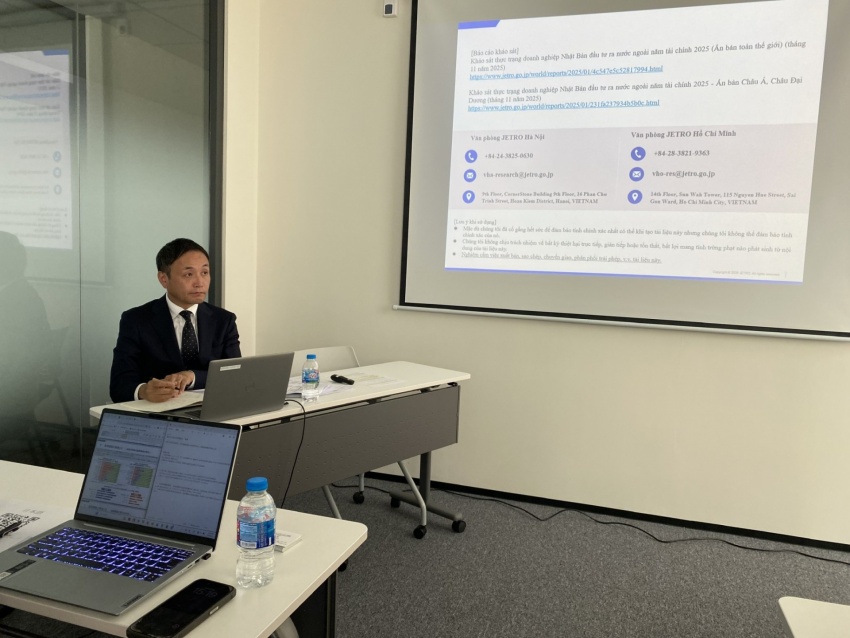 |
| Mitsutoshi Okabe, chief representative of JETRO’s Ho Chi Minh City Office |
In the manufacturing sector, the profit ratio reached 74.1 per cent (up 3.9 points), while the loss-making ratio fell sharply to 13 per cent.
“Several industries recorded improvements of more than 15 percentage points, including paper, wood products and printing; electrical and electronic components; and iron, steel and non-ferrous metals,” said Okabe.
Meanwhile, in the non-manufacturing sector, 61.2 per cent of companies reported profits (up 3.3 points), although the loss-making ratio edged up slightly to 22 per cent. Sectors such as real estate trading and leasing, education, and healthcare saw profit improvements of more than 20 points. However, transport equipment, mining, energy, tourism, entertainment, retail and restaurants continued to report profit ratios below 50 per cent.
The improvement in manufacturing performance was driven mainly by stronger demand in export markets. For non-manufacturing industries, rising domestic demand was the key growth driver, while the most significant risks were intensifying competition and rising labour costs.
Looking ahead to 2026, almost 48 per cent of surveyed companies expect profitability to improve. However, in the transport equipment and transport components sectors, more than 30 per cent of firms anticipate a deterioration in business performance.
Especially over the next one to two years, around 57 per cent of Japanese companies in Vietnam plan to expand operations, up 0.8 points from the previous year. While expansion ambitions remain broadly stable, Vietnam has led ASEAN on this indicator for two consecutive years.
Only 4.2 per cent of companies expect to scale down operations due to declining export orders, while the proportion planning to relocate or withdraw to a third market remains very low at under 1 per cent.
By sector, a little over half of manufacturing firms and close to 62 per cent of non-manufacturing firms plan to expand.
The most commonly cited reasons for expansion across both sectors were stronger domestic demand and growing exports. However, functions such as sales, development of new business areas, and regional management remain below the ASEAN average.
Regarding the impact of US reciprocal tariffs, Okabe noted that 35 per cent of Japanese companies in Vietnam export to the US, higher than the ASEAN average. Of this, just under 14 per cent export directly, while 21 per cent export indirectly via third countries.
In the manufacturing sector alone, the proportion of companies exporting to the US hit 58 per cent, particularly high in electrical and electronic equipment and components, transport equipment components, plastic products, and precision and medical equipment.
About 34 per cent of companies exporting to the US expect to be significantly negatively affected by tariff measures, mainly due to weakening demand in the US market. Nevertheless, many firms are striving to maintain exports by cutting costs, renegotiating prices with suppliers, and accelerating market diversification beyond the US.
Japanese companies continue to rate Vietnam’s investment environment advantages highly, led by market size and growth potential (68 per cent), low labour costs (55 per cent), and political and social stability (53 per cent). All of these indicators increased on-year and are above the ASEAN average.
On the downside, the most significant risk remains complex administrative procedures, cited by 67.5 per cent of companies, up sharply from previous periods and increasing by a further 5.1 points over the past year. Other major risks include an incomplete and insufficiently transparent legal system and rising labour costs, both rated more than 20 points higher than the ASEAN average.
Labour recruitment remains another major challenge. As many as 48 per cent of companies said recruitment has become more difficult over the past two years, far above the ASEAN average. In manufacturing, this figure rises to 67 per cent, particularly in northern Vietnam, mainly due to higher wage and benefit expectations and increasingly intense labour competition.
The average wage increase in Vietnam in 2025 stands at 5.5 per cent and is expected to remain at a similar level in 2026. Average base wages are still slightly lower than in Thailand and Malaysia but are now comparable to those in India and the Philippines.
Japanese investment in Vietnam in 2025 was estimated at $3 billion, up 19.5 per cent from 2024, concentrated mainly in shopping centres, high-tech parks, and the automotive industry.
In addition, many Japanese companies, especially startups, are showing growing interest in digital transformation and support programmes for high-tech enterprises. Notably, several Japanese startups are actively exploring cooperation opportunities in low-emission shrimp farming technologies in the Mekong Delta.
“Vietnam continues to be a key investment destination for Japanese enterprises in ASEAN, with positive profit prospects and expansion plans. However, to sustain its long-term attractiveness, improvements in administrative procedures, greater transparency in the legal system, and effective solutions to human resource challenges remain urgent priorities,” said Okabe.
 | Japanese bold on ventures in real estate Japanese investors continue to participate more deeply in merger and acquisition activities in the real estate sector in Vietnam, with a series of new initiatives and expanding portfolios. |
 | Japanese take on consistent approaches Japanese investors are eyeing bigger slices of Vietnamese businesses to tap into new opportunities at home and abroad. |
 | Japanese firms seeking expansion in Vietnam An increasing number of Japanese firms are planning to expand their operations in Vietnam this year to exploit the country's growth potential. This is according to the latest survey released by the Japan External Trade Organisation (JETRO) on January 21. |
What the stars mean:
★ Poor ★ ★ Promising ★★★ Good ★★★★ Very good ★★★★★ Exceptional
 Tag:
Tag:Related Contents






Latest News





More News
- AEON Vietnam steps up recruitment (October 23, 2026 | 18:16)
- Vietstar partners with Indiana University on AI-era leadership (October 23, 2026 | 12:44)
- Hanoi conference to explore AI, resilience, and integration (October 23, 2026 | 10:19)
- BPC Roundtable Conference 2026 to open in Ho Chi Minh City (October 21, 2026 | 14:46)
- AMATA congratulates Kao Vietnam on 30 years (October 21, 2026 | 14:17)
- Deputy Minister of Finance meets Gujarat delegation in Hanoi (October 21, 2026 | 12:11)
- Vietnam and US discuss financial cooperation and preparations for APEC 2027 (October 21, 2026 | 12:07)
- Vietnam and Denmark sign MoUs to strengthen bilateral ties (October 21, 2026 | 08:00)
- Vietnam and Liechtenstein sign double taxation avoidance agreement (October 19, 2026 | 18:08)
- Creative Young Entrepreneur 2026 showcases five young businesses (October 19, 2026 | 17:59)



Latest News





 Mobile Version